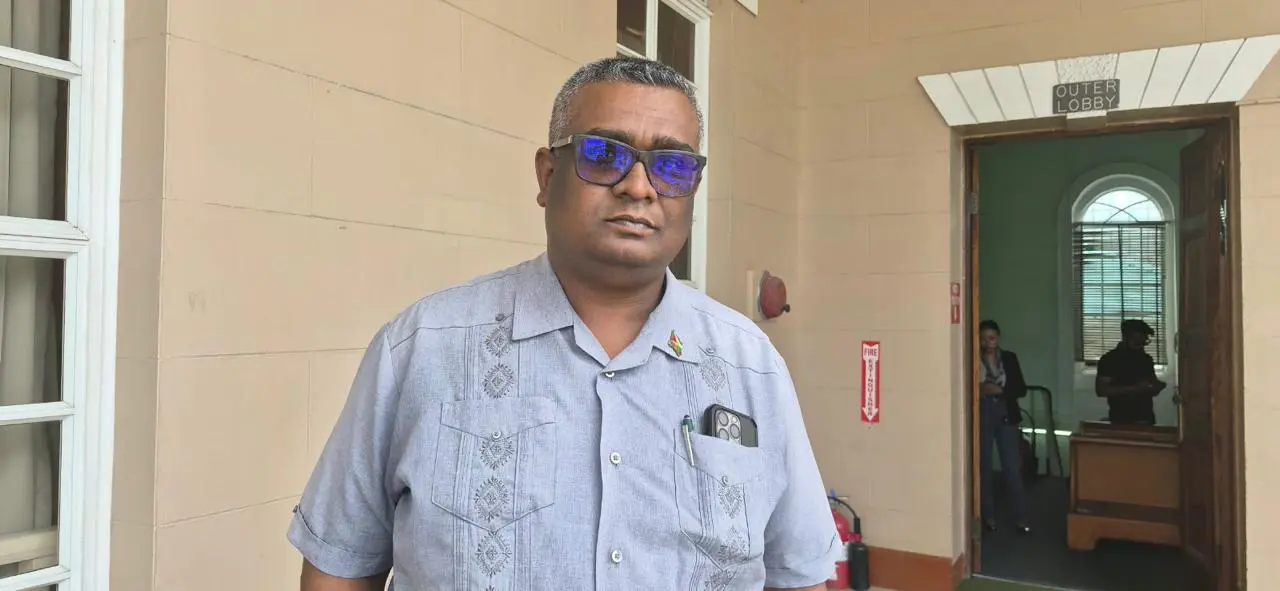
APNU parliamentarian Ganesh Mahipaul has questioned the sincerity of Vice President Bharrat Jagdeo’s call for national unity, stating that the government must demonstrate a genuine willingness to involve the opposition in decision-making rather than rely on statements made during moments of national mourning.
Mahipaul recalled that similar appeals had been made in the past without translating into meaningful cooperation, recalling a unity pitch by then Home Affairs Minister Clement Rohee at the funeral of former opposition parliamentarian Winston Murray in 2010.
He described Jagdeo’s recent remarks as a replay of that earlier appeal and said he was not prepared to accept the vice president’s words as sincere without concrete action.
“This is not something that is new to us attending a funeral,” Mahipaul told Kiskadee Watch at Parliament Building on Monday, adding, “So for me, I’m not taking Mr. Jagdeo’s word as sincere.”
He said that expressions of condolence and calls for unity should not be conflated with the government’s responsibility to ensure the country is properly administered, noting that if Jagdeo genuinely intended to foster cooperation between the government and opposition, that intention should be reflected in the administration’s policies and its willingness to engage political opponents.
According to Mahipaul, the establishment of committees and a broad task force by President Irfaan Ali has so far failed to demonstrate the level of inclusivity being advocated, since the opposition has been excluded from these arrangements. “The genuineness and the sincerity of what Jagdeo said is yet to be tested, is yet to be proven. And I am not optimistic that he sincerely means what he said.”
He added that the party did not currently regard Jagdeo’s statement as a sincere commitment to cooperation. However, Mahipaul stopped short of ruling out the possibility of the opposition participating in a process of national engagement, saying such a decision would depend on whether the government demonstrates a willingness to involve the opposition meaningfully.
“As it is right now, I can comfortably tell you that the party does not find Jagdeo’s statement to be one of sincerity,” he said. “But to answer the latter part of your question, as I indicated, actions speak louder than words. And if Jagdeo demonstrates through his party the ability to meaningfully involve, engage and have the participation of the opposition, then it is not something that can be ruled out.”
Mahipaul suggested several areas in which the government could begin demonstrating its commitment to greater cooperation, including the preparation of legislation, appointments to state boards and commissions, and the national budget process.
He said that opposition participation in the legislative process should begin before bills reach the National Assembly, allowing opposition representatives to contribute to the drafting and preparation of proposed laws rather than being presented with completed documents to debate.
Mahipaul maintained that developments since the vice president made the statement had not convinced him that the government was prepared to embrace the kind of opposition participation being proposed. “From the time he has said so to now, we have seen movement where it does not really encapsulate what he was saying. Personally, I think Jagdeo’s statement was merely condolences messaging and not necessarily policy direction.”
Jagdeo has called for greater cooperation between the People’s Progressive Party/Civic (PPP/C) and the People’s National Congress Reform (PNCR), warning that both parties risk political extinction if they fail to move beyond entrenched divisions.
Speaking at the wake of former PNCR leader Robert Corbin, Jagdeo recalled past discussions with Corbin aimed at fostering political cooperation, which collapsed after the former opposition leader was accused of selling out to the governing party. He said that younger Guyanese are increasingly moving away from rigid political loyalties and said the country’s future would require the two parties to work together in some form.
Jagdeo acknowledged that mistrust had undermined previous efforts at cooperation but maintained that the parties shared common ground and needed to build confidence to advance the national interest.








Discussion