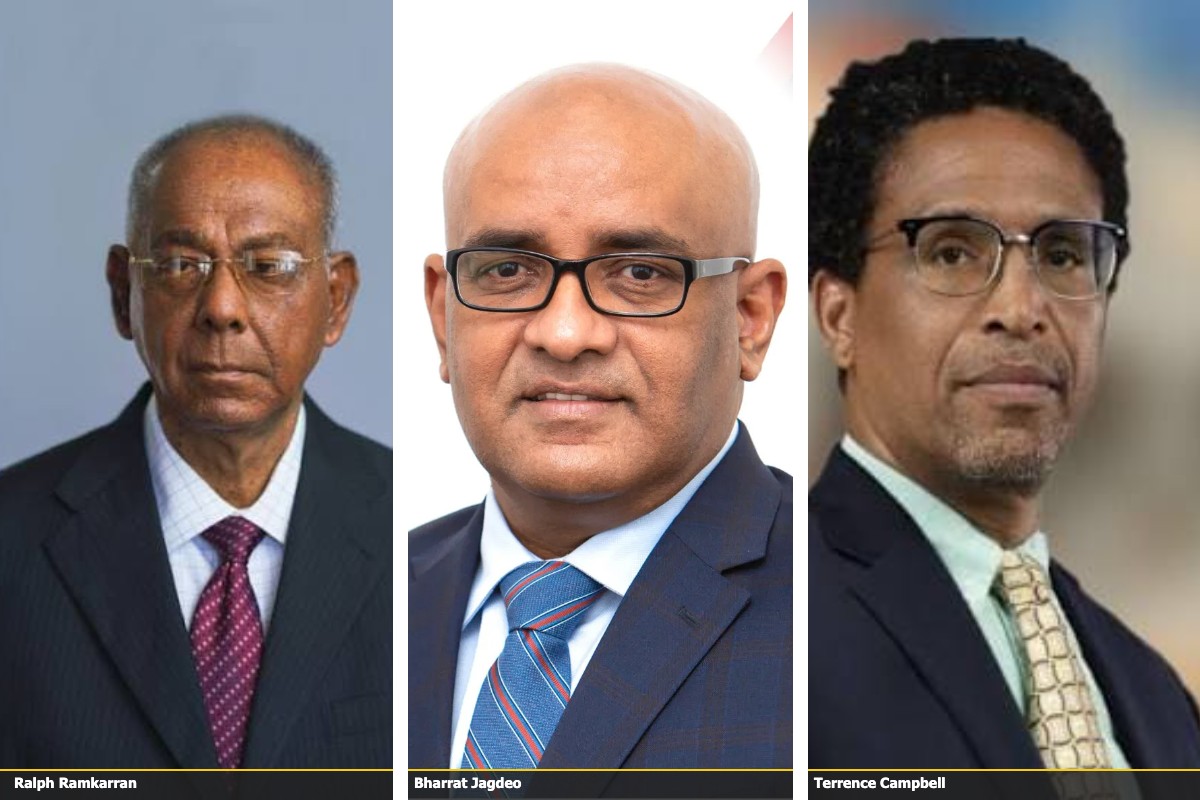
Columnist Ralph Ramkarran says that following a recent overture for political unity with the PNCR from Vice President Bharrat Jagdeo there is a now an expectation that Jagdeo will do something substantive about this.
Writing in yesterday’s Kiskadee Watch, Ramkarran described Jagdeo’s appeal at the recent wake for former PNCR Leader Robert Corbin as “the most important and positive political statement on the subject since his speech in 2003”.
Ramkarran said: “Vice President Bharrat Jagdeo, having set out his views on the issue of political unity in the most important and positive political statement on the subject since his speech in 2003 on “Building Trust and Confidence,” observers would be looking out for something substantive. It is to be expected that the Vice President will invite the PNCR for preliminary discussions”.
Ramkarran said that the issues mentioned by leader of the PNCR/APNU parliamentary wing, Terrence Campbell could be the basis for the opening of talks. Campbell had penned a letter to Kiskadee Watch expressing doubt about Jagdeo’s sincerity on the matter of unity.
Ramkarran warned that if there is no movement from the PPP after the Vice President’s remarks, the danger is that the public will see them as not serious, as merely political “gyaff.” Jagdeo is also the General Secretary of the PPP and a former two-term President of the country.
Ramkarran said that Campbell’s letter indicated that the PNCR has plans other than engagement with the PPP.
“Relying on the historical circumstance that the PNCR has only attained office in coalition with another party, as with the UF in 1964 and the AFC in 2015, it is casting an inviting glance in the direction of WIN. The PNCR conveniently forgets that it unceremoniously dumped both the UF and AFC after one term in office. That being said, no one knows, much less the PNCR, if WIN would be interested. WIN has done so well in its first electoral effort, and the PPP is so buffeted by allegations of corruption, high cost of living and mismanagement, that are not likely to end anytime soon, that WIN may fancy its chances of attaining an absolute majority at the next elections. Nevertheless, it may well be that for the PNCR, a unified list of the PNCR and WIN at the next elections offers the better possibility of removing the PPP from office. Both the PNCR and WIN are aggressive opponents of the PPP. They are not hostile to each other”, Ramkarran wrote.
Ramkarran, who served the PPP for around 50 years before resigning after a dispute over corruption in the PPP/C government, added “Many may interpret the Vice President’s remarks as being based on its fears of WIN, that WIN’s electoral potential poses an electoral danger to the PPP. Terrence Campbell said as much. Depending on the depth of fear, if any, concessions that may be required by the PPP to ensnare the PNCR are likely to be quite significant. But the PPP might have confidence in its own electoral strength and performance in government, and the Vice President may be only pointing to the future and reflecting nostalgic sentiments of a more unified, less contentious, era”.
Campbell in an October 23rd letter to Kiskadee Watch had suggested that Jagdeo’s call for political cooperation between the People’s Progressive Party/Civic (PPP/C) and the People’s National Congress Reform (PNCR) was driven by concerns that a united Opposition could threaten the governing party’s hold on power.
Jagdeo’s proposal, he argued, must be assessed against the government’s actions and whether it is prepared to share meaningful political power. “Jagdeo must wheel and come again. Cooperation without trust, institutional safeguards and a clearly defined framework for accountability risks is a strategy for political survival.”
Campbell said Jagdeo had offered no clear framework for cooperation, no credible commitments to institutional inclusion and no indication that the Government was prepared to surrender any meaningful portion of its executive authority.
He also noted Jagdeo’s failure to mention the now main opposition WIN in his remarks, arguing that its emergence as a significant political force had changed Guyana’s traditional two-party political landscape. He said such a force could create conditions more favourable to power sharing than those that existed when the PPP/C and PNCR dominated the political landscape.
Campbell noted that Jagdeo had pointed to constitutional reforms undertaken in 2001, when the two parties cooperated on changes intended to facilitate power sharing at the legislative level. However, Jagdeo had said that a lack of trust between the parties remained an obstacle to executive power sharing, which he believed could have resulted in “policy paralysis” at the time.
The situation had deteriorated since then, Campbell said, pointing to the government’s failure to demonstrate a genuine commitment to cooperation and inclusivity. Among the examples he cited were the preparation of the national budget without consultation with the Opposition or trade unions, the absence of Opposition representation on the board of the Guyana Development Bank, and the government’s handling of the MV Barima tragedy.
He also criticised the government’s spending of oil revenues without a national consensus on the balance between expenditure and savings, and raised concerns about the circumstances surrounding the removal of Yonette Cummings-Edwards as Acting Chancellor of the Judiciary.
Campbell said that these actions undermined the credibility of Jagdeo’s proposal for political cooperation.
Speaking earlier this month at a wake for Corbin, Jagdeo had warned that the PPP and PNCR risk political extinction unless they move beyond entrenched divisions.
He argued that younger Guyanese were no longer confined by rigid party loyalties and could agree with different parties on different issues.
“Unless our parties, these two parties change today, the era of binary thinking of old is long gone. We will face extinction. We will face extinction,” he declared.
Jagdeo said Corbin had recognised the damage caused by decades of racial division, mistrust and pressure to conform to party positions. He described him as willing to take political risks to overcome those barriers.









Discussion