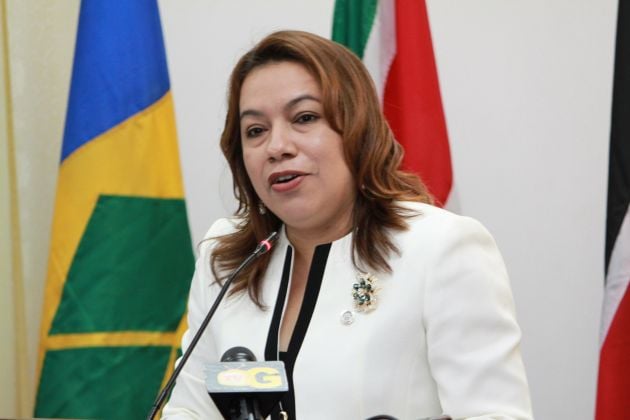
CARICOM Heads of Government have reaffirmed their endorsement of Guyana’s Carolyn Rodrigues-Birkett for United Nations Secretary-General, calling for the next leader to come from Latin America and the Caribbean amid a deadlock in the selection process.
In a statement following their 44th Intersessional Meeting on October 23, the leaders urged the UN Security Council and General Assembly to uphold equitable geographical balance and honour the practice of regional rotation.
They described this as an important safeguard for all countries, particularly small states seeking to contribute to the organisation through its highest offices.
The renewed endorsement follows six rounds of voting without agreement on a successor to António Guterres. Kiskadee Watch reported on October 22 that the United Arab Emirates had nominated Minister of State Lana Nusseibeh in a bid to break the stalemate.
CARICOM leaders recalled their initial endorsement of Rodrigues-Birkett, set out in the communiqué of their July summit, and expressed confidence in her ability and integrity to lead the UN through pressing global challenges and institutional reform.
They pointed to her more than two decades of experience in field work, legislation, politics, diplomacy and the international civil service, describing her as a consensus builder with the skills to advance change.
The leaders also referred to a September 21 declaration by foreign ministers of the Community of Latin American and Caribbean States (CELAC) concerning the selection process.
They said it was now time for a national of Latin America and the Caribbean to assume leadership of the UN, while acknowledging the support received by candidates from the region.
CARICOM expressed appreciation for support extended to Rodrigues-Birkett and said the selection of a Caribbean woman would mark a historic new chapter for the organisation.
Rodrigues-Birkett, Guyana’s Permanent Representative to the UN and a former foreign affairs minister, was nominated by President Irfaan Ali on June 12. During her presentation to member states in June, she pledged to be accessible and to pursue balanced attention to peace and security, development and human rights.
Her candidacy has been competitive in the Security Council’s informal polls. A Reuters report carried by Kiskadee Watch on September 29 said she led an August ballot, while Costa Rica’s Rebeca Grynspan led the first, third and fourth polls.
In the fourth poll, Grynspan received 10 “encourage” votes, while Rodrigues-Birkett received eight. The ballots allow council members to indicate whether they encourage, discourage or have no opinion on a candidate.
However, on October 22 Rodrigues-Birkett and the other candidates had encountered negative votes from permanent Security Council members in the sixth round. Such indications present a significant obstacle to securing the council’s recommendation, although further negotiations may follow.
The Secretary-General is appointed by the General Assembly on the Security Council’s recommendation. A candidate must secure the necessary council support without a veto from any of its five permanent members: Britain, China, France, Russia and the United States.
Guterres’ successor is due to take office on January 1, 2027. The UN has never had a woman Secretary-General.
A seventh vote can he held as early as tomorrow. Meanwhile, according to Reuters, Nusseibeh is already attracting opposition from human rights activists concerned over a number of issues including the UAE’s role in the Sudan war.
“She has been asked about the UAE’s role in arming and supporting the RSF, and she just blatantly denies it without regard to the facts — that is not what we need as UN Secretary-General,” Kenneth Roth, former executive director of Human Rights Watch, told a webinar organized by online campaigns group Avaaz.
Reuters reported that last month, a UN fact-finding mission said foreign weapons, military technology, fighters and logistical networks — including individuals and entities in the United Arab Emirates, among others — are helping sustain Sudan’s conflict.
“This is the opposite of the kind of moral standing of the human rights leadership that we want from a UN Secretary-General,” Roth told the webinar titled “Call To Stop UAE Minister’s Bid for UN Top Job Amid Sudan Genocide”.
Reuters said that the webinar also featured Sudanese experts, as well as a survivor of the El Fasher massacre, on their concerns about Nusseibeh’s candidacy and its implications for the UN’s commitment to protect civilians, according to the organizers.
“Electing (the UAE’s) senior diplomat as Secretary-General would hand leadership of (United Nations) institutions to that government’s chief defender, at the very moment Sudanese civilians most need the UN to hold powerful states accountable,” said Husam Mahjoub, a Sudanese advocate and founder of independent media Sudan Bukra TV.
Asked about Sudan during the dialogue with the General Assembly on Tuesday, Nusseibeh said: “If I were to become secretary-general, Sudan would be a number one priority, as one of the most horrific conflicts we have seen in recent history.”
“The loss of human life on the ground is a tragedy, the atrocities committed by the RSF are atrocious, and I would support the work of all UN fact-finding missions for accountability and transitional justice,” she added.









Discussion