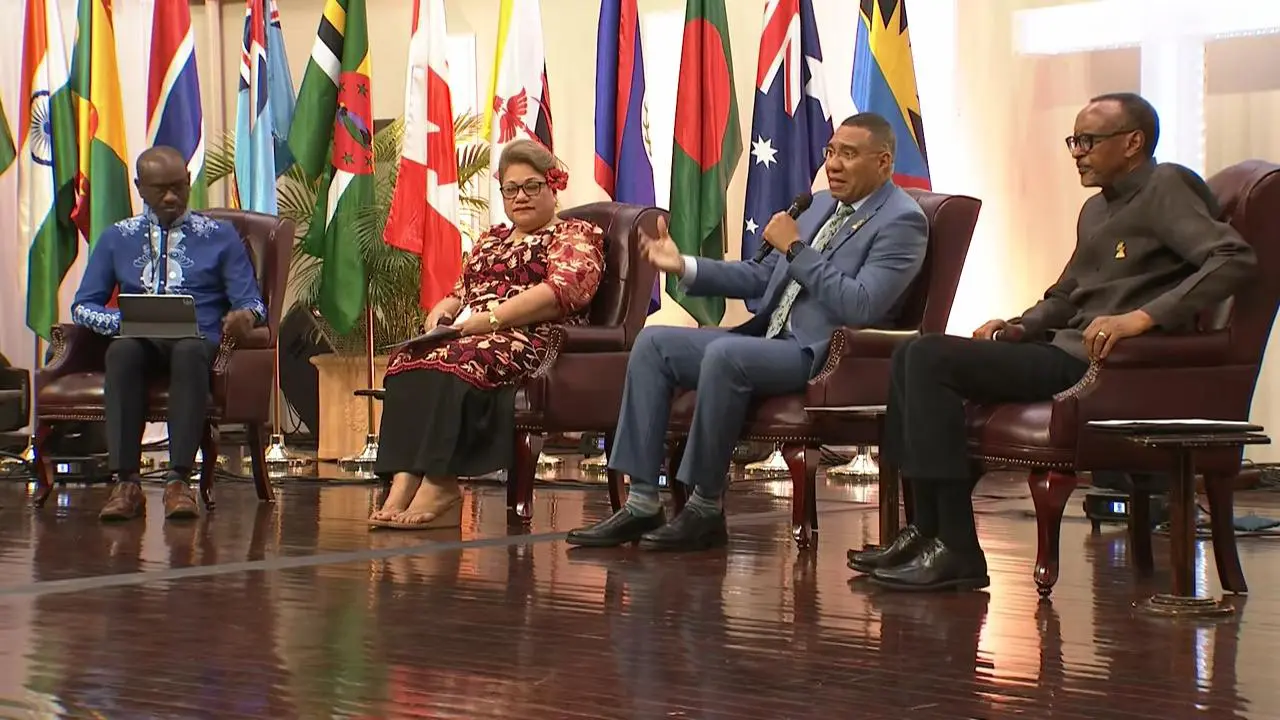
Jamaican Prime Minister Andrew Holness has urged Commonwealth countries to confront inefficient bureaucracy as a barrier to development, arguing that governments must focus on how quickly institutions deliver benefits to citizens.
Speaking during a panel at the joint opening of the Commonwealth forums in Antigua and Barbuda, Holness said that, from Jamaica’s perspective, financing was not the only—or principal—constraint.
“Let’s destroy this assumption that the constraint on development is financial. I think, speaking from a Jamaica perspective, the constraint on development is the bureaucracy to manage development,” he said.
The discussion also featured Rwandan President Paul Kagame and Samoa’s Deputy Prime Minister, Mulipola Anarosa Ale Molioo. It was moderated by Professor Justin Robinson, Pro Vice-Chancellor and Principal of the University of the West Indies Five Islands Campus.
Asked which assumptions about development should be challenged, Holness said efficiency should itself be regarded as a resource.
Citizens, he argued, increasingly expected services to be delivered quickly and tailored to their needs, requiring governments to become more agile.
“So the game now is delivery. How fast can governments deliver benefits to their electorate?” he asked.
Holness said Commonwealth meetings had spent decades discussing the building of institutions, but some existing institutions were now impeding delivery.
“In many instances we have institutions, and they are now inhibiting delivery. So we need to rethink institutions, rethink the bureaucracy,” he said.
Technology and artificial intelligence could assist, he added, but equity and fairness must remain central to their application.
Kagame challenged what he described as the persistent perception that investments in developing countries carried greater risks than those in developed economies.
“There are risks everywhere for any investments you want to make,” he said.
Pooled
He argued that greater cooperation, pooled resources and a better understanding of risk could help remove obstacles to investments needed to create jobs and develop young people’s skills.
The Commonwealth, he suggested, could help change those perceptions.
Asked how viable projects in small economies could overcome barriers such as high financing costs and limited markets, Kagame called for closer cooperation between governments and businesses.
Where a project was feasible and potentially profitable, he said, the remaining gaps should be addressed through appropriate policies, institutions and mechanisms for accessing the resources needed.
He also emphasised regional integration as a way of expanding opportunities beyond national borders.
“It’s not just a small project in a small country but rather a viable project in a growing market beyond the place where it is,” Kagame said.
Holness, meanwhile, called for international financing arrangements that recognised both small states’ exposure to disasters and their efforts to manage public finances responsibly.
Responding to a question about Jamaica’s recovery from Hurricane Melissa, he acknowledged developments in financing, including catastrophe bonds, guarantees and instruments intended to reduce lending risks.
However, he said the international development financing system needed to pay closer attention to the circumstances of small island economies.
Countries demonstrating fiscal discipline should see that reflected in their access to financing and concessional terms, he argued.
“In other words, countries that are demonstrably fiscally frugal and manage their affairs well should be rewarded,” Holness said.
He pointed to the difference of a country’s vulnerability from the pricing of an individual loan’s risk, saying lenders should also consider whether projects would reduce future vulnerability and support growth.
“Fiscal stability is not an automatic pathway for growth,” he stated, calling for deliberate financing approaches that helped countries turn stability into economic opportunity.
Samoa’s Deputy Prime Minister emphasised the human relationships underpinning Commonwealth cooperation, describing the association as an extended family whose members should take collective responsibility for one another.
Reflecting on Samoa’s hosting of CHOGM in 2024, she said the meeting had highlighted Pacific vulnerabilities alongside the region’s resilience and contribution to global affairs.
Small island states, she argued, should not be defined solely by their size or exposure to shocks.
“True influence is measured not by size, but by vision, determination and the ability to bring people together,” she said.
She also urged participants to look beyond exchanges among ministers and heads of government and recognise the community relationships fostered through Commonwealth engagement.
“Our charter says, ‘We the people of Commonwealth’, not we the countries,” she said.







Discussion