
-body found trapped in wreckage; PM says more may be inside
The death toll from the MV Barima tragedy has risen to 53, while the number of confirmed survivors now stands at 76, Prime Minister Mark Phillips announced last evening as search and recovery operations intensified at the wreckage site and across an expanded search area.
Phillips, providing an update as of 18:00 hrs, said 26 of the 53 recovered bodies have been positively identified. Eleven of those identified have already been repatriated to their respective communities at the request of their families. With the estimated number of persons aboard the vessel at 177, it means around 48 persons are still unaccounted for.
The government said the revised figure of 76 rescued followed an ongoing verification exercise and is now the official figure being used by authorities. “We went through the verification exercise, and that is the figure we will be working with, 76 persons,” Phillips shared at a press conference at the Office of the Prime Minister on Camp Street, Georgetown.
Sixteen state and private-sector vessels are now involved in the operation, while authorities have expanded the search area by an additional 400 square miles. Phillips said teams are now covering approximately 2,100 square kilometres in an effort to locate anyone who may still be alive.
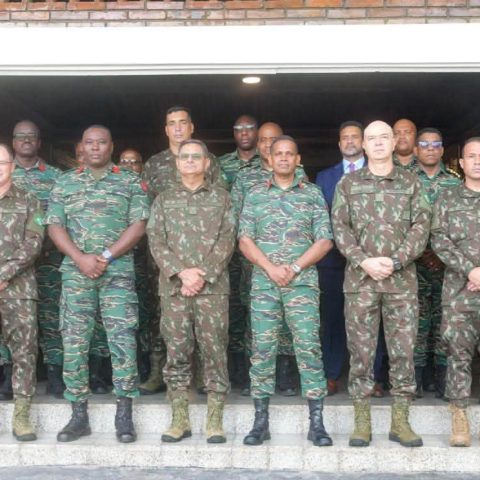
Aerial surveillance has also been deployed to support the maritime operation, while additional assistance from Trinidad and Tobago and Brazil is expected today. Personnel, including divers, from the Trinidad and Tobago Coast Guard and Brazilian Navy are expected to join the ongoing efforts.
Inside the wreckage
Phillips disclosed that divers located one body trapped within the wreckage but were unable to recover it as of 18:00 hrs.
Questioned by Kiskadee Watch about why the body could not be retrieved and whether more victims could be trapped inside, Phillips said the divers must determine whether a recovery can be carried out safely based on the location of the body and conditions inside the vessel.
“They saw one body and the divers, they’re the ones who must make the call as to whether they can, where the body is located and whether they can recover the body from the vessel,” Phillips said.
He noted that efforts to retrieve the body have not ended and that divers will return with additional equipment. “More divers will go down. They will go down with more equipment and it is our hope that we will reach the point where they’ll be able to safely extract the body or extricate the body from the vessel,” he said.
Asked whether more bodies were likely to be found inside, Phillips declined to speculate on a precise number but acknowledged that it was possible given the number of people who were aboard. “I would say there’s a likelihood based on the fact that you had 179 passengers on board. You have the figures as to how many were rescued and how many are missing. There is likelihood that they may encounter more bodies there,” he said.
No overloading
Authorities continue to maintain that the evidence does not indicate that the vessel was overloaded. Kiskadee Watch asked whether authorities had been able to use CCTV footage and other available information to determine if the MV Barima was overloaded and whether its cargo had been properly stored.
Director General of the Maritime Administration Department (MARAD) Stephen Thomas responded that a review of the vessel’s particulars showed that it could carry 126 tonnes of cargo while accommodating up to 397 passengers under a full-load configuration. He said the vessel was carrying fewer than 397 passengers, meaning the difference in passenger weight would also have to be factored into any assessment of its overall load.
“It doesn’t necessarily have to be overloaded,” he offered.
According to Thomas, reports from the wharf also indicated that the vessel’s load line was “barely submerged,” which he said did not indicate that the vessel was overloaded. He explained that differences in water density between river water and seawater affect how low a vessel sits in the water, with a vessel expected to float higher once it enters denser seawater.
The response, however, did not directly address Kiskadee Watch’s question about whether CCTV footage showed that the cargo aboard the MV Barima had been properly packed or secured.
Dry-docking later this year
Kiskadee Watch also questioned why planned works on the MV Barima had not been carried out before the tragedy, with Phillips responding that the vessel had been moving through the procurement process for maintenance and was scheduled to enter dry dock during the latter half of 2026.
“There’s a process where the tender; you have to go through a tender process. And then it passes through Cabinet for no objections,” Phillips explained. He said Cabinet had already granted its no-objection for the process to proceed.
According to him, the MV Barima was last refurbished in 2024, with provisions made for its next dry-docking and maintenance two years later, in 2026. “So this vessel, from all plans, would have been going into dry dock in keeping with the maintenance schedule,” he said, adding that the procurement process had already started.
First official rescue timing
Questions were also asked about the response time following the capsizing, particularly the number of hours between the disaster and the arrival of rescue assets.
Asked by Kiskadee Watch to provide a clear timeline for when the first rescue of survivors occurred, Public Works Minister Juan Edghill said authorities received reports of the incident close to 11:00 hrs, after which the Maritime Rescue Coordination Centre (MRCC) was activated. “Immediately, the MRCC went into operation. The Coast Guard dispatched vessels from both Pomeroon and Georgetown,” Edghill said, noting that the first dispatched asset arrived at the scene at approximately 13:30 hrs. “I think the first one was on scene, probably by 1.30 something, we got a report,” Edghill said, adding that police and other available assets were also mobilised.
Some survivors have spoken about being on the water for six to eight hours before being rescued.
Meanwhile, with the MV Barima out of service, Kiskadee Watch also questioned which vessels are currently available to service the Northwest route. Edghill responded that the MV Ma Lisha, the newer ferry constructed in India and brought to Guyana three years ago, and the older MV Kimbia remain available for the route.
The MV Kimbia, he noted, was extensively refurbished and modified to accommodate increased cargo demand linked to development in Region One, while continuing to transport passengers. “So we still have the two vessels that are available to continue to serve the area,” he said.
The tragedy occurred late Saturday night after the government-operated MV Barima, which had departed Georgetown shortly after 3 p.m. for Port Kaituma in the North West District, encountered difficulties while travelling along the Atlantic Ocean. A distress signal was issued shortly after 11 p.m. before the vessel capsized near the mouth of the Pomeroon River, triggering a major search-and-rescue operation involving the Guyana Defence Force, MARAD, other State agencies, fishermen and international support.
Authorities last evening reminded that all bodies recovered during the operation must be immediately transferred into the custody of the Guyana Police Force at the designated facility at Charity River Dam to ensure established recovery and identification protocols are followed.








Discussion