
President Irfaan Ali has again acknowledged that the controversial 2016 Production Sharing Agreement (PSA) with ExxonMobil was a bad deal which benefited the company more than Guyana, but he maintained that his government could not discard the contract.
Ali made the statement during a 28-minute interview on Qatar-based Al Jazeera’s Talk to Al Jazeera, which was aired yesterday.
Asked directly by the interviewer whether he accepted that the PSA was a bad deal, Ali responded: “Yeah, we do. We never said it was a good deal.”
He added that the company benefited more but argued that the agreement remained binding and that the government had a responsibility to respect the sanctity of contracts.
The President said that Guyana must work within the existing agreement to obtain the best possible returns while ensuring that future production sharing agreements are more balanced.
Ali’s position largely mirrors one he expressed in February 2023 when, according to Stabroek News, he described the agreement as “lopsided” but warned that attempting to alter it could undermine investor confidence and affect development.
At that time, Ali said the government had inherited the contract and had a responsibility to honour it. He also argued that ending production would expose local businesses and financial institutions which had invested in anticipation of continued petroleum development.
The President adopted a similar position during a 2024 interview with the New York Times. When asked whether the PSA was a bad deal, he stopped short of using those words and said ExxonMobil and its partners “had the better hand of the deal.”
Stabroek News subsequently argued that the government’s continued reliance on contract sanctity ignored provisions allowing the parties to amend the PSA by mutual consent.
Former Auditor General Anand Goolsarran has also challenged the government’s position. Writing in his Accountability Watch column, he pointed to Article 31.2 of the PSA, which permits amendments where all parties give written consent.
Goolsarran argued that merely inviting ExxonMobil to renegotiate would not breach the agreement: if the company declined, the existing provisions would remain in force. He also recalled that the PPP/C’s 2020 manifesto had promised better contract management and renegotiation.
In the Al Jazeera interview, Ali was also pressed about claims that ordinary Guyanese were not receiving a fair share of the country’s rapidly expanding petroleum wealth.
The President said more Guyanese families now own homes and vehicles, while lower mortgage-interest rates have increased the assets held by households. He attributed some of the pressure on households to imported inflation and changing consumption patterns associated with improved living conditions.
Ali told Al Jazeera that the government was investing petroleum income in infrastructure, housing, education, healthcare and economic diversification. He said he did not want Guyana to be viewed in another ten years as a country dependent only on oil.
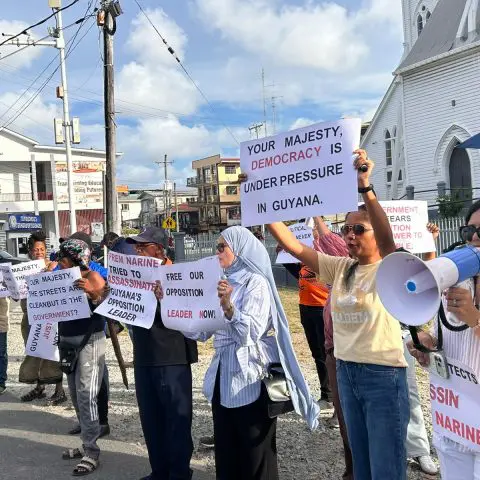
The interviewer noted that the political opposition had accused the government of rampant mismanagement and a lack of transparency over oil revenues. He asked Ali how he would respond to citizens who felt that the country’s oil wealth was bypassing them.
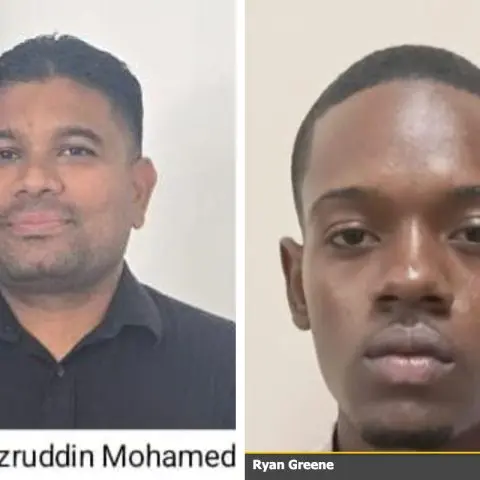
The President began by pointing to Opposition Leader Azruddin Mohamed’s US sanctions, saying these had been imposed before he became Opposition Leader. He then said all oil revenues entered the Natural Resource Fund, withdrawals were made through the national budget and parliamentary process, and the fund was audited by the Auditor General.
Ali concluded that the system governing the use of oil revenues was transparent and that the reality was different from what he described as opposition propaganda.
The President also defended Guyana’s simultaneous pursuit of expanded petroleum production and its low-carbon development programme. He said the government did not consider the two policies incompatible, arguing that petroleum revenue was needed to finance sea defences, drainage, irrigation and flood protection.
Stabroek News has previously disputed aspects of this argument. Following Ali’s 2024 New York Times interview, it noted that Guyana’s rapidly expanding petroleum output was contributing to global emissions and questioned his claim that the country was transitioning to renewable energy faster than others while simultaneously expanding its reliance on heavy fuel oil and natural gas.
During the Al Jazeera interview, Ali nevertheless maintained that petroleum wealth should be used to build a diversified economy founded on agriculture, environmental services, biodiversity, tourism, technology and human development.
Transparency
Pressed about accusations that the government was mismanaging petroleum revenues and failing to disclose how the money was being spent, Ali maintained that there was a transparent system governing the proceeds.
“All the revenue from oil and gas goes into a fund. We have the Natural Resource Fund,” he said.
Ali said withdrawals from the fund were made through the national budget and consequently passed through the parliamentary process. He added that the expenditure was subsequently audited by the Auditor General.
“The government has no direct dip into that fund,” he said, dismissing claims of opacity as political propaganda.
However, while deposits and withdrawals from the Natural Resource Fund are reported, Stabroek News has repeatedly raised questions about transparency in the wider management of the petroleum sector.
Among the outstanding concerns is the audit of approximately US$19.6 billion in expenditure claimed by ExxonMobil and its partners between 2018 and 2020. Stabroek News reported before its closure that the audit remained unresolved, leaving the public without a final account of what expenditure had been accepted, rejected or remained disputed.
The newspaper also repeatedly called for disclosure of oil-production data, recoverable expenditure, government petroleum sales and the basis for major oil-sector decisions.
Ali’s explanation therefore addressed how money already transferred to the Natural Resource Fund is withdrawn, but did not answer the broader transparency questions surrounding the calculation of Guyana’s petroleum earnings and the costs deducted by the ExxonMobil-led consortium before the country receives its share.
The interview was published under the title “Guyana’s oil boom and challenges.







Discussion