
-says PPP has not heeded this call
In the wake of the deepening controversy here over an extensive farm that President Irfaan Ali has admitted to owning, former Speaker of the National Assembly Ralph Ramkarran says that anti-corruption, anti-bribery, transparency and ethics legislation are very much required in Guyana.
Ramkarran’s statement will further challenge the government’s oft-stated position that institutions exist to ensure that corruption is kept at bay.
In a column in yesterday’s Kiskadee Watch Ramkarran adverted to the public commentary that has arisen over Ali’s farm at Long Creek along the Soesdyke-Linden Highway.
Stating that there is nothing wrong with politicians, Presidents and Prime Ministers, having assets, or even acquiring assets, during the time when they hold political office, Ramkarran said that it is widely accepted that adequate measures ought to be in place to ensure transparency.
“In Guyana the main instrument that exists is the Integrity Commission Act which has constituted the Integrity Commission. There have been justified criticism that because the declarations to the Integrity Commission are secret, or not published, and that the Integrity Commission has no investigative, or even prosecutorial authority, it is a fangless poodle, designed for window dressing. In Germany, with a wealthy Chancellor Merz, declarations are accessible through the Bundestag’s website”, Ramkarran said.
He added that there have been calls from many, including from him, from time to time, that anti-corruption, anti-bribery, transparency and ethics legislation are very much required in Guyana.
“These calls, from me since 2012, which forced me to resign from the PPP, of which I had been a member for over 50 years and a leader for over 40 years, have not been heeded. The basis of the calls had been that as government spending increased, and the economy develops, opportunities for corruption will continue to increase. Government spending today has vastly expanded since 2012 and no significant steps to entrench transparency have been taken”, he said.
He added that it is no surprise, therefore, that allegations of corruption and lack of transparency are proliferating.
“And let me be clear, in the absence of measures, allegations of lack of transparency and standards of ethics, will get worse and ensnare others. President Ali and other politicians who wish to engage in business activities would be well advised, for their own protection, to ensure that adequate legislation is in place”, Ramkarran, a Senior Counsel, said.
Ramkarran asserted that unless the government heeds the decades-long calls for legislation to effectively enforce transparency, “eruptions of questions from time to time, which have happened just recently, and now again in the case of President Ali’s farm, will continue”.
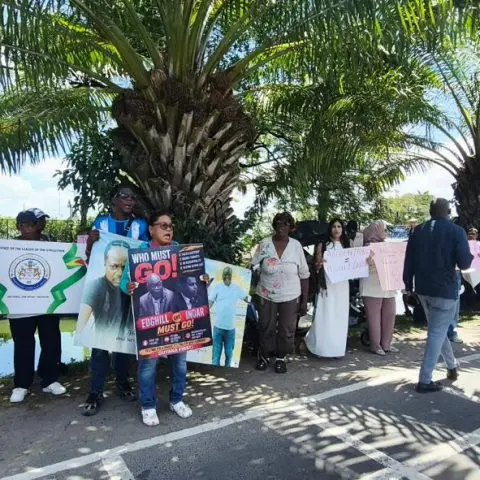
Pressure is continuing to build on President Ali and the government over this farm.
In yesterday’s Kiskadee Watch, former Auditor General Anand Goolsarran said that President Ali has to answer a series of questions.
Goolsarran said to satisfy the concerns of key stakeholders and the citizens “it would be entirely appropriate for the President to publicly provide answers to the following: (i) Who approved of the additional acreage of lease land and for what purpose? (ii) What is the total value of the investment in the lease lands? and (iii) What are the sources of funding of the investment, specifying the amounts involved?”
In a 23-minute video posted to his Facebook page on July 5th, Opposition Leader Azruddin Mohamed stood on a road near the property and provided his own cost estimates for the infrastructure, buildings, machinery, livestock and agricultural operations at the farm.
He contended that a presidential salary of $3.7 million per month could never finance what he described as a 150-acre ranch investment amounting to what he said was more than $2.2 billion.
In a video response on July 9th, aside from saying that his extensive farm at Long Creek was financed by a “huge” loan, President Ali was silent on a multitude of questions that have arisen over the propriety of his business operations following disclosures by Mohamed.
Responding, Ali said: “My farm is not a discovery. It is public information… a farm that I have built and can account for every single; every single investment in that farm.”
However, while insisting that the property has never been hidden, the President did not provide documents or other records to support that assertion during his address. Nor did he indicate whether such records would be made publicly available.
Ali also did not disclose key details about the property, including the total acreage under his ownership or control, when the land was acquired, the purchase price, or how the acquisition and subsequent development of the farm were financed.
The President further did not address the overall value of the investment or the cost of the infrastructure and facilities that appear on the property, as shown in the photographs and video released by Mohamed.
Given the apparent scale of the agricultural operation depicted in Mohamed’s 23-minute presentation, Ali also did not explain whether any measures were taken to manage potential conflicts of interest between his role as Head of State and his private farming enterprise.
Additionally, the President did not comment on the size and scope of the development, including the various structures and amenities visible in the images, nor did he indicate what planning approvals, environmental clearances, building permits or other regulatory authorisations were obtained for the construction and operation of the facilities on the property.








Discussion