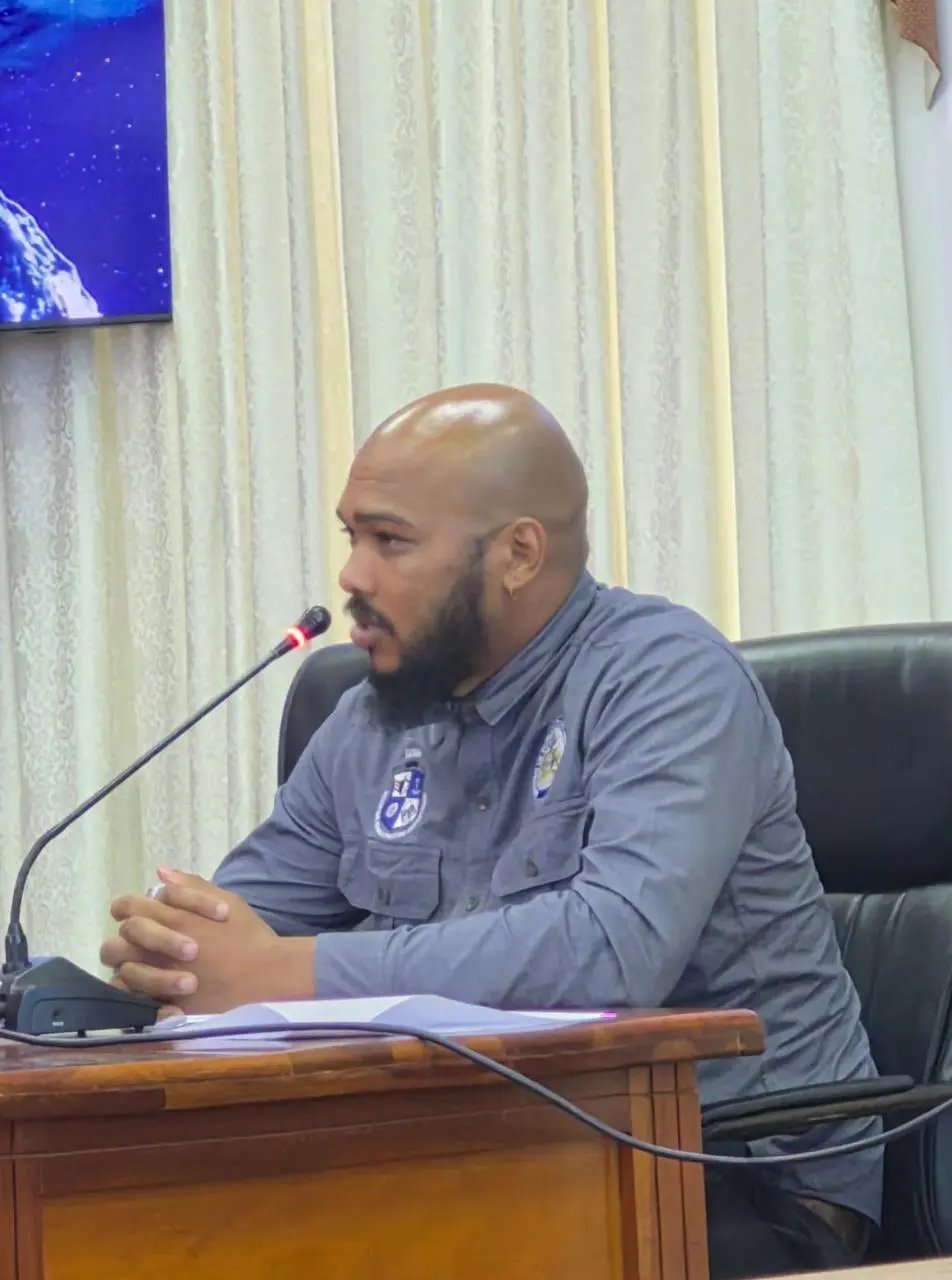
-MARAD officer did not recommend grounding despite multiple deficiencies
Maritime Administration Department (MARAD) surveyor Christopher Bailey was unable to explain why he relied on the Coasting and Passenger Trade Regulations to inspect the MV Barima, after a commissioner at the Commission of Inquiry (CoI) pointed out that the regulations didn’t apply to the vessel because of its tonnage.
Bailey appeared before the commission for a second time yesterday as it resumed hearings at the Arthur Chung Conference Centre, Liliendaal where he was questioned extensively about his November 2025 inspection of the vessel, during which he identified approximately 16 deficiencies.
Commissioner Nyree Dawn Alphonso challenged Bailey’s reliance on the regulations, directing his attention to Regulation 10.1, which provides for the inspection of vessels of less than 150 tonnes carrying passengers between places within Guyana and places outside Guyana.
Asked whether the regulation applied to a vessel of that size, Bailey said he was not a lawyer and could not provide a definitive answer.
The commissioner subsequently pointed out that the regulation on which Bailey had relied did not apply to the MV Barima, thus questioning the legal framework used to assess the vessel’s safety and certification requirements.
Bailey had previously explained that certain documents and safety requirements were not considered mandatory under the regulations he was instructed to use. Earlier, Commissioner Dr Andrzej Jasionowski questioned Bailey about the absence of stability documentation and a load-line certificate aboard the MV Barima.
Bailey acknowledged that he had not checked for a stability manual during his inspection, explaining that the inspection checklist he used did not include a specific requirement for such documentation.
He also admitted that although the vessel had load-line markings, he did not establish whether those markings were accurate or whether the vessel was operating within the appropriate loading restrictions.
When questioned about how an officer could properly determine a vessel’s stability and loading limits without the relevant documentation, Bailey said that in his previous experience working aboard vessels, stability documentation and load-line certificates were available, and draft surveys were conducted after loading.
He acknowledged that he had never worked aboard a vessel without the relevant stability and load-line documentation and could not explain how loading could be properly controlled in their absence.
Jasionowski also questioned the extent of Bailey’s physical inspection of the Barima, and Bailey testified that his inspection lasted approximately 45 minutes to one hour. He further said that he had access to the vessel’s previous inspection reports but did not review them before or after conducting the November 2025 inspection.
Meanwhile, Commissioner Captain Hamada Fouda questioned Bailey about several deficiencies involving the vessel’s life-saving and firefighting equipment and Bailey confirmed that the MV Barima had six life rafts, each with a capacity of 25 persons, providing accommodation for 150 people. However, Fouda pointed out that the vessel’s passenger capacity was recorded as 125, in addition to 12 crew members. At least 179 persons were thought to have been aboard the ferry when it sank.
The commissioner calculated that, based on the requirements he referenced under the International Convention for the Safety of Life at Sea (SOLAS), the vessel would have needed capacity for 274 persons in life rafts, meaning an additional five rafts would have been required.
Further, Bailey confirmed that the six life rafts were overdue for servicing, although he could not recall how long their service dates had passed.
Fouda further questioned Bailey about the vessel’s machinery and firefighting arrangements, establishing that one of its two generators was undergoing maintenance during the inspection and that, to Bailey’s recollection, there was no emergency generator aboard.
The commissioner also raised concerns that the main fire pump was not working and that a portable fire pump was being used instead. Bailey confirmed the presence of the portable pump but said he was unsure whether MARAD had granted an exemption allowing it to be used as a replacement for the main fire pump.
He also acknowledged that no fire suit was seen aboard the vessel. On the life jackets, Bailey said that none of those inspected had lights, although they were fitted with reflective material and whistles.
Commissioner Alphonso rejoined to ask a few more questions, the first being whether the absence of lights constituted a safety deficiency, particularly given that lights are required under SOLAS provisions to help locate persons in the water at night.
Bailey acknowledged that life jackets are required to have lights under SOLAS but maintained that the convention’s requirements did not apply to the MV Barima because it operated on local routes.
The commissioner challenged that explanation, questioning whether Bailey was aware of any specific exemption granted to the vessel from SOLAS requirements and he responded that he was not.
The commissioner also questioned the absence of hand flares, parachute flares, smoke signals and other emergency signalling equipment aboard the vessel and Bailey confirmed that these were not found during his inspection and acknowledged that their absence represented a significant deficiency.
Bailey also faced questions about the follow-up mechanisms employed by MARAD after inspectors identify deficiencies aboard vessels. He explained that inspection reports are submitted to the Director of Safety, who then forwards them to the Transport and Harbours Department. Once deficiencies are reported as corrected, inspectors are expected to return and verify the repairs.
However, when asked whether a follow-up inspection had been conducted on the MV Barima after his November 2025 report, Bailey answered in the negative. He also confirmed that he had not recommended that the vessel be stopped from operating until the identified deficiencies were corrected.
The CoI will continue tomorrow morning.









Discussion