
The D.C. Caesar Fox Secondary School in Waramadong, Region Seven, reopened its doors amid concerns over deteriorating infrastructure, inadequate water and sanitation facilities, and unfinished buildings on the school compound.
Kiskadee Watch understands that students from seven other villages are expected to travel to Waramadong to attend the school, with many of them expected to reside in the school’s dormitory.
However, conditions observed at the school raise questions about the safety and quality of the environment in which the students are expected to learn and live.
Several sections of the school are visibly deteriorating, with rotten walls covered with pieces of paper in an apparent effort to make classrooms more child-friendly.

Windows in some areas are boarded up with pieces of wood, while sections of the steps are falling apart and appear to pose a safety hazard.
The school also has a filtration system, but there is reportedly no water available for it to operate. Kiskadee Watch understands that the school is currently without a reliable water supply.
An older building on the compound, where work is reportedly carried out from time to time, is also in a deteriorated condition and presents a potential hazard.

There are also concerns about erosion around the fireside area.
Meanwhile, a multipurpose hall and kitchen which were expected to be completed in 2025 remain unfinished.
The existing kitchen is also considered unsafe for use, adding to concerns about the facilities available to students and staff.
The conditions have also raised concerns about sanitation, particularly the continued use of latrine toilets by students.
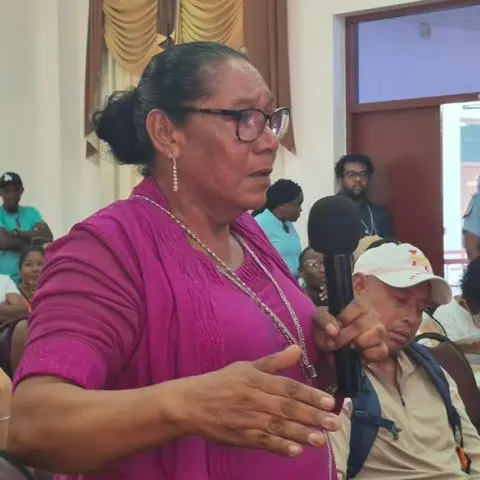
Indigenous rights activist Laura George in an interview stated that hundreds of students at the secondary school and dormitory are required to use latrines, despite the availability of sanitary blocks at the institution.
She said the sanitary blocks are reportedly reserved for teachers, while students continue to use latrine toilets.
“There is no child in Georgetown that uses pit latrine. These discriminatory practices of the Government have to stop because putting our children to use pit latrine, hundreds of girls and boys in a secondary school, and in primary schools, it is wrong. It has to stop. It is discriminatory,” George told Kiskadee Watch.
George noted that every child in Guyana should have access to a safe, clean and conducive learning environment regardless of their geographical location.
“Each child of Guyana, every child of Guyana deserves to have safe schools, clean schools, clean environment and this is our obligation to the children of Guyana,”
George stressed that Indigenous communities should have a greater say in determining how development resources are used in their communities.
She pointed to the Low Carbon Development Strategy 2030 (LCDS 2030), under which Indigenous villages receive 15 per cent of carbon credit revenues, arguing that Indigenous peoples should have direct access to resources to address pressing needs such as school infrastructure.
“If Indigenous peoples have full ownership and are empowered and strengthened to have these good governance systems, they could have just come together long time, and have a good secondary school building there, have teachers there, proper facilities, and all of that,” George told Kiskadee Watch.
She said that parents in the community continue to shoulder responsibilities that she believes should be addressed through proper public infrastructure.
“Because up to today, that secondary school, the parents usually still just go build pit latrines for the children of that secondary school,”
George stated while the Government has constructed a number of new schools in hinterland communities, significant challenges remain, including deteriorating buildings, infrastructural defects and shortages of resources and human resources.
At the National Toshaos Council Conference in July, Education Minister Sonia Parag said the Government had constructed 72 new schools and completed 40 major school extensions across hinterland communities over the past five years.
Parag said the investments were part of the Government’s efforts to bridge the education divide between coastal and hinterland communities.
However, the conditions observed at the D.C. Caesar Fox Secondary School have renewed questions about the state of existing educational infrastructure in hinterland communities, particularly as students from several surrounding villages prepare to depend on the school for their secondary education.









Discussion