
Senior Superintendent of Police Prem Narine came under intense scrutiny yesterday when the extradition proceedings against Azruddin Mohamed and Nazar Mohamed resumed at the Georgetown Magistrate’s Court after a hiatus for a CCJ decision.
Discrepancies emerged between Narine’s testimony and a statement he gave in November 2025 during the extradition committal proceedings brought by the United States against businessman and Opposition Leader Azruddin Mohamed and his father, Nazar Mohamed.
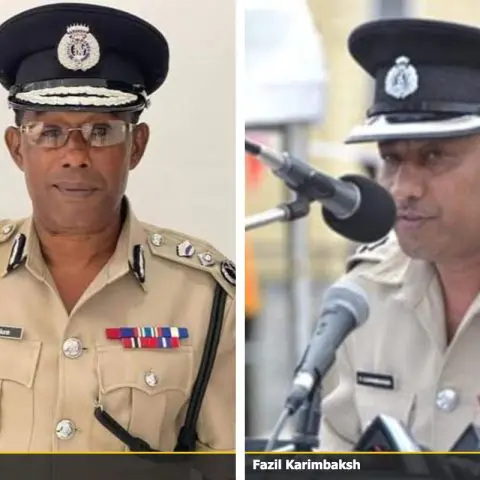
Narine, who heads the Special Branch of the Guyana Police Force, took the witness stand as the proceedings resumed before Chief Magistrate Judy Latchman.
During the hearing, the prosecution was also prevented from tendering two documents through Narine following objections from the defence.
Narine told the court that on October 31, 2025, at approximately 9:15 a.m., he went to the Attorney General’s Chambers, where he collected a bundle of documents.
He said the bundle included an Authority to Proceed (ATP) signed by Minister of Home Affairs Oneidge Walrond, a Section 6 Certificate under the Fugitive Offenders Act signed by Minister of Foreign Affairs Hugh Todd, documents bearing the signatures of United States Secretary of State Marco Rubio and former US Attorney General Pam Bondi, as well as two draft arrest warrants for the Mohamed father-and-son duo.
Narine said he subsequently went to the Georgetown Magistrate’s Court in the company of Detective Superintendent Rodwell Sarabo, where he appeared before the court.
However, when Narine began giving evidence about the contents of the documents, attorneys Roysdale Forde SC and Siand Dhurjon objected, pointing out that the documents had not been authored by the witness and that he had not established identifying marks on them.
The defence also objected when the prosecution sought to tender the ATP, which was used to initiate the extradition proceedings.
Special Prosecutor Herbert McKenzie told the court that there were three original ATP documents and made submissions in support of having the document admitted.
After hearing arguments from both sides, Magistrate Latchman ruled that the ATP would not be tendered through Narine.
The Chief Magistrate also prevented Narine from identifying a Diplomatic Note, noting that the witness had not indicated during his evidence that a diplomatic note was among the documents he collected.
The court, however, allowed a Section 6 Certificate under the Fugitive Offenders Act to be shown to Narine.
Narine later testified that after securing the warrants on October 31, 2025, he and other police officers went to Smyth Street, Georgetown, where he contacted Azruddin Mohamed, who was seated in a vehicle.
According to Narine, Mohamed was informed of the arrest warrant in connection with the extradition request made by the United States in relation to allegations including money laundering and wire fraud.
Narine said Mohamed was subsequently taken into custody and requested to speak with his attorney. An initial call to one of his attorneys went unanswered, he testified.
During cross-examination, Dhurjon focused on Narine’s handling and receipt of the extradition documents and discrepancies between his testimony and a two-page statement dated November 7, 2025.
When asked whether he had given a statement on November 7, Narine said he had, although he initially said he could not recall the date.
Dhurjon then questioned Narine about his evidence that he had received the ATP and Section 6 Certificate from the Ministry of Home Affairs and the Ministry of Foreign Affairs.
Narine acknowledged that his statement did not reflect the circumstances in the same manner as his testimony before the court.
When Dhurjon put it to him that he had stated in his evidence that he uplifted the documents from the Minister of Foreign Affairs and the Minister of Home Affairs, Narine agreed.
The defence then highlighted what it described as discrepancies between the statement and Narine’s testimony.
Narine attributed the discrepancy to a “typographical error.”
Dhurjon subsequently put to the witness that, although he had claimed that the documents were signed by the Ministers of Foreign Affairs and Home Affairs, he had never personally seen either minister sign the documents.
“That’s correct,” Narine responded.
Dhurjon then drew Narine’s attention to his November 7 statement, which was made seven days after the documents were allegedly collected, and questioned what he meant by a “typographical error.”
Narine explained that he had received the ATP and the Section 6 Certificate from the Ministry of Foreign Affairs and the Ministry of Home Affairs and was familiar with the signatures, but had actually uplifted the documents from the Attorney General’s Chambers.
Dhurjon then pointed out that nowhere in Narine’s two-page statement did he mention the Attorney General’s Chambers.
“That’s correct,” Narine responded.
The defence attorney further asked whether Narine’s statement mentioned him going to Carmichael Street, to which the witness again agreed that it did not.
Cross-examination of Narine was subsequently deferred.
Sought a stay
When the hearing resumed yesterday morning, defence lawyers for Azruddin Mohamed and his father sought a stay of the ongoing extradition proceedings, arguing that continuing the matter while related legal challenges remain before the Court of Appeal could prejudice the accused.
The defence’s concerns centre largely on the cross-examination of witnesses.
Counsel argued that several of the issues arising in the extradition proceedings are closely interconnected with provisions and matters currently under challenge before the Court of Appeal.
They submitted that proceeding with cross-examination before the appellate court determines those issues could place the defence in a difficult position.
According to the defence, if they cross-examine witnesses based on the current state of the law and the Court of Appeal subsequently changes the interpretation or effect of the challenged provisions, the defence could be left without an opportunity to revisit its questions.
Counsel also argued that declining to cross-examine could equally prejudice the accused, since the defence could later be unable to return to matters that may become significant depending on the appellate court’s decision.
The defence therefore contended that the Chief Magistrate should exercise her judicial discretion and stay the proceedings until there is greater clarity from the Court of Appeal.
Counsel maintained that the issue goes beyond simply asking witnesses questions about the law, arguing that the statutory provisions under challenge are connected to the evidence and the manner in which the defence is required to conduct its case.
The prosecution, represented by Terrence Williams KC, Herbert McKenzie and Celine Deidrick, opposed the defence’s position.
The prosecution argued that the defence was effectively seeking to re-argue matters that had already been considered by the Court of Appeal and the Caribbean Court of Justice.
The prosecution also maintained that witnesses should not be asked to give evidence on questions of law, since the interpretation and application of the law are matters for the court.
The defence countered that the pending appeal creates a genuine case-management issue for the Magistrate, particularly because the outcome could affect how the defence approaches the evidence before the court.
Chief Magistrate Latchman heard the submissions and indicated that she would consider the written arguments before determining how the matter should proceed.
The pending appeal before the Court of Appeal stems from a constitutional motion filed by the Mohammeds challenging provisions of the Fugitive Offenders Act, which was dismissed by Justice Navindra Singh. That appeal remains pending and has been fixed for hearing on October 13. The Court of Appeal had ordered that the extradition proceedings continue before Magistrate Latchman in the magistrate’s court, while staying only the final disposition of those proceedings until the appeal is heard and determined by the Court of Appeal.







Discussion