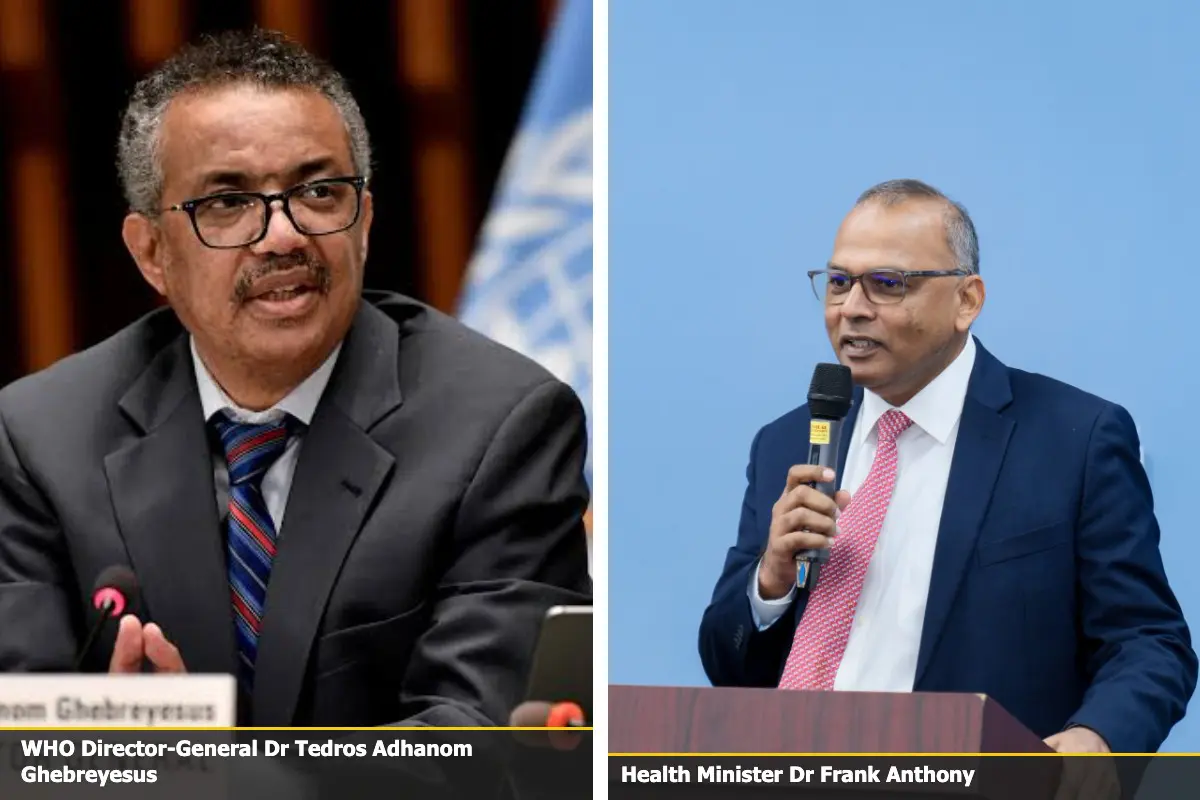
Guyana has received World Health Organisation (WHO) validation for eliminating mother-to-child transmission of HIV and syphilis as public health problems, the Ministry of Health announced yesterday, following an international assessment of its programme during 2022–2025.
The recognition follows years of efforts to prevent transmission to infants and comes weeks after Barbados received WHO certification for eliminating mother-to-child transmission of HIV.
The ministry said WHO Director-General Dr Tedros Adhanom Ghebreyesus conveyed Guyana’s validation to Health Minister Dr Frank Anthony in a November 16 letter. WHO’s Global Validation Advisory Committee assessed the country’s submission on November 5.
“Guyana has been validated as having achieved the elimination of mother-to-child transmission (EMTCT) of HIV and syphilis for the period 2022–2025. I congratulate Guyana on this landmark achievement,” Tedros wrote, according to the release.
“I commend the Government of Guyana for its sustained commitment to a strong EMTCT programme that safeguards the health of pregnant women and their infants.”
The ministry stressed that the certification confirms elimination as a public health problem, rather than the complete eradication of HIV or syphilis.
It attributed the achievement to sustained investment in maternal and child healthcare, expanded screening, improved access to treatment, upgraded laboratory services and stronger disease surveillance.
The release did not provide Guyana’s transmission figures or screening and treatment coverage rates for the assessment period.
The recognition marks a further stage in a longstanding national effort.
The current validation followed an assessment coordinated by the Pan American Health Organisation (PAHO), including a virtual review from June 1–5 and an in-country mission from June 7–13.
Led by Dr Jodie Dionne, the regional validation team examined national programmes, healthcare services, laboratory systems and epidemiological data. The review also covered community engagement, human rights and gender considerations.
The team included Dr Shabbir Argaw, María Belén, Arlene Darmaine, Diane Weeks, Veronica Cenac and Patrick Lalor, with support from PAHO’s Sandra Jones and Dr Leandro Sereno Soares.
Following an initial briefing with Anthony on June 8, the team presented its technical findings to Guyana’s National Validation Team on June 12. The submission was subsequently considered by WHO’s global committee.
Welcoming the decision, Anthony described it as an important achievement in the country’s public health development.
“Today, Guyana has every reason to be proud. We have achieved something extraordinary. The World Health Organisation has officially recognised our success in eliminating mother-to-child transmission of HIV and syphilis as public health problems,” he said.
“This is more than an international certificate. It represents lives protected, infections prevented, and children given a healthier start in life.”
Investment
Anthony linked the outcome to government investment in hospitals, primary healthcare, diagnostic services, medical equipment, trained personnel and public health programmes.
“This achievement demonstrates that these investments are delivering results. We are not only building facilities and introducing modern technologies; we are preventing disease, saving lives and improving health outcomes,” he said.
He recognised the contribution of doctors, nurses, midwives, laboratory professionals, public health officers and community health workers, and thanked PAHO, WHO and other development partners.
The ministry also acknowledged civil society organisations and families for their contributions.
Mother-to-child transmission of HIV and syphilis can cause lifelong infection, stillbirth and neonatal death, the release noted. It said these outcomes were largely preventable through early screening, timely treatment and quality antenatal care.
Barbados received its certification on October 30. Unlike Guyana’s announcement, which covers HIV and syphilis, the Barbados validation concerned HIV.
WHO reported that no new HIV infections resulting from mother-to-child transmission were recorded among infants born in Barbados during 2022–2024. Its assessment found that 98 per cent of pregnant women received antenatal care, 98 per cent were tested for HIV and 98 per cent of pregnant women living with HIV received antiretroviral treatment.
Testing and treatment were free for pregnant women regardless of nationality, while HIV-exposed babies received early testing and follow-up care. WHO also said testing was voluntary and confidential and that its assessment found no evidence of coercive reproductive health practices involving women living with HIV.
The ministry said Guyana would undergo a further WHO review in 2030, covering programme performance during 2026–2029.
It intends to continue strengthening maternal healthcare, screening, treatment and surveillance while pursuing the broader goal of eliminating mother-to-child transmission of HIV, syphilis and hepatitis B.
“WHO looks forward to continuing its technical cooperation with Guyana in support of the broader triple elimination of mother-to-child transmission of HIV, syphilis and hepatitis B virus, and commends the progress made to date,” Tedros wrote.
The achievement contributes to PAHO’s regional Disease Elimination Initiative, which seeks to eliminate more than 30 communicable diseases and related conditions as public health problems by 2030.
“Our responsibility now is to sustain this achievement and continue working towards eliminating other preventable diseases,” Anthony said. “No child in Guyana should suffer from an infection that modern medicine can prevent.”









Discussion