-following leak of acrimonious correspondence among judges
The heads of seven regional judiciaries today expressed confidence in the Caribbean Court of Justice (CCJ) amid controversy over leaked internal correspondence.
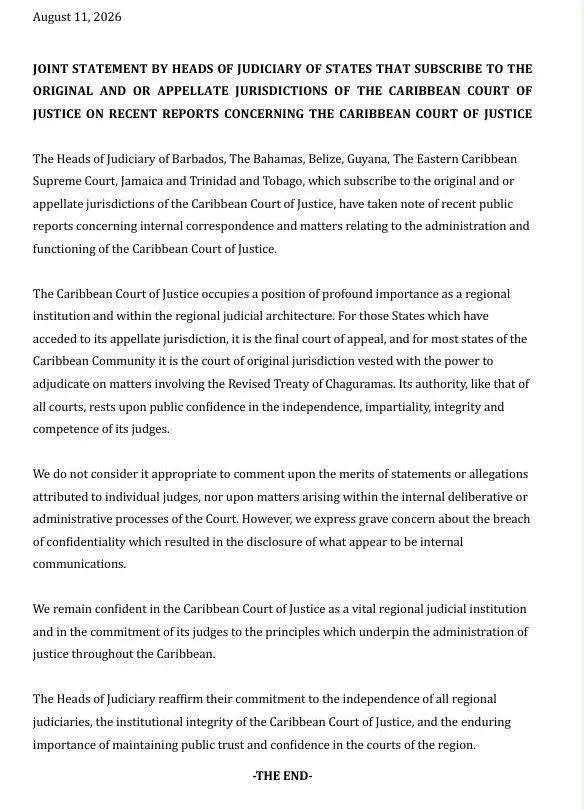
The joint statement, posted on the Facebook page of the Supreme Court of Judicature of Guyana, was issued by the heads of the judiciaries of Barbados, The Bahamas, Belize, Guyana, the Eastern Caribbean Supreme Court, Jamaica and Trinidad and Tobago.
They said they had taken note of recent reports concerning internal correspondence and matters relating to the administration and functioning of the CCJ.
“The Caribbean Court of Justice occupies a position of profound importance as a regional institution and within the regional judicial architecture,” the statement said.
It noted that the CCJ serves as the final appellate tribunal for those states which have acceded to its appellate jurisdiction and exercises original jurisdiction in matters arising under the Revised Treaty of Chaguaramas.
“Its authority, like that of all courts, rests upon public confidence in the independence, impartiality, integrity and competence of its judges,” the judiciary heads said.
They declined, however, to comment on the claims attributed to individual CCJ judges or on the court’s internal administrative and deliberative processes.
“We do not consider it appropriate to comment upon the merits of statements or allegations attributed to individual judges, nor upon matters arising within the internal deliberative or administrative processes of the Court,” the statement said.
The judiciary heads instead focused on the disclosure of the correspondence, saying they viewed the breach of confidentiality with “grave concern”.
They added: “We remain confident in the Caribbean Court of Justice as a vital regional judicial institution and in the commitment of its judges to the principles which underpin the administration of justice throughout the Caribbean.”
The statement reaffirmed their commitment to the independence of regional judiciaries, the institutional integrity of the CCJ and the maintenance of public confidence in the region’s courts.
The intervention follows a dispute among the CCJ judges which became public following the leaking of email exchanges to the Trinidad Express. According to a report in the newspaper, the correspondence showed five of the court’s six judges raising concerns about the leadership of CCJ President Justice Winston Anderson.
The reported dispute began after Justice Anderson circulated a proposed judicial dress code in June and advised that it would be placed before the Regional Judicial and Legal Services Commission. Several judges said that the proposal should first have been discussed and approved by the judges.
The correspondence subsequently widened into allegations concerning unilateral decision-making, the composition of judicial panels, the court’s internal working environment and attempts to influence the handling of cases.













Discussion