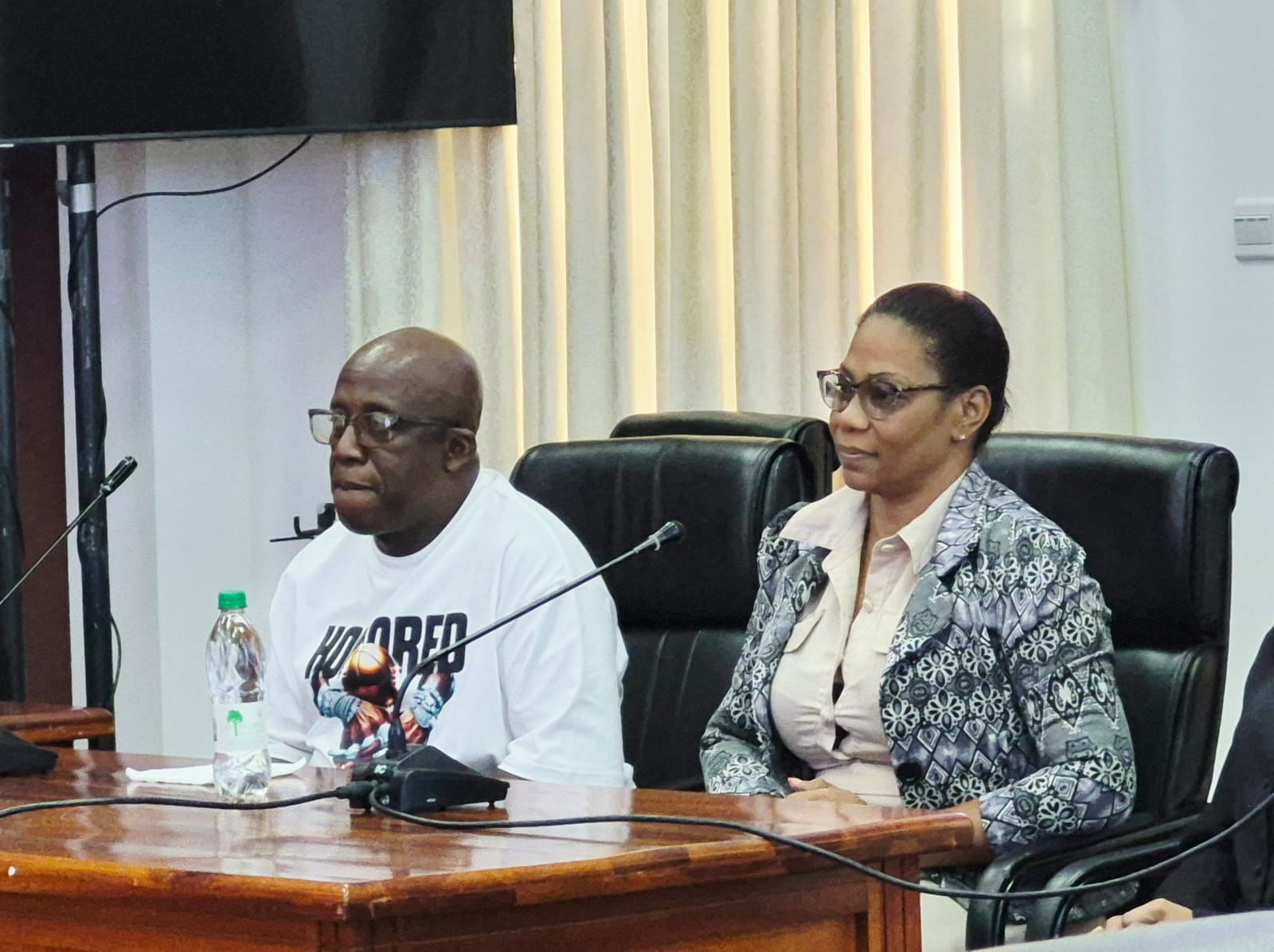
The MV Barima was operating on one engine, had water entering its hull and reportedly had defective bilge pumps before it capsized on July 18, the father of missing crew member Trevon Sam told the Commission of Inquiry (CoI) yesterday, as he detailed a number of safety concerns his son had repeatedly raised before the tragedy.
Rudolph Sam, a heavy-duty mechanic, testified that his son had shared videos and photographs showing the vessel’s deteriorating mechanical condition, including an engine that was experiencing severe back pressure and another that had been completely disassembled.
Responding to questions from Commissioner Rear Admiral (Ret’d) Hayden Pritchard, Sam explained that one of the bilge pumps, located closest to the disassembled engine, was not functioning properly, while water was entering the vessel. He said the crew had attempted to use ordinary water pumps to remove the water, at one stage trying to operate two pumps.
According to him, the failure of one engine also meant that equipment attached to it, including its generator, was no longer operational. A third generator was subsequently brought aboard as a backup, but it could not fit through the doorway into the engine compartment.
He told the inquiry, which continued at the Arthur Chung Conference Centre that the generator was therefore mounted on top of the vessel and secured with ratchet straps instead of being properly bolted down.
Sam said he believed the generator could move with the vessel’s movements, thus affecting its stability.
When Pritchard sought clarification on whether the MV Barima had been sailing with only one functioning engine, Sam responded affirmatively, saying this was based on his conversations with his son.
He had earlier told the commission that the vessel had been operating with one engine for more than three weeks, including during a trip from Georgetown to Port Kaituma and back.
Sam said his son had sent him three videos showing the condition of the engines before the tragedy with one showing an engine that had been completely disassembled, and another capturing the remaining functioning engine experiencing severe back pressure.
He explained that the pressure was so high that it was forcing the engine’s dipstick out, adding that the engine had little power.
Sam, who said he had trained with Caterpillar engines and had experience as a heavy-duty mechanic, told the commission that he had assisted his son remotely with troubleshooting engine problems, sometimes through late-night telephone calls and video conversations.
He also criticised the maintenance practices aboard the vessel, noting that repairs were often undertaken only after equipment broke down, rather than through a structured preventive maintenance programme.
Responding to questions from Commissioner Dr Andrzej Jasionowski about whether the vessel had engine manuals available, Sam said there was no established culture of maintaining and consulting manuals for the engines.
He described the vessel’s condition as one of total disrepair, claiming that problems were routinely addressed “on the fly,” with repairs made as best as possible before operations continued.
The father further testified that engineers aboard the vessel, including his son, had repeatedly documented mechanical and safety concerns in reports submitted through their chain of command.
Commissioner Nyree Dawn Alfonso sought clarification on who was responsible for receiving the reports. Sam explained that the engineers would submit them to the captain, who was then expected to pass the information on to shore-based management.
Sam’s wife Michelle, and mother of Trevon, testified that her son had frequently complained about the MV Barima, telling her that the vessel was giving problems and that nobody appeared to be listening to the crew’s concerns.
She recalled that, during the week leading up to the tragedy, Trevon repeatedly complained about having to make trips back and forth between the wharf and the vessel because it was not working as it should.
She also told the commission that her son had previously suffered minor burns to his hand and stomach when the MV Barima caught fire in Port Kaituma.
Asked by Jasionowski about the worst incident her son had shared with her, Michelle identified that fire as the most serious incident before the July tragedy.
She also recalled him complaining that water was entering the vessel and that the pumps were struggling to remove it.
The mother recounted that, shortly before the tragedy, Trevon had expressed frustration over the vessel’s condition and said that even the captain had been complaining without anyone taking action.
Trevon, 32, who remains missing, was employed as a third engineer with the Transport and Harbours Department and had a 12-year-old son.
Meaningful consequences
Meanwhile, Rudolph Sam also used his testimony to criticise the deeply entrenched culture of disregard for safety in Guyana, arguing that the MV Barima tragedy should force a change in how safety standards are treated.
Drawing on his experience as a heavy-duty mechanic, Sam said safety was routinely taken for granted, with equipment being operated despite obvious defects and repairs often being done without proper attention to standards. He pointed out that preventive maintenance was neglected, with workers instead left to address problems after equipment had already broken down.
He said the problem really rests with those in positions of authority whom he believed failed to ensure that proper procedures were followed. He told commissioners that people occupying senior positions must understand their responsibilities and ensure that the necessary resources, maintenance and safety measures are provided.
“Fish don’t rot from the tail,” he said, using the expression to make his point that responsibility for the country’s safety culture must begin with those at the top.
Sam said he did not want the loss of his son and the other victims to become just another tragedy without meaningful consequences. He urged the commission to make strong recommendations that would lead to changes in the system, insisting that safety must be taken seriously rather than treated as an afterthought.
He added that while he did not wish to see anyone lose their livelihood, the circumstances surrounding the tragedy demanded accountability and a fundamental reassessment of how safety is managed in Guyana.







Discussion