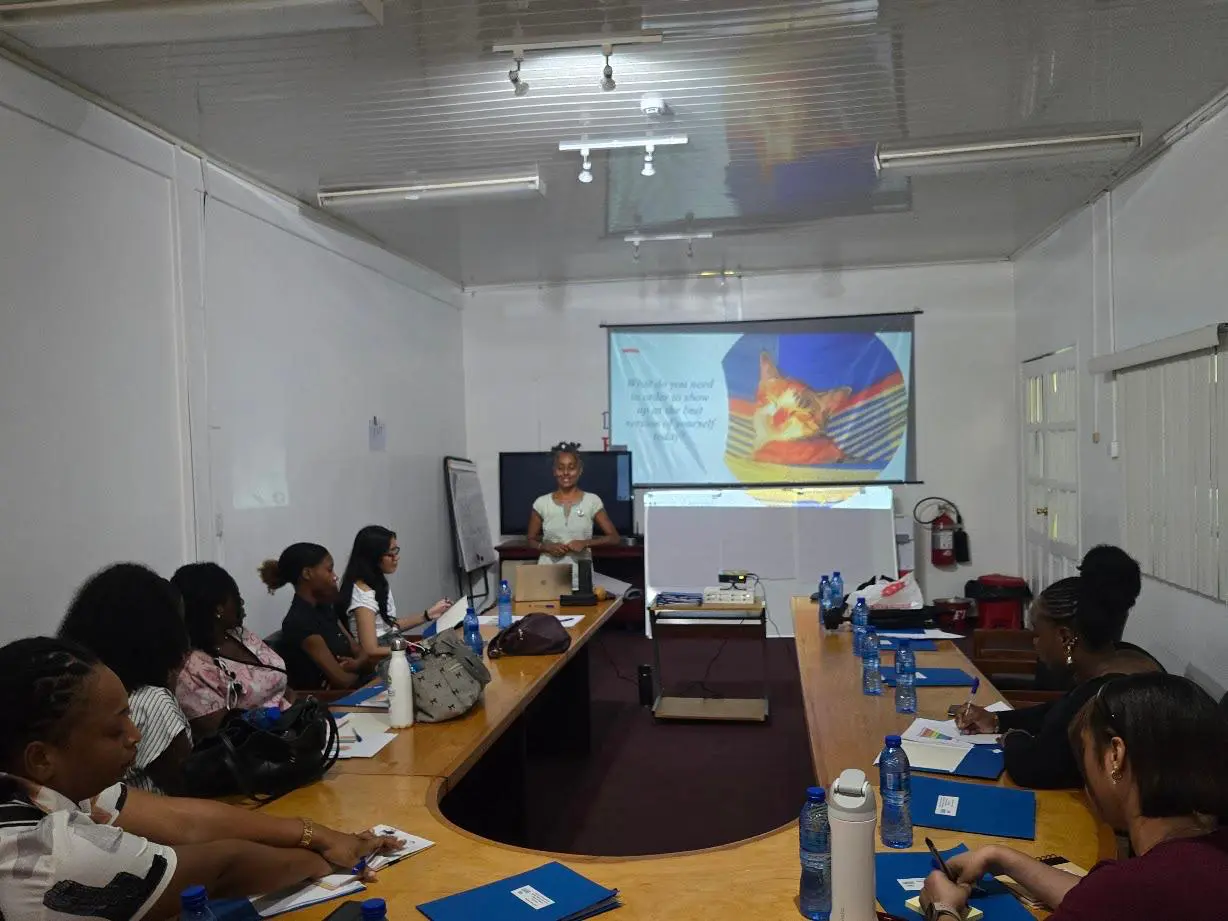
Tamùkke Feminists has launched a sexual and reproductive health and justice training manual intended to strengthen community education, with particular attention to the needs and experiences of Indigenous people.
The 186-page manual, developed in collaboration with the Wapichan Wiizi Women’s Movement and the South Rupununi District Council, covers healthy relationships, bodily autonomy, contraception, family planning, safe abortion, sexual and gender diversity, and responses to sexual violence.
According to an October 24 release, the document was launched in Georgetown on Saturday alongside a training-of-trainers session.
Tamùkke Feminists Managing Director Akola Thompson said the resource was developed in response to shortcomings in access to reproductive healthcare and education.
“Access to reproductive healthcare and education generally needs major work across Guyana,” Thompson said.
For Indigenous communities, she added, remoteness compounds those gaps, while stronger responses and support mechanisms are needed to address violence.
Thompson said the organisation wanted “a comprehensive toolkit grounded in our local realities” that would be attentive to Indigenous people’s cultural relationships and needs.
Tamùkke Feminists board member Renata Chuck-A-Sang described the manual as “groundbreaking”, saying it combines a feminist perspective with an approach rooted in community experience.
“It really grounds itself in revealing the cultural values of a community before shaping how the material is presented,” she said.
According to Chuck-A-Sang, the manual provides tools and guidance for people conducting community training, while promoting bodily autonomy and the right to make informed choices.
“This manual is for persons who will go out into communities to conduct SRHJ training. It contains all of the tools and guidance for effective training sessions,” she explained.
She said the training should better equip participants to understand and uphold their rights and guide their communities on family planning, healthy relationships and seeking healthcare.
Titled De Whole Ting: Sexual and Reproductive Health and Justice Training Manual, the publication is intended for community facilitators, Indigenous women leaders, youth advocates, community organisations and peer educators.
Its introductory sections explain that, although women’s safety and experiences are central, the activities are designed to involve men, boys and gender-diverse people in discussions about relationships, violence prevention and shared responsibility for wellbeing.
The manual encourages facilitators to examine how power operates within households and communities and how gender expectations influence people’s opportunities and risks.
It also distinguishes between respecting cultural knowledge and accepting practices that perpetuate inequality or harm. Facilitators are encouraged to begin with local experiences, recognise positive traditions and discuss harmful practices critically and respectfully.
Rather than relying primarily on lectures, the modules use storytelling, role play, mapping exercises, group discussions and reflection. They include suggested agendas, learning objectives, assessments and guidance for planning advocacy.
Activities can be adapted to participants’ ages, literacy levels and language preferences, including translating key terms into locally understood language.
The publication also places emphasis on how facilitators respond to disclosures of sexual abuse or violence.
It advises against pressuring participants to share personal experiences and calls for calm, non-judgemental responses, respect for confidentiality and attention to immediate safety.
Facilitators are encouraged to know local referral services and to connect people with appropriate support. The manual makes clear that it is an educational resource and is not intended to replace professional healthcare, counselling or legal services.
Thompson said the document is publicly available for people to read and use in their own training sessions.
Founded in 2017, Tamùkke Feminists says its work includes education on consent, menstrual and sexual health, contraception, parenting, communication between generations, freedom from gender-based violence and access to abortion without stigma.
The manual is available through the organisation’s [public press kit](https://drive.google.com/drive/folders/1OlDy2ub4368-Sstc5VScGMOFjmM3KNJ5?usp=sharing).







Discussion