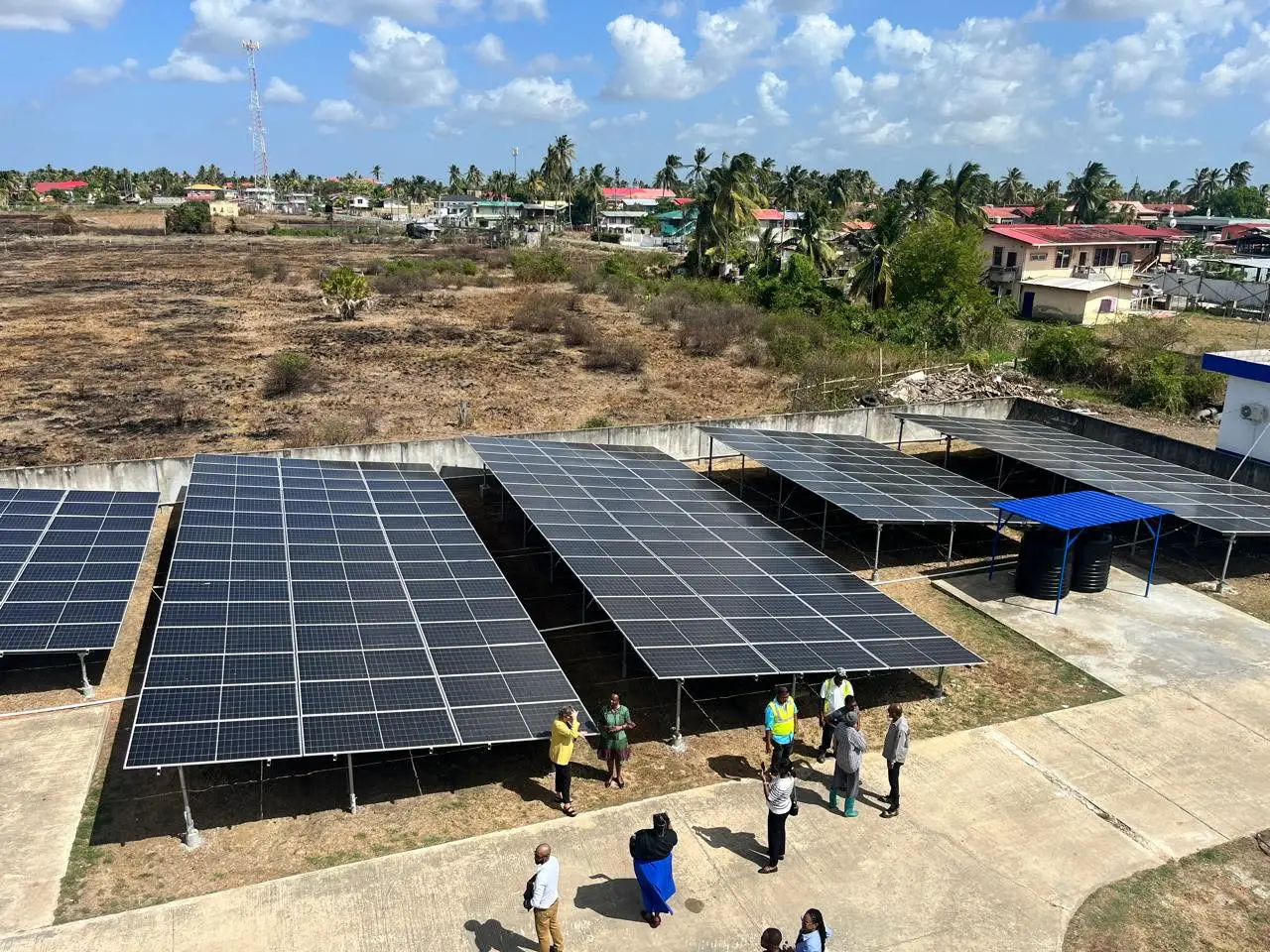
Prime Minister Mark Phillips on Tuesday commissioned a 200-kilowatt-peak solar power system at the Sheet Anchor Water Treatment Plant in Region Six that is expected to cut the amount of electricity the plant draws from the national grid by about 45 per cent.
The United Nations Development Programme (UNDP) said Guyana Water Incorporated (GWI) has committed to incorporating renewable energy into the design of future water treatment plants.
Sheet Anchor is one of eight GWI treatment plants fitted with solar power systems across Regions Three, Four and Six. The installations have a combined capacity of 1.05 megawatts and are projected to generate about 1.63 million kilowatt-hours a year, enough to meet nearly one-third of the eight facilities’ combined electricity needs.
Phillips said GWI’s demand for electricity was equivalent to about five per cent of national generation and that electricity had accounted for more than 40 per cent of the utility’s operating budget in many years. He said treatment plants supply water to 52 per cent of GWI’s service areas.
“That money could be doing other things. It could be laying new mains in communities still waiting for a reliable supply. It could be improving water quality. It could be fixing leaks, replacing old pumps and training staff,” Phillips said.
In a Facebook post, UNDP Guyana said reducing the cost of treating water could help GWI sustain its operations and put more of its resources into maintaining and improving the infrastructure communities rely on. It said the eight installations were expected to avoid about 1,000 tonnes of carbon dioxide equivalent emissions annually. At Sheet Anchor alone, the projected annual reduction is about 200 metric tonnes, according to the commissioning statement.
Sheet Anchor and Great Diamond each have a 200-kilowatt system, while Central Ruimveldt has a 150-kilowatt system. Timehri, Village 56, Uitvlugt, Pouderoyen and Queenstown each have a 100-kilowatt system. The programme provided 15 energy-efficient submersible pumps and variable-speed drives in February, followed by the solar installations in October.
Phillips said electricity demand was growing as the economy expanded, particularly around midday. Large consumers that generate their own electricity during those hours could free up grid capacity for new homes and businesses, he said. The GWI plants will also be able to feed surplus power into the Guyana Power and Light Inc. grid.
He said the project could help build a local solar industry by giving engineers experience in designing and installing systems, technicians opportunities to learn how to maintain them, and suppliers a market for their equipment. He urged ministries, state agencies, hospitals, schools and businesses to look for ways to use solar power and reduce energy waste, and asked GWI to track its savings to guide future investments.
Phillips linked the project to Guyana’s Low Carbon Development Strategy 2030, saying the eight systems were expected to avoid about 25,900 tonnes of carbon dioxide emissions over their projected 25-year lifespan. UNDP said the investment also advances the Sustainable Development Goals on clean water and sanitation, affordable and clean energy, and climate action.
The Global Environment Facility funded the work through the Mainstreaming Low-Emission Energy Technologies to Build Guyana’s Green Economy project, which UNDP implemented in partnership with the Guyana Energy Agency.










Discussion