
Claude Benjamin has spent all 64 years of his life in Region One. He currently lives 20 miles from Port Kaituma in a village called Sebai and so has been heavily dependent on the government’s transportation system to Georgetown, more specifically, the ill-fated MV Barima that was working the route for years.
Sleeping on a piece of cardboard, literally touching the passenger next to him because of being crammed in the boat, enduring vomit and urine scents for the entire 24-hour journey, and being without proper toilet facilities, are only some of the memories he has from travelling on the MV Barima.
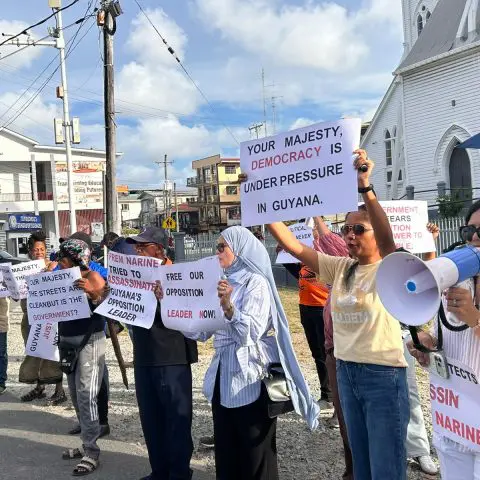
Benjamin, a father of seven, was among those protesting outside the Office of the President last Wednesday with a placard bearing the words: “Safe transport is a right not a privilege.” It clearly was not just a sign he wanted to hold up; it represented a deep-seated issue that has been gravely affecting him and his fellow Indigenous peoples for years: poor transportation systems in place by the government.
He joined the demonstration that was being led by the Amerindian Peoples Association (APA), on Vlissengen Road, out of solidarity for what his people have been going through for decades now, and he used the opportunity to speak about the misery of traveling from the northwest to Georgetown.

“I have not travelled on the ferry for some time now, but traveling on that boat is not good. The boat inside is something like that truck back there; rust,” he shared while pointing to the back of a truck. “That’s what we have to go and stay on from this morning to tomorrow morning; whole night,” he expressed in an interview with Kiskadee Watch.
“When you on the boat, you pull something to sleep on, like a piece of cardboard; some persons have hammocks. You have a few benches and you have to sit on them all night,” he continued, as he spoke about how limited the space on the boat is. It is literally impossible not to be touching the passengers next to him, he said.
“I don’t have words to describe the poor conditions of traveling on that boat. You have to get your sheet, throw your clothes bag there, and make much of that,” he reflected, adding, “Hygiene is bad also. When someone gets upset stomach; vomit, vomit, vomit. No one moves because they cannot afford to lose their space. You have to lie down whole night with that there, even with urine smell.”
Benjamin said he stopped traveling on the boat for some time now because he couldn’t handle these conditions. Instead, he opted for a speedboat to Charity. “You couldn’t avoid traveling on the boat. You had to jump on it because of the price of the airfare. So, you had to travel on it whether you liked it or not,” he said.
Benjamin said he attended the protest in solidarity with Indigenous people and described the MV Barima tragedy as a “man-made” disaster that could have been prevented. He attributed the tragedy to negligence and said the incident has left many people questioning whether they can continue to feel safe using river transportation.
He maintained that safe transportation is a basic right and called on the government to strengthen the systems in place to ensure that vessels operating in Guyana’s waterways are properly maintained and safe for passengers.
Meanwhile, also present at the protest was Youth representative of the APA, Crystal Atkinson of Santa Rosa village, Moruca who observed that even after the MV Barima tragedy, the transportation conditions for Region One have not improved. “I believe we deserve better transportation for indigenous people, especially for Region One,” she expressed.
Speaking with Kiskadee Watch, she said Indigenous peoples deserve better systems. “To see what Indigenous people have been going through in this modern time; I think we deserve better. Look at the size of the boat. How can almost 200 people fit there comfortably? I can’t imagine the uncomfortable situation children and mothers were placed in,” she said.

Graham Atkinson, Field Officer responsible for governance at APA, pointed to problems affecting riverine transportation for years, including unreliable water pumps, electrical faults, inadequate sanitation facilities, overcrowded vessels and uncomfortable conditions for passengers, who he said are often packed together with luggage, cargo and fuel.
He noted that air travel is too expensive for many people, leaving them dependent on river transportation. The APA, he said, wants the highest possible safety standards to be maintained, with regulations properly enforced and independent officials responsible for ensuring compliance rather than individuals appointed because of political allegiance.
The MV Barima was travelling from Georgetown to Port Kaituma last July 18 when it capsized off Guyana’s northern coast after issuing a distress call. Dozens of passengers were rescued, while scores of others died, prompting a massive search-and-rescue operation involving Guyanese and regional authorities.
The tragedy has since sparked widespread calls for accountability, with survivors, relatives and Indigenous groups raising concerns about the vessel’s condition, passenger safety and the adequacy of maritime oversight. The government has established a Commission of Inquiry to investigate the circumstances surrounding the disaster and determine what led to the loss of so many lives.







Discussion