By Khafra Kambon
Khafra Kambon is a founding member of National Joint Action Committee (NJAC) and Co-Founding Chair of the Emancipation Support Committee of Trinidad and Tobago. This article is based on an interview by Dr. Asha Kambon, October 2026
Knowing of Eusi Kwayana may have come at the same time as revolutionary thought entered into my consciousness as a 6th form student somewhere between 1965 and 1966, at Trinity College, Port of Spain, Trinidad and Tobago. I can’t seem to separate the two.
Then it was also the time of the New World Movement, which consisted mainly of scholars and University lecturers, such as Lloyd Best, George Beckford, Norman Girvan, James Millette, Walter Rodney, CY Thomas and Kamau Braithwaite who were expanding independent thought in the region, helping to shape ideas of social justice and transformation, while inspiring and integrating University students. They would argue that genuine Caribbean freedom and development required independent thought rooted in the region’s unique history—specifically a critique of plantation economies and global neo-colonial dependency—rather than copying foreign ideologies.
My early years at the University of the West Indies, on St. Augustine Campus, were spent focussed on what could be done to transform the nation and the region. Considering what real independence could mean and what it should or could look like. At the local and immediate level it meant going into communities to share educational capacities and raise the consciousness of those who had less opportunity for a formal education than some of us had. We engaged in groundings in marginalised and poor communities. It was a very exciting time for students who wanted more than a university degree and who demanded answers to questions on regional transformation and a new world order.
Students were drawn to activism and the politics of the region. It was a moment of the inter-Caribbean movement of lecturers and students, a moment when we were no longer Vincentian, Trinidadian, Grenadian or Dominican. We became West Indian. In that time, Eusi was in my consciousness as the founder of ASCRIA, The African Society for Cultural Relations with Independent Africa (ASCRIA) and as a former Government Minister in Guyana, who had changed his name from Sidney King to Pan-Africanist, Eusi Kwayana,in the tradition of earlier Pan Africanists such as M’zumbo Lazare of Trinidad and Tobago.
Eusi and the Caribbean Liberation Steering Committee (CLSC)
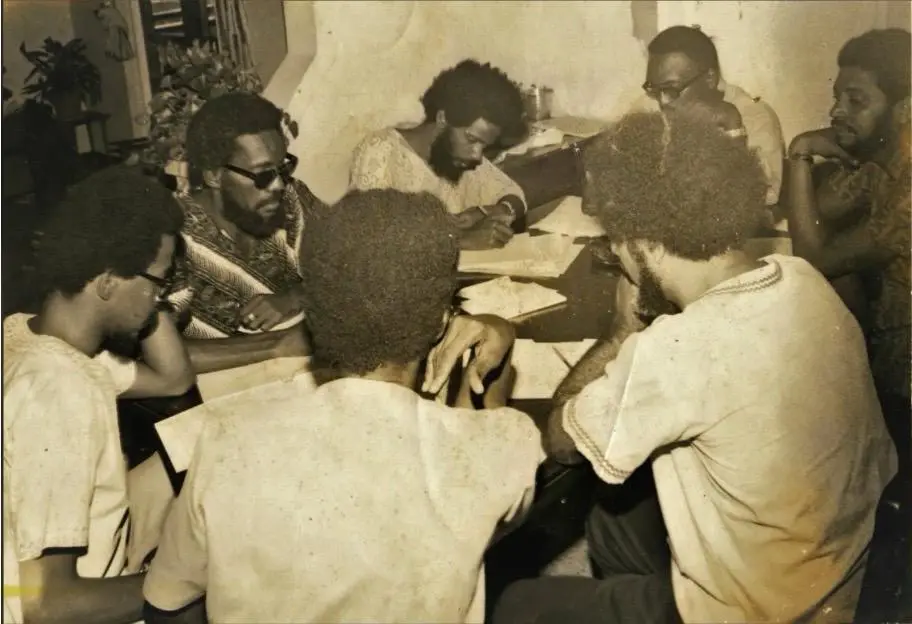
Eusi was a radical thinker who questioned the social and economic status quo, the traditional power structures, and the accepted wisdom of his time. He was an eminent part of the intellectual regional environment. We, the political activists of that period, wanted true independence and openly challenged the governments of the day to make that happen. The Caribbean Liberation Steering Committee (CLSC) was formed in the early 1970s on the heels of the high point of the Black Power revolution in Trinidad and Tobago, the opening of the decade of Black Power, and on the cusp of what was described as “ the century of Black Power” in the Call for the 6th Pan African Conference. The CLSC was one vehicle which brought progressive leaders of Caribbean liberation movements together. It was a space for discussion on ideas, strategies, disappointments and small victories. It was fully functional by 1973, with its meetings moving around the region to match the locations which had not yet banned its members. It was in that environment that I really met Brother Eusi.
Members of the CLSC included Maurice Bishop of the New Jewel Movement of Grenada, Bobby Clarke of the People’s Progressive Movement of Barbados, Makandal Daaga of the National Joint Action Committee (NJAC) of Trinidad and Tobago, Rosie Douglas of the Independence Committee of Dominica, Tim Hector of the Antigua-Caribbean Liberation Movement (ACLM), Eusi Kwayana of the Working People’s Alliance (WPA) Guyana and myself, Khafra Kambon of the National Joint Action Committee (NJAC) of Trinidad and Tobago.
It was a group of radicals, most in their mid- twenties, with some in their forties. All saw themselves as having some responsibility for transforming the region. We held differing ideologies, but one goal of breaking the white western powers’ stranglehold on the Caribbean and building a new society on our own terms. We would not tolerate control or dominance, by old or new colonialists. We would build our societies in our own way. All peoples who had been exploited, dehumanised and made powerless were to be empowered. Power had to come to the powerless. It was a very idealistic moment.
Differing ideologies did not become a breaking point. Eusi had respect for Marxism but not as a bible and together with Bobby, became the glue that held us together.
Eusi’s years of radical organisational experience and his keen insight into the challenges of governance, made him a formidable figure. You learned quickly that he stood for truth and was a revolutionary. He was the elder statesman of the regional movement, held in the highest regard by all progressive individuals and groups for his experience, knowledge and humility. When you were in Eusi’s presence you felt you were in the presence of a moral being.
As a leftist progressive leader, Eusi brought his own special characteristics. He had a special morality. He wanted us all as young revolutionaries to get the job done and supported us morally and physically. He did so with humility and a strong sense of purpose. He also did so with a small bag of peanuts in his pocket, which he brought to meetings to sustain himself.
At meetings, Eusi would make no attempt to dominate a conversation, but when he chose to speak all listened to him as a wise elder. He had no reason to shout out his position. Actually, I never heard him shout. He was always respectful in his interactions with people. Listened attentively to all things being said. Showed respect for all.
We all learned to appreciate his capacity to aid our interpretation of world events and the profound thoughts he had to offer. No matter how hot a matter would get, Eusi never got hot. He was always the patient teacher – a very special human being. He would call us all to order but with a very soft voice. He only got stern if absolutely necessary. Everything was done in a measured way. No idea or action was exaggerated by Eusi. One thing you were sure of, was that he would stick firmly to his principles of social justice and equality for all.
You could count on Eusi to highlight the logical points that were being made in an argument so that consensus could be reached. Should the progressive forces of the Caribbean attend the 6th Pan African Conference in Tanzania? How were the issues of self- reliance, the independence of Southern Africa and the economic independence of not only Africans but the people of the global south, to be realised? These issues were being debated and fleshed out.
Concern for the people, the ordinary people of the region, was always at the centre of his thoughts at meetings, he would not let us forget the purpose of our work, as echoed by Maurice’s last words so eloquently spoken, “…the masses, the masses”. We all learned from Eusi. His life was an example hard to follow, as he seemed determined to live the life of the ‘new man’ whom Fanon wrote that we should create as we moved away from the man Europe had created. Eusi demonstrated how we should live if we were to live as Fanon suggested. He made no prescriptions, only that this new human being would emerge through the collective struggle against colonial and neo colonial oppression.
Eusi’s Life Philosophy
Eusi lived what he believed. He never ran down wealth. He lived frugally, believing that the less you took from the world, the more the needs of others could be fulfilled.
He treated all with respect – the young and brash or the old. Don’t take up more space than was required, always be considerate of others; demonstrate respect for all; practice patience, these were parts of his unspoken guides.
Although he had been involved in conventional politics with the People’s Progressive Party (PPP) and the People’s National Congress (PNC), he would be among the few who had turned his back on conventional politics and remained without blemish. He was one whose commitment to revolution with the Working People’s Alliance (WPA) was not self-seeking.
He was a family man with deep love and respect for woman-as-partner, with his wife Tchaiko, in life and struggle. A penetrating thinker, dedicated fighter against injustice in all its manifestations, he remained humble until his transition.
I do believe if we had even a small number of people like Eusi in the world, it could be reshaped.







Discussion