The Standing Orders of the National Assembly require the Public Accounts Committee (PAC) to examine the accounts showing the appropriation of the sums granted by the Assembly to meet public expenditure and such other accounts laid before the Assembly as the Assembly may refer to the Committee together with the Auditor General’s report thereon. The Committee’s scrutiny of the public accounts is indispensable to any system of public accountability under the Westminster system of government. As such, their timely examination and reporting back to the Legislature are of crucial importance. Once the PAC issues its report, it is referred to the Government for appropriate action to be taken.
The Government is then obliged to report back to the Legislature within 90 days in the form of a Treasury Memorandum, setting out the actions it has taken or proposes to take in relation to the PAC’s findings and recommendations, thereby completing the accountability cycle. In principle, this cycle should be completed within 12 months of the close of the financial year to enable the Government to demonstrate to citizens of the country the extent to which it has discharged its financial stewardship in compliance with the constitutional and legislative provisions, with due regard to economy, efficiency and effectiveness, and actual impacts are commensurate with those intended. It also serves as an important reference point to assist legislators to properly review the Government’s budgetary proposals for the next commencing fiscal year. Suffice it to state that the lack of timeliness in discharging this stewardship responsibility runs against the grain of good governance, transparency and proper accountability in the use of State resources.
PAC’s checkered history
The PAC has had a checkered history of delinquency in its examination of and reporting on the public accounts. The Committee’s last report as of 1991 was in respect of 1973 and was therefore 18 years in arrears in its reporting to the Legislature. This was notwithstanding that it had completed its examination of the public accounts for the years 1974-1976, 1977-1979 and 1980-1981. With the approval of the PAC, the Audit Office was able to use the verbatim records of the Committee’s meetings to ascertain the discussions that took place as well as the findings and recommendations of the Committee. Within a matter of months, the draft reports for these years were completed and were laid in the Assembly without amendment.
Apart from the public accounts and the Auditor General’s report thereon, there is no evidence over the years that “such other accounts” were referred to the PAC for examination. These accounts, especially those of such entities as Guyana Sugar Corporation, Guyana Power and Light Inc., and Guyana Water Inc., are in need of scrutiny by the Committee, considering the extent of transfers from the Treasury that were made over the years.
PAC’s decision to examine five years together
The work of the PAC is now seven years in arrears. The Committee has decided to combine five of these years, i.e., 2020, 2021, 2022, 2023 and 2024, in its examination of the public accounts. Since 1992, eight attempts were made to do so without any success in bringing the examination of the backlogged accounts up to date, due mainly to partisan political considerations trumping the public good and the public interest. On at least two occasions, the PAC examination was very superficial and lacking in comprehensiveness. If this approach continues without due regard to the national interest, would such an examination not be tantamount be a write-off those years in question? Additionally, what useful purpose will be served in the issuance of a Treasury Memorandum for those years, given the passage of time? And what of accounting officers and other government officials, many of whom are no longer in place to provide answerability for the shortcomings and discrepancies highlighted in the Auditor General’s reports? This is why we suggested that the PAC takes a more forward-looking approach by scrutinizing the latest audited public accounts, with a sub-committee examining the backlogged years.
Four-fold reduction in the number of audit queries
The Minister of Public Works, who is a member of the PAC, stated that the number of audit queries raised by the Auditor General was reduced from about 800 in 2019 to 179 in 2024. We consider this more than four-fold reduction very much unprecedented, requiring some analysis. Under normal circumstances, such a significant decrease in the number of audit queries could be as a result of a complete overhaul of an organsation’s financial management; or change in the scope of the auditor’s examination. The latter is not expected, considering that the Auditor General’s mandate is clearly defined by Article 223 of the Constitution and elaborated on by the Audit Act 2004. Additionally, the number of audit queries in government tend to increase with increased public expenditure, especially as regards infrastructure development and the number of projects involved.
In 2014, expenditure was around $188 billion and attracted 397 audit queries. On the other hand, during the period 2015-2020, the average annual expenditure was $257 billion while the number of queries raised was 527, a 32 percent increase. For 2019, this figure jumped to 645, a 63 percent increase, compared with 2014. In 2021, the number of queries dropped by more than half from 428 to 203. How do we explain this fluctuating trend?
In 2014, Guyana was assessed at 29 out of 100 on the Corruption Perceptions Index (CPI), suggesting clearly that corruption was a serious problem in government. In fact, based on a survey we had carried out in public procurement in 12 specific areas, we had estimated that the extent of the leakages in procurement was in the order of 20 percent. Considering what currently prevails, that estimate could be much higher. Additionally, it was in 2014 that the National Assembly disapproved of $36.7 billion in the original budget that the Government had presented. The Minister, however, went ahead and authorized withdrawals from the Consolidated Fund to meet this expenditure, prompting the Leader of the Opposition to seek judicial review on the ground that the Minister breached Article 2018 (3) the Constitution. On 14 February 2015, the Chief Justice ruled that the Minister’s action was unconstitutional.
During the period 2015 to 2020, several initiatives were taken which saw Guyana achieving an unprecedented 12 percentage improvement in the CPI from 29 in 2014 to 41 in 2020. These initiatives include:
(a) Holding local government elections in 2016 and 2018 after a hiatus of 22 years.
(b) Amending the Anti-Money Laundering and the Countering of Financing of Terrorism (AML/CFT) Act 2009 to bring it in compliance with the requirements of the Financial Action Task Force (FATF).
(c) Conducting numerous forensic audits of State institutions and the involvement of the Special Organised Crime Unit in instituting charges against those who have been fingered in the abuse and misuse of State resources.
(d) Establishing the now disbanded State Assets Recovery Agency in keeping with a key provision of the United Nations Convention Against Corruption relating to freezing, seizure and confiscation of property.
(e) Activating the Public Procurement Commission (PPC) some 15 years after the constitutional amendment of 2001 to provide for the establishment of this important oversight body to monitor procurement and the related procedures to ensure fairness, equity, transparency, competitiveness and cost-effectiveness in the award of government contracts.
(f) Activating the Bid Protest Committee to investigate complaints from aggrieved suppliers and contractors in relation to the award of public contracts.
(g) Appointing new members of the Integrity Commission after a hiatus of 17 years following the resignation of the Chairman in 2006; and revising the Code of Conduct contained in the Integrity Commission Act.
(h) Establishing the Guyana’s Extractive Industries Transparency Initiative.
(i) Tabling draft legislation for the establishment of the Petroleum Commission.
(j) Enacting the now repealed Natural Resource Act 2019.
(k) Enacting whistleblower protection legislation.
(l) Amending the Fiscal Management and Accountability (FMA) Act to provide for the financial independence of constitutional agencies.
Additionally, a Budget Transparency Action Plan (BTAP) was designed and approved in 2015, and implementation began with effect from 2016. BTAP contained 14 action items, including:
(a) Advancing the accountability time-frame from budget preparation and approval to the PAC examination of and reporting on the public accounts.
(b) Approval of the National Budget before the beginning of the fiscal year in question.
(c) Preparation of comprehensive procurement plans in support of the Budget.
(d) Preparation of a more comprehensive and timely Mid-Year report.
(e) Preparation of End-of-Year report on the results of the execution of the Budget.
Unfortunately, the political situation following the approval of the no confidence vote on the Government in December 2018 marred any further efforts at improvement.
As regards, the CPI for the years 2021 to 2025, there has been no further improvement. In fact, it declined to 39 in 2021 but recovered slightly to 40 in 2025. The latest assessments, however, do not appear to concur with the reality of the situation on the ground where there are credible allegations of corrupt behaviour among several State agencies, especially in the award of contracts for infrastructure development works. Additionally, there was a continuation of what Transparency International (TI) described in 2024 as ‘state capture by economic and political elites [that] fostered misappropriation of resources, illicit enrichment and environmental crimes’. According to TI:
State capture describes the seizure of political, legal, and economic levers of a nation by an unaccountable elite. It takes place wherever public institutions, government officials, and the justice system fail to safeguard a nation’s democracy, rule of law, and resources. When state capture takes hold, the machinery of the state starts to favor specific groups rather than the public interest. State capture does not exist in national vacuums – it is typically enabled by transnational networks, and its proceeds are routinely laundered through the global financial system. Wherever it occurs, state capture leads to endemic corruption, poverty and socio-economic disparity, human rights abuses, media censorship, resource depletion, and environmental degradation. Left unchecked, state capture can escalate into armed conflict, atrocities, and mass migration.
TI further stated that attacks on dissenting voices, activists and journalists were increasingly common, thereby curtailing oversight and accountability; and although there are anti-corruption legislative and regulatory frameworks in place for dealing with corruption, compliance continued to be very low. It is indeed regrettable that since 1995 when Guyana was first assessed on the CPI, it continues to remain at the bottom of the table among the English-speaking Caribbean countries.
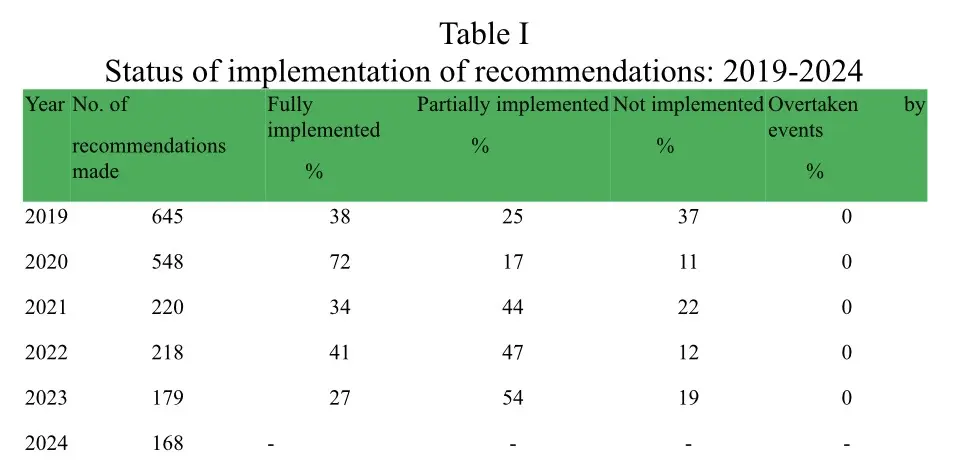
All of the above appear to have escaped the attention of the Auditor General in his recent reports when both he and the President spoke glowingly of what they consider notable improvement in transparency, accountability, good governance and financial performance between the period 2020 and 2024 as well as improvement in the rate of implementation of prior year recommendations. In his 2024 report (his latest publicly available report), the Auditor General stated that there was as 27 percent rate of full implementation of the recommendations made in the previous year, which is very much considered unsatisfactory by any standard.
Table I shows the status of implementation of recommendations made by the Auditor General during the period 2019 to 2024.
This is what he said in his reports for the years 2018, 2019, 2020 and 2021:
Overall, I am concerned with the lack of action towards the implementation of these recommendations; since, 62% of the recommendations have not yet been fully implemented. In addition, in many instances, recommendations are repeated each year without appropriate action and as a result, weaknesses and issues that impacted negatively on Government’s governance and accountability mechanisms continue to occur.
No such comment could, however, be found in the Auditor General’s report for the years 2022, 2023 and 2024!








Discussion