
It was January 2025 and the forecast was for snow. I received a call from Japneet Singh. He was a candidate for the District 28 seat, in the New York City Council. I knew the politics. I was a candidate for the same seat in 2005 and it did not go well. It was a contentious, fractious, and divisive affair. I also made some poor choices that saw me as a big-time loser. District 28 has gone to an Afro-American candidate for three reasons. He or she will get the endorsement from the party machinery. The second reason is that one of the biggest voting blocs, Indo-Caribbeans, stay away from the polls. The third is that the community seemed unwilling or unable to field talented candidates.
Indo-Caribbeans are a special breed. They will sing, chant, and walk miles to meet an elected official to ask for fair and free elections in Guyana. They will instigate, advocate, and enunciate, but will turn a blind eye when it comes to voting in New York. There are at least 20,000 Indo-Caribbean registered voters in New York. The numbers can determine the outcome of local and congressional races. But apathy and the obsession with politics ‘back home’ have led to a lack of interest, and have resulted in minimal voter participation in New York politics. Politicians know that Indo-Caribbeans are disorganized and do not take them seriously.
Japneet is different. He is from the Punjabi community. They are serious about elections and vote as a bloc. They may not have the numerical strength of Indo-Caribbeans but they use their vote wisely and strategically. For example, their vote was able to ensure the victory of an Assemblywoman for District 38, in Queens. The Assemblywoman lost in 2026 when the Punjabi vote went to her rival. The Punjabi vote went almost in its entirety to former Councilwoman Adrienne Adams, who went on to become Speaker of the New York City Council. The community in return benefitted from name recognition when streets were named in Richmond Hill as Punjab Avenue, Gurudwara Way, and Guru Tegh Bahadur Ji Marg Way.
In January 2025, the Immigration and Customs Enforcement (ICE) were running rampant in certain states, notably New York and in New Jersey. Applicants for legal residence were in a limbo. A person would be requested by letter to attend the Federal Plaza in New York for an interview to discuss the status of his or her immigration application. At the conclusion of the interview, that person would be arrested by ICE agents, and would spend days living in sub-human conditions before being deported. But what if the person decided to skip the interview? The application would be stamped ‘DEPORTED’ and ICE agents would be deployed to find the person. What this has shown is that there was no way one could regularize one’s status following the rules.
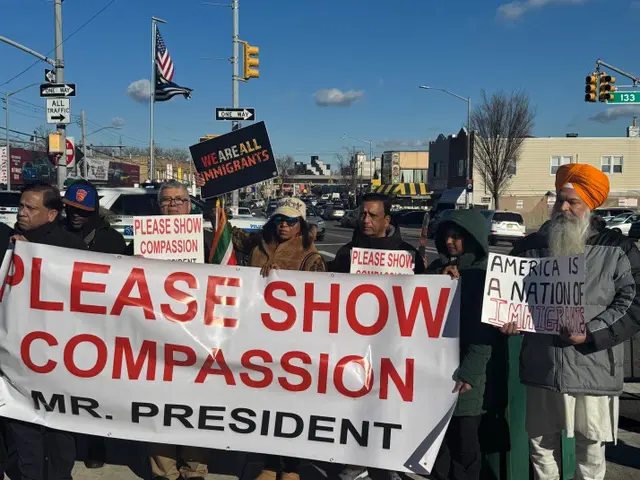
I suggested to Japneet that we should hold a rally in Richmond Hill to bring attention to the treatment of immigrants. The rally was held on a cold and wintry day with a bullhorn as a microphone. The community from diverse backgrounds came out, including CBS Channel 2 News. It turned out that this was the first rally of its kind and it called on President Donald Trump to show compassion for immigrants. The nationwide television coverage acted as a springboard for activism in other places. There were similar rallies in other states. But alas, the compassion was lacking. The enforcement by ICE continued unabated. In the month of January 2026, eight persons died at the hands of ICE, with the high-profile cases being Alex Pretti and Rene Good in Minnesota. In addition, there were shootings by ICE officers that led to injuries and physical attacks on people, and children were also arrested.
Tom Homan, the immigration czar, would appear regularly on television to justify the actions of ICE, while his boss Stephen Miller drove an immigration policy that was seen as heartless. It was agreed at the rally that the drug dealers and criminals had no right to stay in the United States. But compassion should be shown to a special category: those who entered the country illegally but have broken no other laws in the past twenty-five years and have contributed in an honest way to their communities. The Trump administration’s answer to this was to lump that category as ‘illegals’ and to deport as many as possible to meet quotas. This created fear, especially in the Latino communities.
In the 2024 elections, Trump secured 48 percent of the Latino vote which was an increase of 16 percent from 2020. According to Poll Tracker, “That surge, particularly pronounced among Latinos living along Texas-Mexico border region, was one of several factors that helped him regain control of the White House.” How did Trump fare among Latinos in the 2026 mid-terms? He felt their fury. Trump made Latinos the target of ICE operations, according to a number of observations.
Latinos expected people with criminal records to be deported. But workers and family members with minor infractions were picked up, imprisoned and deported. This caused outrage among Latinos who saw ICE as attacking their communities. The fall for the Republicans was dizzy and seismic. Latinos turned out in record numbers and voted for the Democrats. The vote propelled victories in both the House of Representatives and the Senate with a 28-point shift in favour of the Democrats. There will be new Latino political honchos in Texas, Georgia, Arizona, and Nevada. They are careful to point out that the Democrats are on probation and their votes should not be taken for granted.
Then there were issues of affordability, the Iran war, and tariffs, a trifecta of discontent. Bringing down the cost of living was one of the campaign promises of Trump. He promised that he would lower the price of food on his first day in office. This did not happen. According to the Bureau of Labor Statistics, food prices rose to about 2.6 percent over twelve-months that ended in November 2025. Despite the promises, inflation rose from 2.3 percent to 2.9 percent. Trump claimed in September 2025 that, “We have no inflation. Prices are down on just about everything.”
But that was not the case. In fact, due to the tariffs, the increased costs of imported goods were passed to consumers. By August 2025, grocery prices increased by 0.6 percent which was “the largest leap in three years.” The increases were felt across the board. Clothing and audiovisual products rose by 0.5 percent while car parts went up by 0.6 percent, and, “coffee cost 20 percent more than it did more than a year ago.” The checkout prices for food, drugstore products, and dollar stores also rose. Clearly, Trump’s policies were not working.
Tony Singh, his pastor Khemraj Singh, and others, run a Community Pantry in Ozone Park, in Queens, New York. The pantry has served the community for more than thirty years. On any given weekend, there would be about four hundred persons. But for the past year, this number has doubled. According to one volunteer, “we are running high numbers every week. The lines are long and extend into several blocks. We give food to more than 800 persons on some days. Our resources are strained but we make sure that everyone leaves with some food. People are hurting.” A random check on some of the other pantries in the area reveal the same story. Then there is the 30 percent cut in the Supplemental Nutrition Assistance Program or SNAP. It is estimated that around 40 million Americans use SNAP annually. The cuts to this program have increased poverty. The cuts are expected to be around $187 billion through 2034. The result to date is that many families cannot afford basic foodstuff. Children have been particularly at risk. According to the Center on Poverty and Social Policy at Columbia University, “every $1 in SNAP cuts to families with children costs society $14 to $20.” Inflation, tariffs, and the US-Iran War have hit ordinary people hard.
The Institute for Policy Studies estimates that by the end of June 2026, the cost of the war was $103 billion with $ 2.9 billion going to Israel as military aid.
There are a number of critics who argue that these excessive sums could have been better spent elsewhere. For instance, the $103 billion could have, “paid for a year of Medicaid health care for more than 12 million people.” Medicaid and Medicare have struck discordant chords in low-income groups. People complain that they have worked hard and paid up their contributions, but only to be told that that couldn’t qualify for Medicaid because their income was too high. “This is outrageous,” says one patient in the Rehabilitation Center at Jamaica Hospital, in New York. “You work all your life and contribute to Medicaid and when you need it most, they tell you that Medicaid is for people who have nothing, who have no jobs, and have no contributions in the system. Something doesn’t seem right,” she added.
Medicare, on the other hand, can cover the expenses for patient care, but it runs out after about six weeks, at the end of which the patient will have to fork out over $500 a day for treatment and therapy. There is an appeal process, but the chances of a reversal of policy is minimal. Apart from health, it is argued that six million children could benefit from Head Start programs and forty-five million people from SNAP food assistance. The drain on the American taxpayer will not stop even if there is a ceasefire in the war. In the April 2026 ceasefire, it cost $60 million a week to service the Navy destroyers. President Trump and the Pentagon plan to ask for a mind-boggling $1.5 trillion war and weapons budget for 2027 which will be an increase of $610 billion, if approved.
One of the big questions in the run up to the mid-term elections was: how is the war affecting the family budget? Higher fuel costs mean that by the end of 2026 each household will pay around $978 more for food. Farmers were forced to plant crops without fertilizer when the Strait of Hormuz was closed for weeks. The higher cost of production was passed on to the consumer. It is no wonder that affordability, and the war, became a main campaign issue that has been acknowledged by Vice-President, JD Vance.
Scott Colom’s historic Senate win in Mississippi was the first for a Democrat in more than forty years. Colom made affordability and rising food prices the heart of his campaign, and it worked. The mid-terms were a wake-up call for the Republicans who seemed out of touch with the realities facing ordinary people. The Democrats, on the other hand, must use their majorities to bring relief to those that are struggling. Trumpism has lost its shine and glitter and the MAGA movement has been fractured. At a time of soul-searching, a nifty move for Trump would be to excel in foreign policy. Trump’s legacy could be repaired if belligerence gives way to lasting peace, dictators embrace democracy, and there is affordability at home. Spare a thought for Vice-President JD Vance. He hitched his wagon to Trump and the wheels are creaking.







Discussion