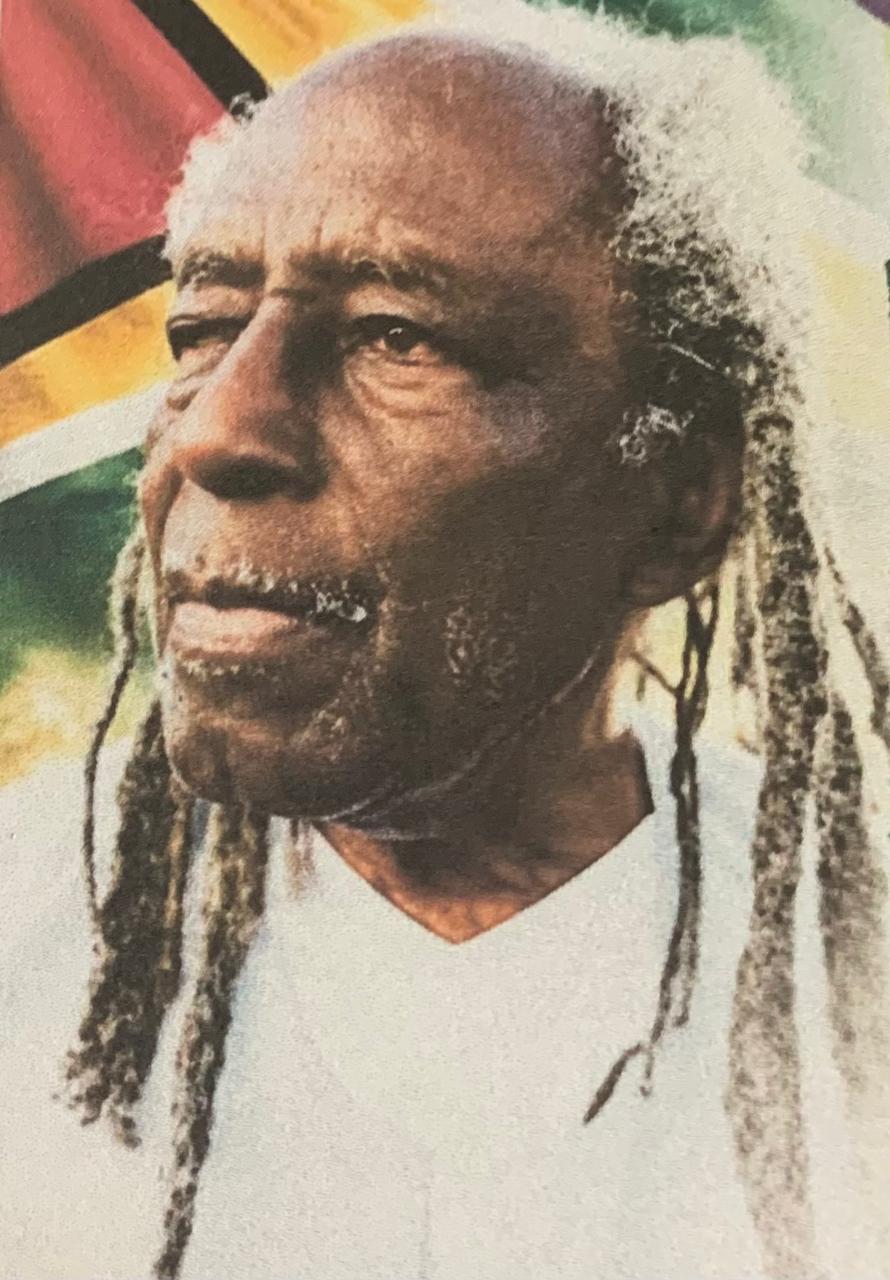
No one adjective could have described the late ‘Sage of Buxton’ Eusi Kwayana as an appreciative generation of comparatively young academics, professionals and activists paid heartfelt tribute to the elder statesman, educator and the last of a generation of politicians who founded the People’s Progressive Party with a vision to unite a fractured people in colonial and post colonial Guyana.
Kwayana, named Sydney Evanston King at birth, was born in Lusignan and his family moved to Buxton in 1932 where he lived for most of his life. He died on the 10th of October at 101 years.
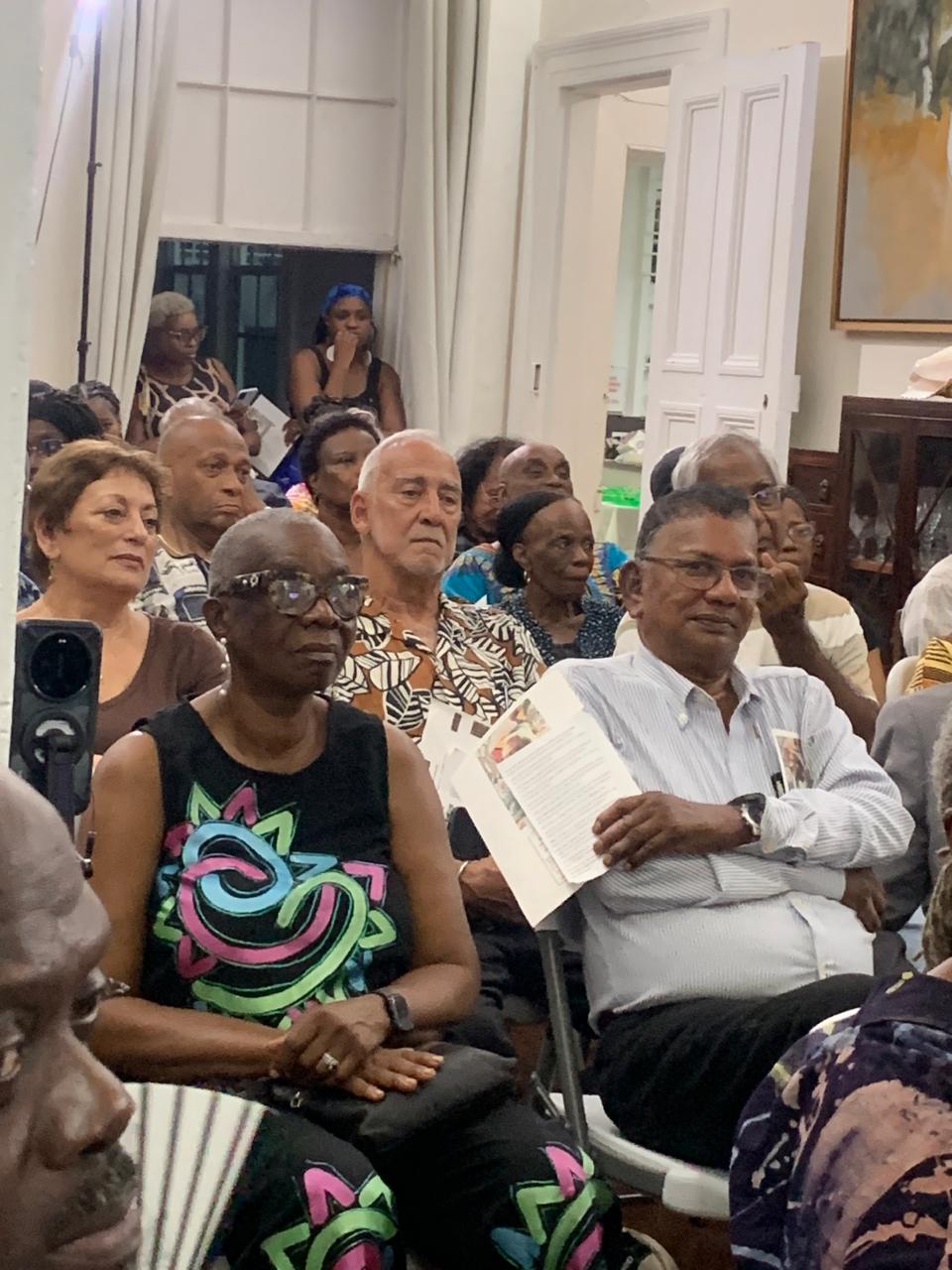
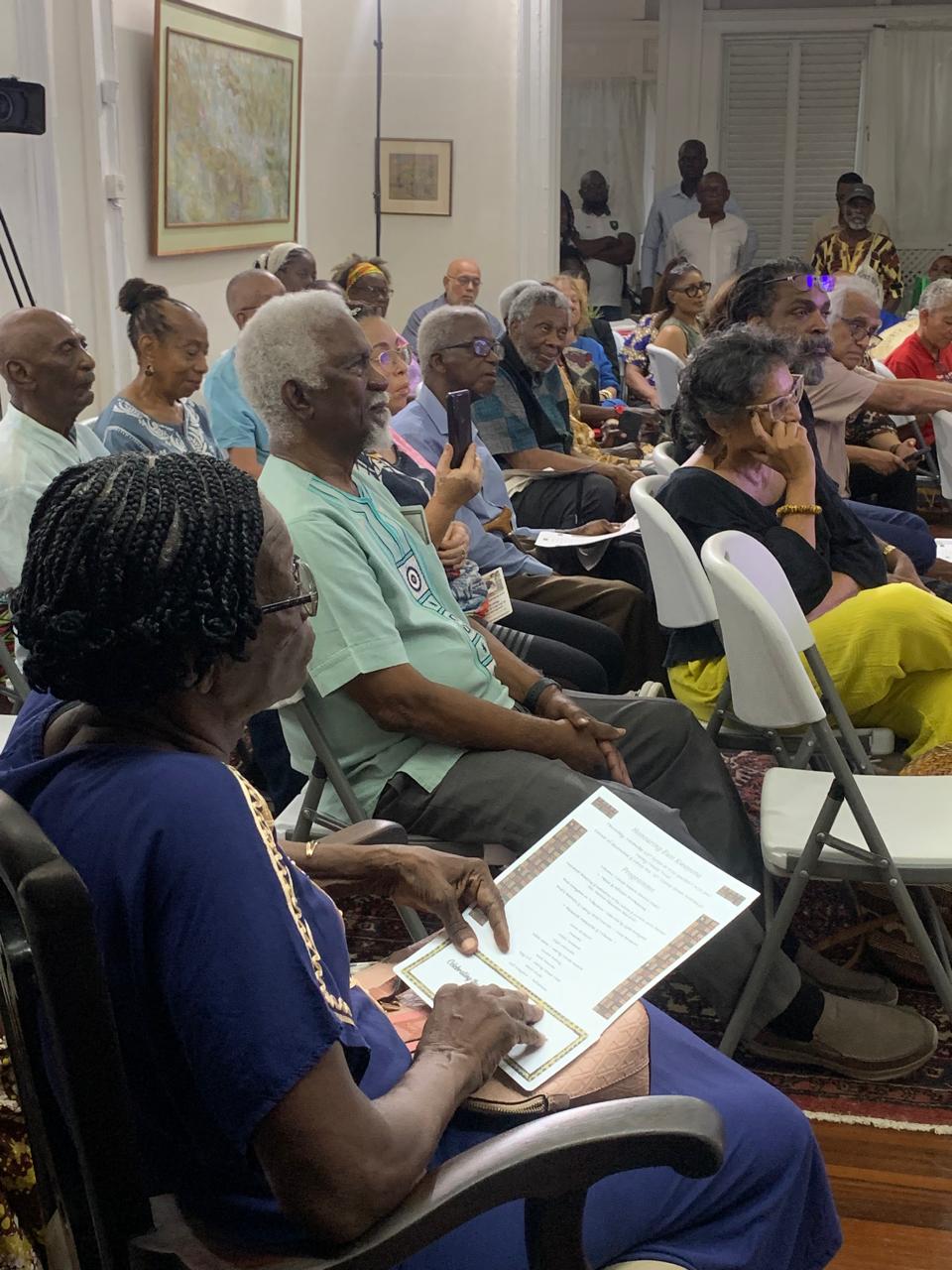
Among those paying tribute in person and via Zoom at Moray House, South Cummingsburg, Georgetown last evening was his comrade and friend Moses Bhagwan who joined the leadership of the Working People Alliance (WPA) in the days of Walter Rodney and Rupert Roopnarine.
The atmosphere was filled with political history as stories were told against a background of rolls of Tassa and African drumming.
Bhagwan described Kwayana as a man of philosophy with a capacity for self criticism, a scholar, headmaster, teacher, revolutionary activist and a Caribbean man of letters who was a poet, playwright and composer.
Due to his political activism, Bhagwan said that Kwayana’s fight for justice, dignity, freedom and unity is now rooted in Guyana’s political history.
He noted that Kwayana enjoyed a relationship with many young people in a global community that was marked by marked by mutual respect and intellectual curiosity.
Bhagwan said the symbolic gesture of Kwayana linking his hands with those of Roopnarine and Rodney, then co leaders of the WPA, at a public meeting in 1980 and lifting them in the air was the bringing together of “a new breed in a long struggle for unity.”
Describing him as an outspoken liberationist, Bhagwan said, Kwayana in his gentle tone for which he was well known, “democratized political education on the ground.”
In 1954 after Dr Cheddi Jagan and Forbes Burnham went their separate ways, he said Kwayana, the peacemaker, advised them “to federate” the two factions of the then PPP to bring unity to the country. This was misinterpreted to mean partitioning the country by some. “That submerged a promising idea in an ocean of controversy.” Today, the shared governance some are calling for is the same federating Kwayana spoke about, he said.
In his reflections, Kwayana’s son, Kofi said he was overwhelmed by the many heroes of Guyana’s revolution who were in the audience at the tributes’ ceremony. Among those present were former President, Donald Ramotar, former minister of foreign affairs Clement Rohee and ret’d Major General Joe Singh. Also present were Kwayana’s daughter Iyabo and his grandchildren.
Iyabo featured a video clip of her father as he gave meaning to liberation and freedom in poetry and prose.
While he was reflecting on his father’s life, Kofi said he wondered what happened to children of revolutionaries.
He also wondered about how people like his father absorbed shock after shock, some from the 1950s, the 1960’s, the 1970s, the 1980s and are still absorbing them. “I ask myself when was time taken to heal?”
As his father’s son, he thinks of continuity and if he is successful in meeting his father’s standards. “You’re only successful when your successors are successful,” he said not sure of the source of the quote.
Overwhelmed at the loss of his father, he said that people who were inspired by Kwayana will continue to stand up to create a new world that people want.
Recalling when his father started “to transition, and some will say he was hallucinating,” Kofi said he was not surprised because of his father’s focus on children and the necessity of feeding them throughout his life.
One of the most heartfelt feelings he said comes from past students of the County High School which his father founded in 1956. Some might speak of his father’s generosity or his economic insanity as no one could say they were cut short of an education because they had no money.
His father, he said, “was kind, compassionate and fearless; hardcore as we say in my generation.”
Paying tribute in person were activists Karen De Souza, Omawale, Donald Rodney and David Hinds. De Souza who saw Kwayana as a mentor who did not need to raise his voice to correct anyone recalled some lighter moments driving Kwayana to Buxton after meetings and having a car that was built for four accommodating many more. She read a poem that Dr Rupert Roopnaraine had written in honour of Kwayana before his own demise.
Also describing him as a remarkable teacher and a mentor, Omawale said he met Kwayana after he was protesting racism in Toronto, Canada. Kwayana asked to meet with him and subsequently to join ASCRIA (African Society for Cultural Relations with Independent Africa). He was 28 when he joined and called an elder.
Rodney first met him when he was a student at Queen’s College at the then milk plant in Kingston and later after his brother Walter was assassinated. Kwayana became many things to Donald including advisor in seeking justice for his brother and to clear his own name after he was blamed for killing his brother in an explosion.
He took political asylum in the United Kingdom after he was dismissed from his job in Guyana. He said he was inspired to return after the elections of 1985 were rigged and in which the WPA was apportioned one seat in the Parliament. Kwayana took up the one seat.
Paying tribute via Zoom were Wazir Mohamed, Nigel Westmaas, Keith Carter, Ray Kril and Rishee Parasram all of whom enjoyed close relations with Kwayana either through working relations or through the elders in the family as in Keith Carter, the son of Martin Carter. Carter was incarcerated along with Dr Cheddi Jagan and Kwayana by the colonial government for their political activism in the 1950.
Mohamed bemoaned the fact that an elderly statesman of Kwayana’s stature who had a good eye to spot injustice and stood against evil, was deserving of a state funeral which he was not afforded.
Parasram originally from Annandale, East Coast Demerara said he was Kwayana’s neighbour in the villages that share contiguous borders. They could have seen each other’s homes where they lived. He regarded Kwayana as a brother, confidante and an inspiration.
Noting that Kwayana was very meticulous about his food and grew greens and vegetables organically, Parasram said he was inspired to adopt some aspects of Kwayana’s practices.
Noting also that Kwayana was a voice of unity and fairness, he said that especially those aspiring to political office, should take a leaf out of his book.
In his tribute read by Alissa Trotz, Ray Kril spoke of meeting Kwayana through filming. He has featured Kwayana in the documentary ‘The Terror and the Time’ that could be found on YouTube.
David Hinds in his tribute said it should be noted that the ‘Cooperative’ in the name ‘The Cooperative Republic of Guyana’ was suggested by Kwayana. He said when Burnham told Kwayana that Guyana was to become a Republic, Kwayana jokingly said, a banana republic. Nevertheless, he suggested to Burnham, the Cooperative Republic. Kwayana next heard Burnham announcing to the nation that Guyana was to become The Cooperative Republic of Guyana.
As the WPA and the people celebrate the life of Kwayana, a walkabout and wake will be held in Buxton today Friday, 13th of November starting at 4.00 pm at Lot 50 Middle Walk. This will be followed by a wake at Cockfield Residence, 196 Friendship Middle Walk North.
A procession and funeral service will be held on Saturday 14th of November starting at 10.00 am at the northwestern corner of Lusignan Main and the Public Road to Buxton Ball Gound.
At noon, there will be a public viewing, funeral service followed by the burial.
A Congosaw, repast and cultural performances will be held from noon to 5.00 pm on the 15th of November at the Ball Ground.








Discussion