By Dhanpaul Narine
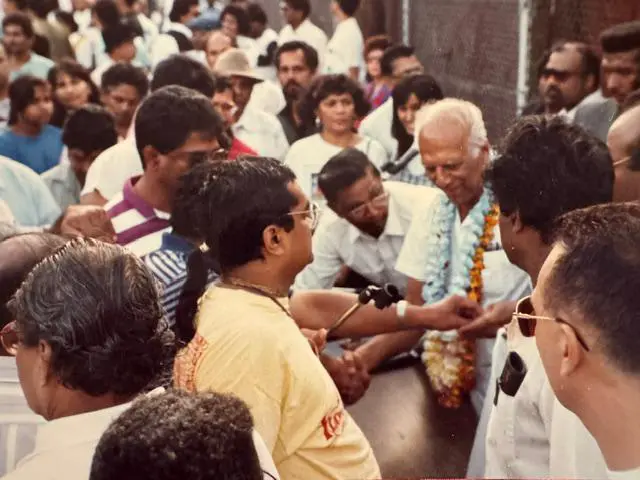
Guyanese are everywhere. From Roraima’s peaks of power to Alaska’s foreshore, you’ll find Guyanese striving for more! In September 2026, Ministers went to the podium, extolled the progress of the Guyana government, and invited the diaspora to return and serve their country. The event was arranged for President Irfaan Ali to meet and greet Guyanese in New York. The line was long and covered several blocks. It soon became clear that the hall in Jericho Turnpike was too small to accommodate the crowd. The President, to his credit, took extra time to meet with the hundreds who couldn’t get into the building.
The political spinners were in full force. The opposition saw the big crowd as a wave of protest against the government. The supporters remarked that people came out to meet with President Ali out of love for Guyana, and to show support for the policies of the government. Inside the hall, it was clear that this was a crowd that was in full throttle for the government. A dedicated disruptor, who was loud and vexatious, ended up in the arms of the President! Dr. Cheddi Jagan used to remind us that politics is an art and a science. You keep the disruptors close.
There is nothing more to excite the Guyanese palate abroad than the magical words, “Come back home and serve.” These words are poetry to the ears. They conjure up images of a country of green pastures with boyhood and girlhood memories, when things were calm and genteel. They tempt those in the basements and rickety upper tenements to dream of the big bungalows, with oversized rooms, and verandahs with cool breezes. They form remembrances in Liberty Avenue, and Church Avenue, of the personalities and places that help to shape the dream of belonging. And if one happens to run into money, then Guyana becomes the ideal destination to break up the biting cold.
On the evening of the President’s visit, people hardened by New York’s round-the-clock routine, wanted to hear about the flowering of Guyana and its possibilities. Foreign Minister, Hugh Todd, took to the podium. It was a robust presentation on the importance of the diaspora in Guyana’s development. The audience was told that national planning is done with the diaspora in mind and that Guyanese abroad should continue to feel connected to the motherland. “You are directly connected to Guyana; you are included in Guyana’s development,” Minister Todd said. He added that Jamaica has, “done it very well using its diaspora. We want to do it too, to harness the skills.”
Diaspora engagement was also reinforced by the other speakers. Minister of Education, Sonia Parag said that, “Guyana awaits you. There are opportunities upon opportunities, all over the place.” Minister Vickram Bharat reminded all, “that Guyana is one of the fastest growing economies in the world, but one of the biggest problems is the labour shortage and the traffic situation.” He wanted to see a partnership between the diaspora and the government to help resolve some of the problems. Minister of Health, Dr. Frank Anthony, spoke about the transformation in health, including the expansion of health centres and hospitals. He invited those in the diaspora who are interested in the health sector to return and work in Guyana. Finance Minister, Dr. Ashni Singh, stated that the Guyanese diaspora, “has continued to show love for Guyana. We have a huge diaspora in New York City, so much so, that a decision was made to designate a specific part of New York as Little Guyana.”
It came time for President Ali to speak, to address the party faithful, and the detractors. Some had traveled from Canada and Florida, and other states, for the meeting. The President looked relaxed and dapper, fresh from the rostrum of the United Nations. He said that the love for the diaspora, ‘motivates us to work harder.’ He stated that the current transformation would see Guyana as a nation of love, unity, pride, and hope. He affirmed that all barriers would be pulled down to give unity a chance, and he outlined some statistics. In the last five years, there were more than 160,000 new jobs and more 50,000 housing units, more than 5,000 kilometers of new roads, and more than 100 new schools. “We will not bow to the lies of the social media critics,” he said. He added that the government did not take the last election victory for granted. It will work harder to win over the opposition forces.
President Ali remarked that Guyana is attracting a number of investments because the economy is well managed. “The reality is that Guyana is moving forward,” he said. Recently, a Guyanese bank was in Liberty Avenue in New York, to open accounts in Guyana, and the lines were long and winding. President Ali acknowledged that there was more to be done in electricity, and other areas. “Guyana is where the future lies,” he said. He addressed the M.V. Barima tragedy. It was one of the greatest tragedies in the country and he explained that there was nothing to hide. There will be a Commission of Enquiry, and there will be a salvaging. It was recently announced that BK Enterprises was awarded the contract to salvage the vessel.
Many persons in the diaspora are applying for pensions and cash grants in Guyana. This does not include the re-migrants, the President said. He welcomed the fact that the government is being held accountable. President Ali, and others, will do well to know that diaspora engagement in earnest started with Dr. Cheddi Jagan, and his support groups in New York. It was 1987, and there were calls for free and fair elections in Guyana. Arjune Karshan was a leading member of the Association of Concerned Guyanese (ACG). He knew the New York streets well, and with Abdool Samad, James Morgan, and others, the Guyanese neighbourhoods were blitzed with pamphlets, flyers and tracts calling for free and fair elections. The group also met with officials in the US Congress, and other politicians, to reinforce the call for a democratic Guyana. Another group, the Jaguar Committee for Democracy, was also prominent at the time in working for democracy.
In 1988, Guyana and its diaspora were distant and disconnected. It was unusual to hear live reports from Guyana to bring people up to date with the latest news there. The lone plane, Guyana Airways, broke down frequently and ran on a haphazard schedule. Dr. Jagan needed to get his message to the public. But his visa was taken away by the US authorities and he was practically a voice in the wilderness. The support of overseas groups to agitate and plea the case for democracy became paramount. Incidentally, Mr. Forbes Burnham was among those who called on the US to take away Dr. Jagan’s visa. Such was the politics of the day.
A lifeline was thrown to Dr. Jagan when he was invited to be the keynote speaker at the East Indian Diaspora conference in 1988. It was to mark the 150th anniversary of East Indian migration to Guyana. This brought out the rank and file in New York to meet, and interact with Dr. Jagan, for which he was grateful. He made the point that class was more fundamental than race and urged the diaspora to keep up the fight for democracy in Guyana.
Dr. Jagan visited New York in 1991 and attended a meeting in Lefferts Boulevard where he was given a lukewarm reception. It was clear that many in the audience did not think that he, and the People’s Progressive Party (PPP), would be returned to power. It was the time when many of the communist regimes were falling in Europe. Dr. Jagan proclaimed that he was ‘Gorbachev before Gorbachev.’ Some attendees at the meeting called on him to distance himself from socialism and to adopt the capitalist, American style of development.
Dr. Jagan visited the New York diaspora in early 1992. This time it was to introduce his running mate, Sam Hinds, to the public. Mr. Hinds, from the Civic wing of the party, was supposed to create an ethnic balance and to make inroads into the Afro-Guyanese vote. The PPP won the October 1992 elections. President Cheddi Jagan called for “no recriminations.” He repeated what he had said in 1947 that, “We the people have won.” Dr. Jagan said something else, “I hope to develop a constructive relationship with Mr. Desmond Hoyte and the leadership of all parties in order to deepen our democratic process and accelerate our economic development.” This begs the question: Is there a constructive relationship between President Irfaan Ali and Opposition Leader Mr. Azruddin Mohamed, and the leadership of all parties, to accelerate economic development? In December 1992, Dr. Jagan was again in New York. He spoke at York College and reinforced the importance of the diaspora. He said that, “without the help of overseas Guyanese, and others, Guyana would not have returned to a democracy.”
During his presidency, Dr. Jagan traveled frequently to the diaspora and engaged Guyanese. His charming simplicity won over many critics. Dr. Jagan understood the diaspora, its strengths, and possibilities. Regrettably, a number of his successors see the diaspora as a money tree to fight elections, while mouthing the platitudes about how much the diaspora is valued. Dr. Jagan, even in 1992, was in the storefronts in Queens and the shires of Brooklyn, winning friends and influencing people. He used his status as a senior statesman to call for a new international economic order but that call died with him. Dr. Jagan’s passing saw the rise of a new cadre that would win and lose elections in Guyana. The losses and setbacks would have disappointed him greatly as the PPP, under him, was a party that encouraged inclusion. It was only a matter of time before the support groups imploded and led to the formation of splinter organizations.
The battle for turf and political patronage among PPP support groups grew in intensity. Karshan was appointed as Guyana’s ambassador to Suriname and had little to do with the running of the ACG. There were reports that the ACG, New York Chapter, could not get along with the ACG, New Jersey Chapter. A power struggle in the ACG, New York Chapter, led to a split that resulted in the formation of the Guyana Solidarity Movement, and other minor groups. There were calls to Freedom House to intervene and bring an end to the squabbles but this did not happen.
According to one observer at Freedom House, “the more groups in New York, the better it is for the Party. They will compete with each other to see who can raise more funds and the Party will benefit.” There was another dimension to the in-fighting and competition. A number of groups in New York aligned themselves to a particular personality in Guyana and actively campaigned for that person to hold high office. For example, in the 2020 elections, one group openly supported Clement Rohee, while another went for Frank Anthony and a third for Ralph Ramkarran. The candidacy of Anil Nandlall was also mentioned. These groups took full page advertisements in newspapers with their candidates and their agendas. As it turned out, Irfaan Ali won the nod as the presidential candidate.
There are in essence two Guyanese diasporas in New York, one in Brooklyn, and the other in Queens, and they seldom meet. Dr. Jagan was able to move seamlessly in both, but his successors have found many challenges in Brooklyn. The Brooklyn diaspora appears to be better connected to the political mainstream in America. The two diasporas mirror the ethnic divide in Guyana. Queens is seen as primarily an enclave for PPP Indian support while Brooklyn supports the PNC with its Afro-Guyanese base. Certain members of the Brooklyn diaspora criticize the Guyana government relentlessly, with little rebuttal from the government. The various PPP/C administrations are still to master the art of messaging.







Discussion