A brief statement yesterday by the US Embassy on the border controversy with Venezuela has raised more concerns about Washington’s position as it floated the prospect that both parties could “consent” to a new boundary.
The embassy here had been attempting to quell a controversy that erupted in Georgetown yesterday after Reuters reported that a now former senior US State Department official had signalled possible deal-making with interim Venezuelan President Delcy Rodrigues that would have required Guyana ceding land.
Yesterday afternoon the embassy issued the following statement: “The policy on the land boundary between the two countries has not changed. The United States reaffirms its support for the 1899 Arbitral Award that determined the land boundary between Venezuela and Guyana, which should be respected unless or until a new boundary is set by a competent legal body or with the consent of both parties”.
It was the final qualification that was the major problem. Guyana has made it clear that there are no grounds on which there could be any consent between the two countries for a new boundary. Guyana’s position has been that the 1899 arbitral award is a full, final and perfect settlement of the boundary and that the matter is now before the International Court of Justice (ICJ) for a juridical decision on the validity of the award which is expected sometime next year.
Even the embassy’s mention of a “competent legal body” is problematic. The only legal body which Guyana is relying on for a decision is the ICJ in line with a decision that had been taken by UN Secretary General Antonio Guterres. Washington’s failure to mention the ICJ in the statement will raise further questions.
Analysts believe that the Guyana Government should seek further clarification from Washington on the meaning of the embassy’s statement.
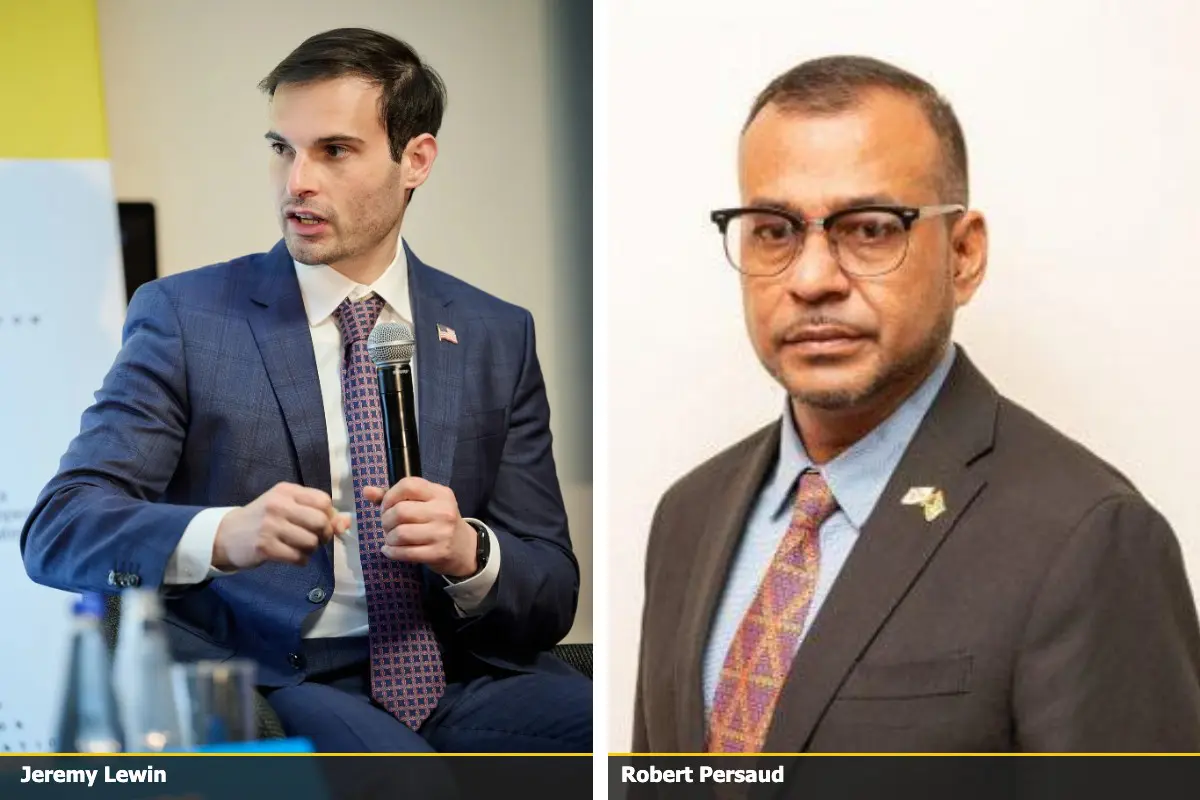
The furore blew up yesterday over Reuters’ disclosure that State Department policy chief Jeremy Lewin told Guyanese Foreign Secretary Robert Persaud during a September meeting in Washington that he could help broker territorial talks with acting Venezuelan President Rodriguez. This has not been denied by Georgetown and it was the first disclosure of the September meeting held by Persaud.
Analysts say the disclosure about Lewin’s attempted deal making with Rodriguez underlined the folly of the Guyana Government’s unrestrained embrace of Trump’s policies in the belief that the US would not stray from backing the 1899 arbitral award. Washington’s capture of Venezuelan President Nicolas Maduro in January this year eventually paved the way for massive deal with Rodriguez to access Venezuela’s oil.
On August 31st this year, the White House hailed it as the biggest oil deal in world history and said in part “President Donald J. Trump has secured U.S. majority control of more than 65 billion barrels of proven oil reserves in Venezuela – vastly expanding our current U.S. territorial proven reserves of roughly 46 billion barrels. This deal secures our energy dominance for the next century—all at zero cost to the United States. The deal, signed by Secretary of State Marco Rubio and Secretary of War Pete Hegseth, gives the U.S. government powerful governance rights, economic ownership, and guaranteed low-cost off-take from a new private Venezuelan oil champion, which will be the second-largest private oil company by reserves in the world”.
Analysts say it was possible that the border controversy between Guyana and Venezuela had come up as a bargaining chip in this deal leading to Lewin’s later foray into talks with Rodriguez and ultimately raising this matter in September with Persaud. Lewin left his post in October for the private sector amid controversy over his role in dismantling the USAID and other matters.
Letter
In a May 11 letter provided by Lewin to Reuters, Rodriguez sought support from Trump to help create conditions to allow a rapprochement with Guyana with the aim of addressing what she described as the “historic territorial controversy” regarding the Essequibo. She wrote that Caracas always advocated that this matter be addressed via talks.
Reuters said it was not able to independently confirm the authenticity of the letter, which Lewin provided to the news agency.
Lewin told Reuters that Rodriguez, after sending the letter, then “raised the issue with me and the White House asked me to conduct preliminary and confidential conversations with the Guyanese and Venezuelans to better dimension the issue for the Administration. I did so and reported back to (Secretary of State Marco Rubio) and White House.”
Lewin, an alumnus of Elon Musk’s Department of Government Efficiency, became the State Department’s director of policy planning in August, a position he held for about two months before leaving.
According to two people familiar with the matter, Lewin during his July conversation with Rodriguez in Caracas discussed the possibility of US companies doing business in the Essequibo.
In his September meeting with Guyanese officials, Reuters said that he noted that he had a very close relationship with Rodriguez, telling the meeting’s attendees that he could help arrange bilateral talks, said one of the people with knowledge of the encounter.
While sources differ on the exact wording used by Lewin during that meeting, Guyanese officials were concerned enough that they quickly sought clarifications from other State Department officials. In response, those officials assured Guyanese counterparts that the US position regarding the Essequibo had not changed, two of the people said.
Lewin did not provide additional details of his conversations, which he described as “confidential,” but said he was acting at the direction of the White House, and any suggestion otherwise was “entirely false”, Reuters said.
In Georgetown, questions were being raised as to who asked for a meeting in September that led to the discussion between Lewin and Persaud and what exactly had been the substantive agenda for the meeting. It is also not known what response Persaud gave to Lewin when the matter was raised.
Following the eruption of the controversy, the Ministry of Foreign Affairs issued a bare response yesterday which answered none of these questions. It said: During a September 2026 meeting between Guyanese and the United States State Department officials, the issue of the Guyana-Venezuela border controversy was raised.
“The focus was on the pending International Court of Justice (ICJ) ruling, and on reaffirming the United States support on the process. This has been reflected by public and private statements across the State Department and the United States Government.
“Guyana has received the assurance of the United States Government that nothing has changed since”.
Observers have pointed out that Lewin worked directly under US Secretary of State Marco Rubio and the question would naturally be asked if Lewin had had permission to raise this matter or he had acted solo.
Reuters said that in the September talks, Lewin “floated the possibility of Venezuela taking partial control of the Essequibo region, which comprises the western two thirds of Guyana”.
In an interview with Reuters, Lewin said he held “preliminary” talks with the Guyanese and Venezuelans regarding the territorial controversy. He said those talks came after Rodriguez wrote a letter to US President Donald Trump in May seeking US mediation to facilitate direct talks with Guyana on the status of the territory. Notably this letter preceded the massive oil agreement that was announced on August 31st.
Rodriguez also raised the issue directly with Lewin, he said, during a meeting in Caracas in July. The conversations were fully directed and authorized by the White House, Lewin stated, according to Reuters.
The Reuters report added: “The episode highlights the deepening ties between the Trump administration and the Rodriguez government, which, following a US operation to grab former president Nicolas Maduro earlier this year, has swung open the doors to greater US involvement in the country’s affairs”.
When asked by Reuters for comment, a State Department official said in an email that the department is “pitched different ideas and policy options from outside parties everyday,” but that its position on the Venezuela-Guyana boundary had not changed.
Reuters said that the White House referred questions to the State Department, without addressing whether it had directed any talks over the future of the Essequibo or whether it had received any letter from Rodriguez.
A person familiar with US dealings with Venezuela also said Lewin was tasked on the issue by the White House.
Reuters added that the Guyanese and Venezuelan governments did not respond to multiple requests for comment.
After the US captured Maduro in a January snatch-and-grab operation, relations between Washington and Caracas have vastly improved, Reuters said. On Wednesday, Pentagon chief Pete Hegseth met with Rodriguez in Caracas and signed an agreement to boost military cooperation between the nations. This is a matter that would also be of grave concern to Guyana given Caracas’ routine aggression along parts of this country’s border.
Yesterday, a key Florida Democrat waded into the Trump administration over the reported deal-making that was being considered.
U.S. representative for Florida’s 25th congressional district, Debbie Wasserman Schultz said in a post on X: “Guyana’s territory belongs to Guyana. Not Chevron, not Delcy, and definitely not Trump.
“This betrayal of a democratic ally on behalf of Venezuela’s dictatorship further proves that Trump’s priority is corrupt oil deals, at the expense of democracy and international law”.







Discussion