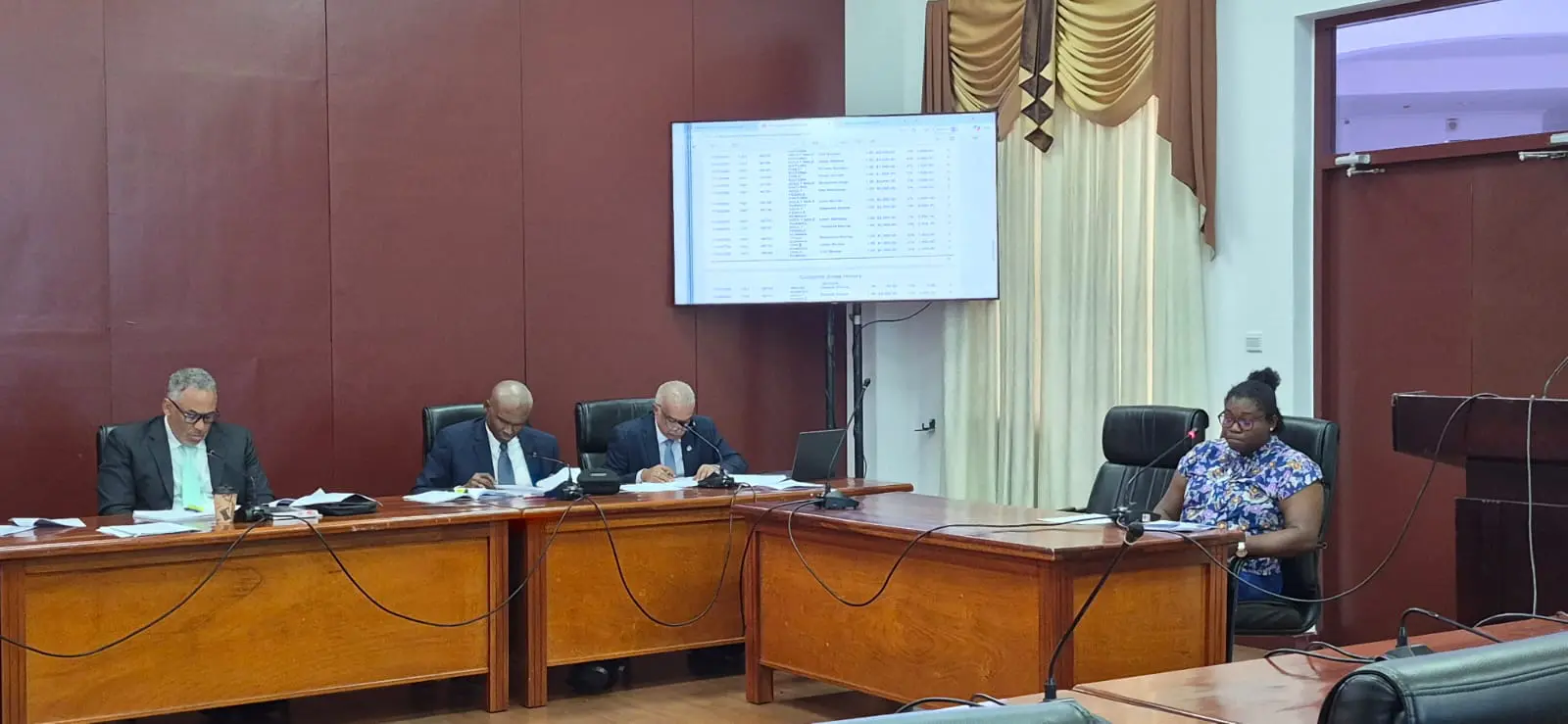
A review of CCTV footage showed that 213 gas cylinders were loaded on the MV Barima on July 18, more than twice the 101 recorded in the Transport and Harbours Department’s (TH&D) electronic cargo records, moving commissioners to ask how the additional cylinders passed through the department’s checks without being accounted for.
The discrepancy came up yesterday during the Commission of Inquiry into the sinking of the ferry on July 18 when Commissioner, Dr Andrzej Jasionowski questioned Goods Cashier Kenese Mc Lean about the records she maintained for the boat’s trip to Port Kaituma.
Jasionowski’s examination of the electronic cargo records showed 101 cylinders – 91 weighing 20 pounds, four weighing 40 pounds and six weighing 100 pounds, but he said his review of CCTV footage showed that 213 cylinders were loaded on the boat.
The commissioner referred to an invoice dated July 17, numbered 48624, which recorded 10 20-pound gas cylinders belonging to a customer identified as Mr Dhanraj, before asking Mc Lean how so many additional cylinders could have reached the boat without being entered into her system.
Mc Lean said she could not account for the discrepancy, explaining that she only recorded items for which customers presented slips to her for payment. “I only can account for the slips that come in because I do not load the vessel and the items that go on the vessel. I only can record what comes to me on that slip,” she said.
She identified Jamaica Andrews as the floor supervisor responsible for overseeing the loading of the vessel. Asked whether Andrews would have known how the additional cylinders reached the vessel, Mc Lean said the supervisor would have to know.
Jasionowski then sought to establish who would have collected payment for the additional cylinders if they had not been paid for in Georgetown, and Mc Lean explained that when goods reached Region One without appearing on the manifest, a person travelling with the vessel was expected to identify the items and collect payment, together with a 25 per cent penalty.
She said the checkers responsible for receiving and recording goods maintained separate records, including a gas book, which should contain the names of customers and the quantities of items brought for transportation. However, she said she did not handle those books and could not say where they were kept or whether they had been presented to the commission.
Jasionowski questioned why the additional cargo would not have been reflected in the electronic manifest, particularly since the checkers’ records were supposed to capture the items they received. Mc Lean maintained that she worked inside an enclosed office and could only enter goods for which she received slips. She said she would not know about items that were not brought to her for payment.
The commissioner also highlighted other discrepancies between the cargo records and his review of the CCTV footage, including an entry showing two bottles of oil when, according to his count, 10 had been loaded. He also referred to vehicles seen being loaded which were not reflected in the cashier’s records.
He questioned how such quantities of goods could have been transported without corresponding payments being recorded and whether Mc Lean knew that more cargo had been loaded than she had accounted for. But she said she was unaware of any additional goods because she was not present at the loading area.
Chairman Godfrey Phillip Smith interjected asking Mc Lean if to her knowledge it was possible for a checker to record a smaller quantity on a slip than the quantity actually allowed onto the boat. But Mc Lean said she could not say whether that was possible. She explained that customers were present when checkers recorded their goods and were expected to verify the quantities being documented.
Asked where the breakdown in the system could have occurred, she suggested it could have been due to negligence by colleagues responsible for checking the goods, but said she could not identify precisely where the system had failed.
Commissioner Rear Admiral (Ret’d) Hayden Pritchard sought to understand how the department’s checks and balances were supposed to account for cargo that was loaded but had not been processed through the cashier’s system.
Mc Lean explained that checkers maintained separate records of the goods they received and that these were supposed to be compared with the cashier’s electronic records. Where items were found to have been loaded without payment, a “to-pay list” would be prepared and sent to the purser travelling with the vessel so that the outstanding charges could be collected at the destination.
Pritchard suggested that combining the checkers’ records with the cashier’s records should provide a comprehensive account of the goods transported aboard the vessel. Mc Lean agreed that the two sets of records were supposed to correspond. However, when he pressed her on why the reconciliation process had not identified the additional cylinders, Mc Lean acknowledged that she and the checkers had not sat down to compare their records after the particular voyage. “Honestly speaking, that trip we did not sit down together, because it was a Saturday,” she said.
She explained that the staff were tired after work and that the reconciliation could be undertaken later, possibly on the Monday, when the department resumed its regular operations.
Pritchard questioned how the additional cylinders could have been distributed at the destination if the records had not been reconciled, and Mc Lean said the checkers would still have their own records of the goods and would be expected to identify items that had not been paid for.
The commissioner reminded her that she had explained that the checkers’ records were intended to capture goods that did not pass through her system and that the two sets of records should subsequently be reconciled to identify outstanding payments.
Mc Lean agreed that the reconciliation was supposed to take place but reiterated that she had not conducted the exercise with the checkers following the Saturday voyage.
Earlier in his questioning, Jasionowski established that no cargo entry could be made in Mc Lean’s electronic system without a slip being presented to her. She said she had previously compared her records with the checkers’ slips and had sometimes found discrepancies, including instances where customers had not paid for certain items or where an item was inadvertently omitted during the cashing process.
She further explained that, during busy periods, a cashier could accidentally leave an item off a transaction but that such errors could be identified during subsequent checks and brought to the attention of colleagues so payment could be collected. Mc Lean said the slips she processed were normally submitted to the department’s audit section.
The commissioners also questioned how the department arrived at a figure of 268 tonnes of cargo for the Barima’s July 18 voyage, given that the electronic system did not consistently record the weight of individual items.
Mc Lean confirmed that she had assisted another employee, Ms Hughes, in compiling the figure. She said that the department’s tonnage calculations were based on accumulated revenue from goods and other services rather than the actual weighing of every item loaded aboard the vessel.
She said the calculations were done manually using spreadsheets, with records kept electronically and in hard copy.
Jasionowski requested the spreadsheet used to arrive at the 268-tonne figure, along with historical records showing the revenue generated from cargo transportation over the previous five years, and Mc Lean agreed to assist in retrieving the documents.
She estimated that cargo fees could generate between $800,000 and $1 million per voyage, although she said the amount varied depending on the quantity of goods transported.
Mc Lean also explained that goods began arriving at the wharf for the July 18 voyage from around July 13, while the first invoices in her records were dated July 14. She said checkers issued slips when goods arrived, which customers subsequently presented to her for payment.
During questioning by Commissioner Nyree Dawn Alphonso, Mc Lean confirmed that charges were not based on the actual weight of goods but on classifications and prices already programmed into the POS system. A 20-pound gas cylinder attracted a charge of $250, a 40-pound cylinder $500 and a 100-pound cylinder $1,000.
Alphonso requested a printable list of the prices programmed into the system, but Mc Lean said this would likely have to be generated by the person responsible for programming the software or the department’s IT personnel.
The commissioner also established that passengers were excluded from the department’s tonnage calculations, which were based on goods, miscellaneous items and freight.
The inquiry further heard that the electronic passenger manifest contained 100 names, while another list being reconciled contained 116. Jasionowski noted that the commission had established that at least 160 people boarded the vessel.
Mc Lean said she could not explain the missing names because she was not present when her colleague prepared the passenger manifest. She acknowledged that the manifest was supposed to reflect all persons travelling aboard the vessel.
Pritchard subsequently asked whether the electronic passenger list was routinely checked against the department’s handwritten passenger logbook after a vessel departed. Mc Lean responded that the records should correspond but said nobody routinely carried out that reconciliation.
She is to return today with the documents requested by the commissioners and possibly, for further questioning.












Discussion