-as gov’t insists spending remains subject to parliamentary approval
The National Assembly passed the Former Presidents’ Benefits and Other Facilities Bill 2026 shortly after midnight today following another almost five hours of fiery debate, with opposition members demanding financial safeguards and government speakers insisting that parliamentary control of expenditure would prevent unlimited spending.
The division, taken at about 12.00 am, recorded 35 votes in favour and 22 against. Eight speakers contributed during the resumed debate, which followed last Wednesday’s lengthy sitting. The government has 36 seats and the opposition 29.
The bill repeals the 2015 legislation and restores the framework contained in the 2009 law. The central disagreement was whether removing express financial ceilings would expose taxpayers to excessive costs, or whether the scope of the benefits and the parliamentary budget process provided sufficient controls.
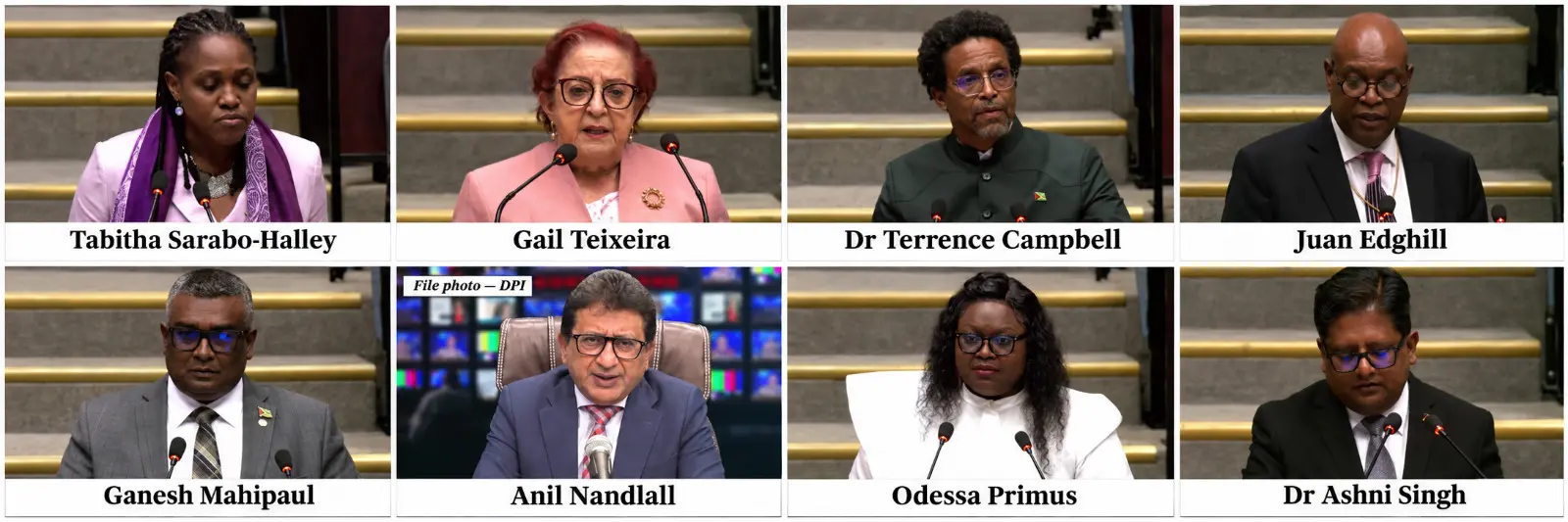
“The dignity does not require the absence of accountability,” WIN MP Tabitha Sarabo-Halley argued, rejecting the suggestion that questioning the proposed expenditure amounted to disrespect for former presidents.
Closing the debate, Finance Minister Dr Ashni Singh maintained that former presidents could not simply demand vehicles, staff and other facilities and automatically receive them.
“Not a penny is drawn from the Consolidated Fund unless it is appropriated by this House,” he said.
Singh argued that expenditure would require advance budgetary approval and remain subject to subsequent scrutiny by the Auditor General and Public Accounts Committee, which is chaired by an opposition member.
“The concept of a president deciding they want 10 cars and 100 staff simply does not exist,” he submitted.
He said estimates for the Office of the President, including supplementary provisions, could be questioned in the National Assembly. The absence of monetary ceilings in the benefits legislation did not, he maintained, remove those requirements.
“Those cars are not going to drop from the sky,” Singh said. “They’re going to have to be appropriated through the budgetary process.”
Singh described the bill as restoring arrangements that had already existed, rather than creating a new package. He rejected opposition projections of potentially enormous expenditure as exaggerations intended to generate controversy.
Did not answer
Opposition speakers, however, argued that parliamentary approval of expenditure did not answer their demand for express limits, clearer eligibility provisions and safeguards governing the use of publicly funded resources.
Sarabo-Halley questioned the government’s repeated references to former president David Granger and his wife, saying these did not explain the removal of the 2015 restrictions.
“Their names do not answer the question before this House,” she said.
“They do not tell the taxpayers what the potential cost will be. They do not establish what controls will prevent these facilities from becoming an open-ended commitment.”
She argued that the legislation would establish a framework extending beyond any one former president and therefore had to be examined on its own merits.
“The money being discussed in this House does not belong to the government. It does not belong to the President. It does not belong to the former President. It belongs to the people,” she said.
Sarabo-Halley contrasted the proposed support with the pressures faced by households meeting food, housing, electricity, transportation and medical expenses.
On housing, she argued that allocating a house lot and enabling a family to afford a home were different achievements. The appropriate measure, she submitted, was how many recipients could turn their allocations into affordable, liveable homes.
She also questioned what would prevent state-funded staff and resources from supporting the private commercial activities of a former president.
“What safeguards will prevent publicly funded staff and resources from being used for partisan commercial purposes?” she asked.
Attorney General Anil Nandlall SC countered that the opposition was overlooking restrictions inherent in the wording of the benefits framework.
Reading provisions of the 2009 law, he pointed to payment for water, electricity and telephone services at a former president’s residence in Guyana, and to the provision of personal and household staff, including an attendant and gardener.
He argued that references to a residence and household services did not authorise the financing of unrelated commercial operations.
“If we can’t provide lights, water and electricity for our former presidents at their house, then we should be ashamed of ourselves as a nation,” he said.
Nandlall also cited provisions for clerical and technical staff, medical assistance, Presidential Guard services, state-owned and maintained vehicles, and an annual vacation allowance equivalent to two first-class tickets.
He maintained that the 2009 law had codified benefits already provided through Cabinet decisions, custom and practice. Before legislation, he said, their provision depended on administrative arrangements and individual circumstances.
He also stressed that the bill concerned benefits and facilities rather than the separate presidential pension entitlement.
Challenged
APNU’s Dr Terrence Campbell challenged the government to provide a financial assessment of the proposed arrangements.
“What is the projected annual cost of the benefits under this … compared with the 2015 Act?” he asked, also seeking projections over 15 to 20 years, actuarial analysis and an estimated lifetime cost.
“None of these details have been provided to this House yet,” he said.
Campbell acknowledged that existing ceilings were inadequate, identifying the $25,000 monthly limit for utilities and $200,000 annual limit for medical expenses. His proposed response was to establish realistic, updated limits rather than remove them.
He also sought clarity on who would qualify as a dependant for medical benefits and what the broader entitlement would cost.
“If the government intends … medical expenses of a wider category of relatives, then it must define that category clearly and explain the financial implications,” he argued.
Campbell presented what he described as back-of-the-envelope calculations putting an assumed package of benefits at approximately $71.4 million annually. That was his estimate, based on selected staffing, transport, security and other assumptions, rather than a cost supplied by the government.
He contrasted the attention given to former presidents with the unresolved pension claims of former Guyana Telecommunications Corporation workers, saying some had died while waiting.
“Why is there such urgency to restore unlimited benefits for former presidents but so little urgency to resolve the plight of those workers, these pensioners?” he asked.
Singh, responding, questioned why the matter had not been resolved during the APNU+AFC administration’s 2015–2020 term. He accused opposition speakers of invoking the difficulties of workers and other groups while overlooking their own record in government.
WIN MP Odessa Primus made a distinction between the categories of benefits, supporting uncapped medical care while objecting to open-ended arrangements for vehicles and staff.
“I do agree with the open-ended medical care,” she said, indicating that she would not support imposing a medical ceiling on a former president.
But she questioned the absence of stated limits on staffing expenditure and the number of vehicles to be maintained at public expense.
Primus also opposed allowing a former president with substantial private commercial interests to receive the same unrestricted support.
“We cannot and will not accept that you must retire as the president and enjoy having a mega business … and still be entitled to the very same uncapped rights that you are proposing here,” she said.
She argued that former presidents could be treated with dignity while reasonable limits were retained. She also called for greater attention to teachers, nurses, police officers, soldiers, cultural figures and sportspeople who had served the country.
Invoking the MV Barima tragedy, Primus questioned the government’s priorities.
“Where is the bill for the families of the MV Barima?” she asked, arguing that affected families continued to suffer while Parliament devoted hours to former presidents’ benefits.
Defended
Public Works Minister Juan Edghill defended placing the support firmly in law, arguing that its provision should not depend on the disposition of a succeeding administration.
“A state must not be left to negotiate gratitude to a president at the change of government,” he said.
Edghill argued that a president’s responsibilities extended beyond party leadership, encompassing the interests and security of people who had voted against the office holder.
“A president is not just a political leader. He is the head of state,” he said.
He also compared former presidents with uniformed personnel who could retire with pensions and subsequently enter other fields of employment.
Minister of Parliamentary Affairs and Governance Gail Teixeira, meanwhile, challenged the opposition’s claim to be defending taxpayers, citing the coalition administration’s ministerial salary increases, tax measures, sugar estate closures and its provision of benefits for former prime minister Hamilton Green.
She described the opposition’s position as “bleeding hearts and crocodile tears”, arguing that its record in office contradicted its professions of concern.
Teixeira also said the 2009 benefits framework had emerged from discussions between the PPP/C and PNCR, identifying the late Lance Carberry and Winston Murray among those involved.
APNU Ganesh Mahipaul challenged the government’s consistency on respect for the law, returning to Minister Priya Manickchand’s statement during the earlier sitting that benefits had been provided to Granger without applying the statutory restrictions.
“You cannot selectively decide that you will break this law and enforce this law,” he argued, calling on Manickchand to withdraw the statement and apologise.
He also disputed the government’s presentation of the coalition-era salary increases, maintaining that opposition parliamentarians had benefited from increased remuneration as well.
Mahipaul further raised former prime minister Moses Nagamootoo’s request for benefits, saying a letter to President Irfaan Ali had not received a reply.
During his contribution, Mahipaul read an email he said he had received from Granger after contacting him about the bill.
Granger recommended that the two sides agree on a formula reflecting changing economic realities, while ensuring former presidents and their dependants could live in dignity, comfort, good health and safety.
“The cost of living and the value of money are changing rapidly. It would be unwise to fix inflexible monetary benefits in these times,” Granger wrote, according to the email read to the House.
He also advised against references to personalities and political parties.
“The aim should be to seek a solution to the problem rather than a victory over an enemy,” he stated.
In his closing response, Singh maintained that the proposed law reinstated an established framework and that the appropriation process ensured the National Assembly retained control over its financial implications.
The bill was subsequently passed by the government’s majority.










Discussion