
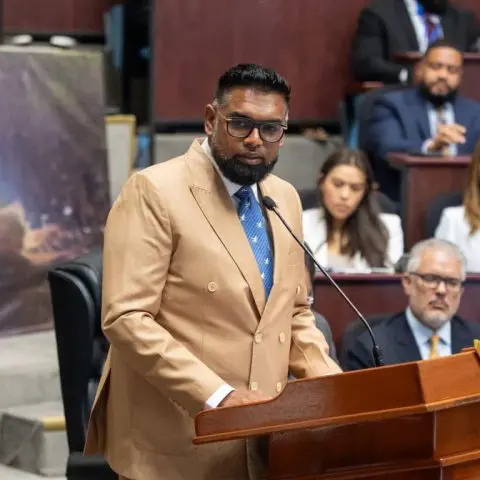
Opposition Leader Azruddin Mohamed has questioned the cost, pace of construction, road safety measures and employment practices associated with the US$161 million reconstruction of the Soesdyke-Linden Highway, alleging that the project is overpriced and that Guyanese workers are being overlooked.
In a video statement from the highway, Mohamed questioned why the rehabilitation of approximately 72 kilometres of an existing highway is costing US$161 million.
Public Works Minister Juan Edghill did not respond to a request by Kiskadee Watch for comment on the allegations raised by Mohamed.
The project was awarded in August 2024 to a joint venture between Trinidad and Tobago-based Namalco Construction Services and GuyAmerica Construction Inc. The contract is being financed through funding from the Islamic Development Bank and includes the reconstruction of the highway, drainage works, bridges, roundabouts and roadway lighting.
Mohamed compared the project with the US$190 million Linden-Mabura Road, which covers approximately 121 kilometres and involves upgrading an existing largely gravel road to an asphaltic concrete surface.
The Linden-Mabura project reportedly includes a 7.2-metre-wide two-lane carriageway, a dedicated pedestrian and cycling lane, replacement of bridges and culverts, bus stops and roadway lighting. “How is 73 kilometres of an existing highway costing 161 million US$ while 121 kilometres of slush and mud, the Mabura project, costs 190 million US$”, Mohamed asked.
He further alleged that construction costs on the Soesdyke-Linden project included excessive mark-ups and questioned where the remaining funds were going. “The length and width of the highway, along with that amount of crusher run and asphalt, the 3,000 lights they will buy from China, and the two roundabouts, all those materials combined will not cost us more than 50 million U.S. dollars,” he argued.
Mohamed also criticised the project’s pace, pointing to the disruption faced by motorists and residents along the corridor. The contract was signed in August 2024 and was initially expected to take two years. Government officials had subsequently reported varying levels of progress, with the project reaching about 50 per cent overall completion by January 2026.
Mohamed said that the works are now expected to continue beyond the original September 2026 completion period. Safety was another major concern raised by him. He said poor visibility and ongoing construction posed risks to motorists, and called for proper lighting, road signs, barriers and traffic management measures to remain in place throughout the construction period.
Mohamed further claimed that residents are now complaining that Spanish-speaking and Bangladeshi nationals are being sought for construction work because they are willing to work for lower wages. He said Guyanese capable of doing the work should not be left on the sidelines while foreign workers are employed.
Mohamed also contrasted the present project with the construction of the original highway more than five decades ago, arguing that Guyana now has substantially greater financial resources and should therefore be able to deliver the reconstruction faster, safer and at better value.










Discussion