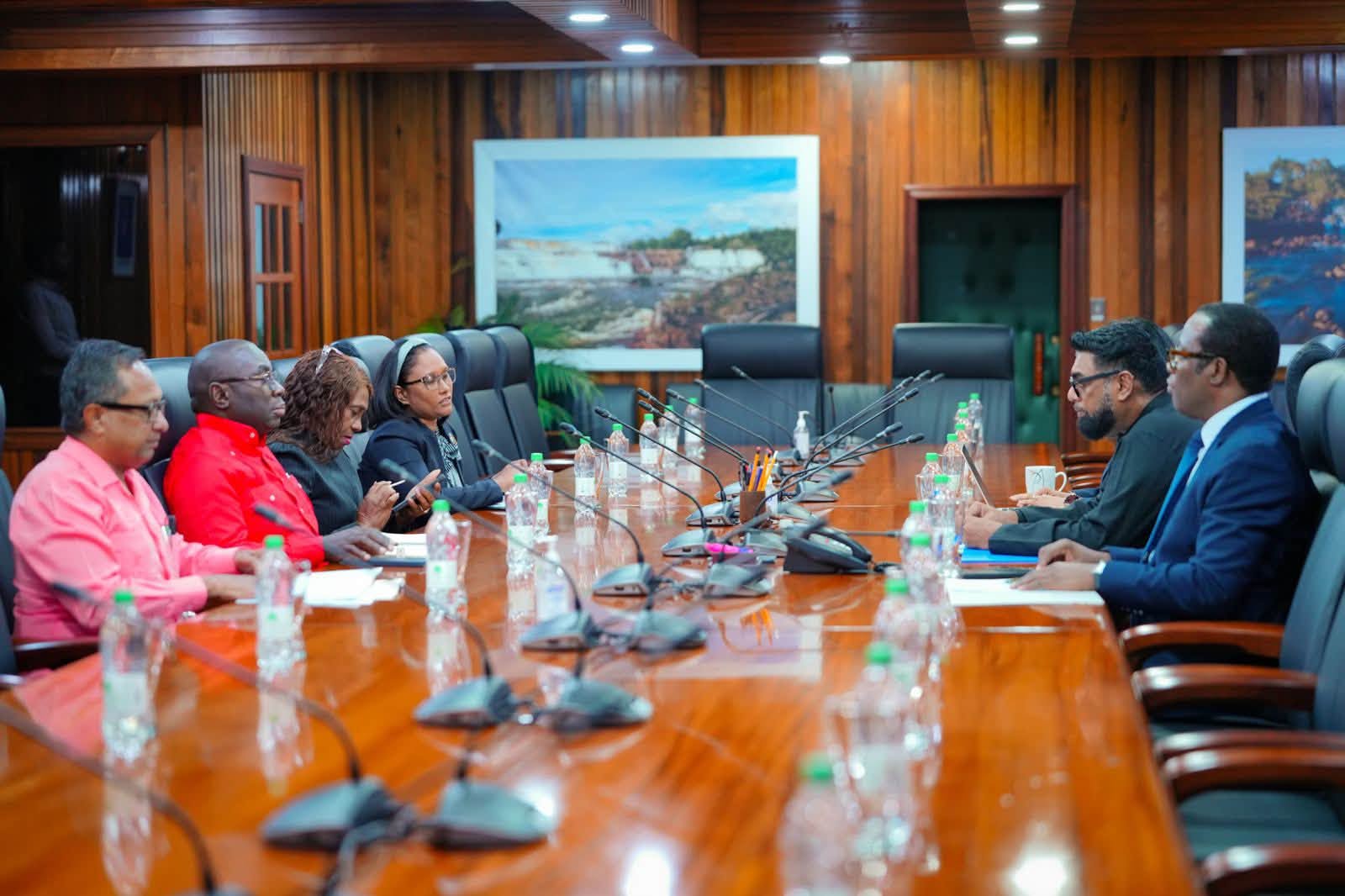
Opposition members of the Parliamentary Sectoral Committee on Foreign Relations boycotted a meeting with President Irfaan Ali yesterday after no agenda was provided and in the case of WIN there were concerns that the Opposition Leader was being sidelined.
Ali, however, proceeded to meet with the four PPP/C MPs on the committee at the Office of the President.
A similar engagement with members of the Parliamentary Sectoral Committee on Economic Services is scheduled for today but also faces a boycott by the opposition.
Opposition Chief Whip Tabitha Sarabo-Halley yesterday told Kiskadee Watch that committee members received a letter last Thursday, September 10, from Clerk of the National Assembly Sherlock Isaacs informing them that the President had invited them to a meeting.
She said the correspondence did not indicate the agenda.
According to Sarabo-Halley, she attempted unsuccessfully to contact Isaacs, who was out of town, and subsequently wrote to Nadir seeking clarification. She questioned whether the proposed engagement was a meeting of the parliamentary committees, noting that such meetings are ordinarily convened by their respective chairs. She also requested an agenda.
Sarabo-Halley said a response was later received through the Deputy Clerk confirming that the engagement was a meeting with the President. However, she said her question about the agenda remained unanswered.
Pellucid
In a statement yesterday, Speaker of the National Assembly, Manzoor Nadir acknowledged receiving correspondence from Sarabo-Halley on Sunday in which she raised several questions and requested an early response.
The Speaker said Parliament Office sent a letter to her early on Monday and sought to make it “very pellucid” that all the questions she raised were addressed.
Nadir also cited Article 51 of the Constitution, which states that Parliament comprises the President and the National Assembly.
The Office of the Leader of the Opposition, however, said the invitation was issued without an agenda or any indication of the matters to be discussed.
It said clarification was sought from the Speaker but “no meaningful response was received” and, in those circumstances, We Invest in Nationhood (WIN) did not believe it appropriate for its MPs to participate.
WIN accused Ali of bypassing genuine engagement with the Leader of the Opposition and attempting instead to engage individual parliamentary committees. Ali has made no attempt to convene a meeting with Leader of the Opposition, Azruddin Mohamed.
“These are parliamentary committees, not departments of the Executive,” the statement said.
The party said it remained willing to engage with the executive where that engagement was transparent and respected the roles of Parliament and the Office of the Leader of the Opposition.
APNU members of the two committees also said they had no difficulty participating in a properly organised meeting with the President, but maintained that an agenda and relevant documents should be supplied beforehand.
“A heading is not an accountability agenda,” APNU said, referring to the broad subject areas identified by Ali.
The party said consultation should take place before agreements are finalised so that participation could influence national decisions. It also sought information on proposed agreements, financing arrangements and their likely implications.
“We are prepared to help shape sound decisions for Guyana. We are not prepared to decorate decisions already taken,” APNU declared.
It added: “As a principled opposition party in a democracy, APNU must determine whether to attend the meetings proposed by the President according to the prevailing context and content. Our decision cannot be reduced to an automatic acceptance or rejection of an invitation. We will assess whether there is a genuine opportunity to influence policy, obtain answers and secure improvements for the people we represent.
“Attending a meeting after national decisions have already been made, with no genuine opportunity to change them, is not consultation. It is a dictatorial exercise seeking cover behind a poorly planned political photo opportunity. Attendance must never be misrepresented as endorsement, and legitimate disagreement must never be dismissed as opposition to development.
“Foreign relations and economic development require adequate discussion and consultation before Guyana is committed to consequential actions, financial obligations or international arrangements. The government must explain the options, costs, risks and safeguards, and seek broad national support. It must not commit the country to actions whose national support it has neither sought nor established, then summon elected representatives to provide political cover. The PPP/C cannot substitute a presidential announcement for a national consensus”.
APNU’s statement was signed by MPs Dr. Terrence Campbell,
Juretha Fernandes, Dr. Riaz Rupnarain and Coretta McDonald.
Policy level
At his press conference on Monday, September 14, Ali announced that he would meet the two committees later in the week, saying, “I believe in working and letting everyone understand what we are doing at the policy level.”
When asked what would be on the agenda, the President said the Foreign Relations Committee would be updated on critical national and foreign policy issues. He referred to Guyana’s border controversy case before the International Court of Justice, the arrangement with the United States concerning third-country deportees and other foreign-policy matters.
“I think as President, I have a responsibility to update every stakeholder,” Ali said, adding that committee members could ask questions about the third-country nationals arrangement and other foreign-relations issues.
He said the Economic Services Committee would be briefed on the Mid-Year Report, the performance of the economy, the cost of living, inflation and the global energy and transportation crises.
“It’s going to be a broad agenda. It’s not going to be a structured agenda,” Ali said.
Following yesterday’s meeting, the Office of the President said Ali updated those PPP/C MPs present on the proceedings before the International Court of Justice and Guyana’s third-country national arrangement with the United States.
The release said all members were invited through the Speaker, but claimed that up to the time of the meeting the opposition members had neither accepted nor declined the invitation. This position is at odds with WIN’s account that it had sought clarification and decided not to attend after receiving no meaningful response.
The government members present reportedly welcomed the engagement and expressed an interest in continued discussions on Guyana’s foreign-policy agenda.
Ali said his government intended to strengthen its engagement with all parliamentary committees in an “open, transparent and accountable manner.”
In a separate statement, Forward Guyana Movement MP Amanza Walton-Desir supported the decision by WIN and APNU not to attend, arguing that the President was engaging Parliament selectively and on his own terms.
Walton-Desir questioned whether yesterday’s engagement had the features of a formal parliamentary committee meeting, including notice from the committee clerk outlining the proposed business, an official record and a mechanism for reporting to the National Assembly.
She said that if no parliamentary record or reporting process existed, the engagement was an executive briefing attended by government MPs and could not be presented as the collective position of a bipartisan committee.
“The right thing must also be done in the right way,” Walton-Desir said, while calling on Ali to address the National Assembly.










Discussion