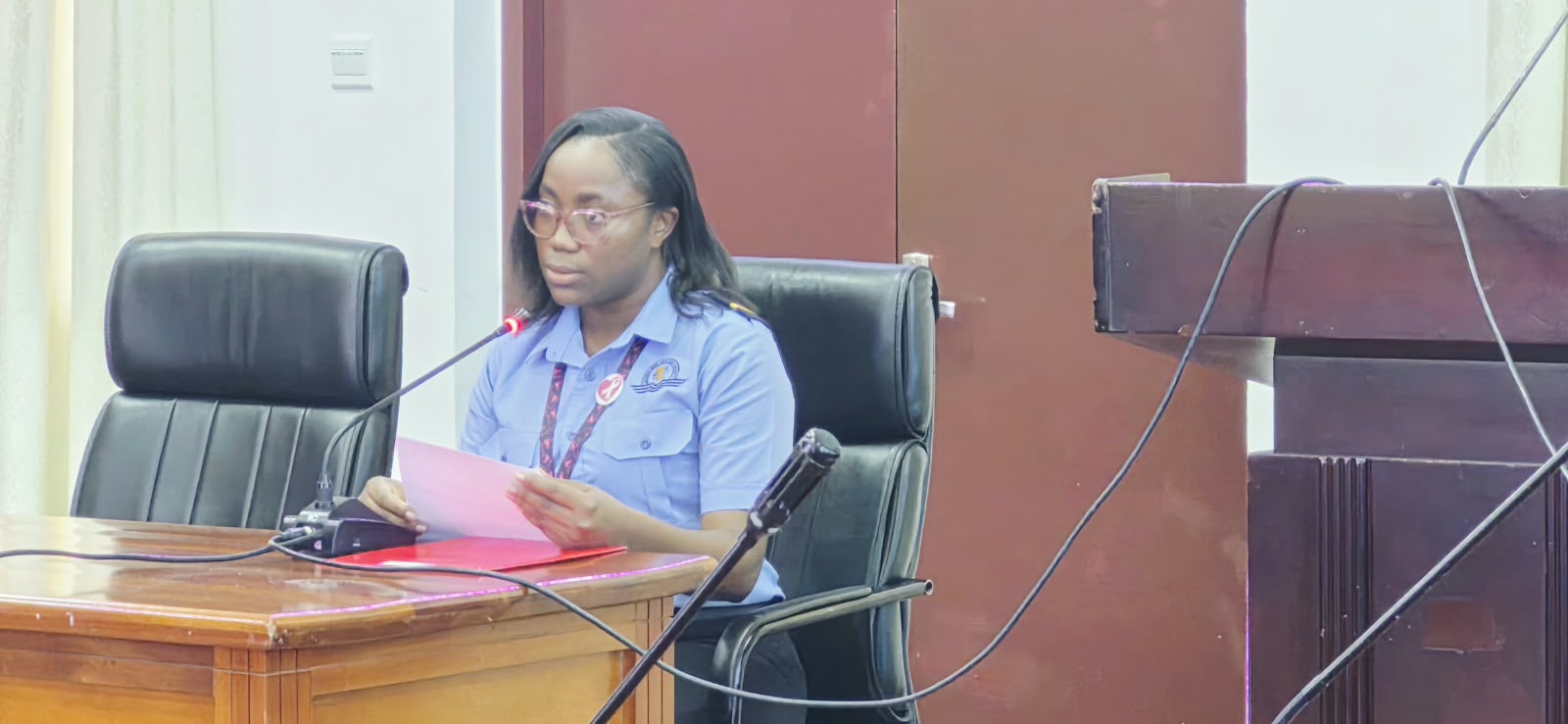
One fully trained Aeronautical Information Services officer and a trainee were on duty at the Timehri control tower during part of the response to the MV Barima disaster, the Commission of Inquiry heard yesterday.
Officer Saskia Trapp testified that she took over the midnight-to-8 am shift on July 19 after being briefed on the emergency by outgoing officer Tia Valenzuela, who did not remain to assist.
The commissioners questioned the staffing arrangements and requested the July duty roster for examination.
Trapp, who has worked with the Guyana Civil Aviation Authority (GCAA) for one year, said she arrived approximately 20 minutes before her shift began. By then, the tower had already received distress alerts relating to the maritime emergency.
Valenzuela briefed her on the steps taken before handing over, Trapp said.
Asked whether it was normal to work with only a trainee, Trapp said supervisors determined the shifts and that the number of fully trained officers varied, with two or three sometimes on duty.
A commissioner questioned whether additional personnel would be brought in during an emergency, noting the limitations of trainees.
Trapp said the officer on duty would continue handling the distress alert and that no additional officer would come in to assist in such circumstances. She acknowledged that she had not asked Valenzuela to remain.
Her testimony also outlined difficulties obtaining updated information from the Coast Guard during the search.
At 5.30 am on July 19, Trapp said, she received a message advising that the Guyana Defence Force (GDF) was on site, 26 persons had been rescued and the search was continuing.
She sent a request at 7 am for the actual coordinates of the incident. After receiving no response, she called at 7.14 am and was told that the information could not be provided because the search remained ongoing.
No coordinates had been supplied in response to her request by the time her shift ended at 8 am, she testified.
Trapp said officers receiving distress messages were required to acknowledge them to the United States Mission Control Centre (USMCC), identify the type of emergency, check the beacon’s registration and plot its coordinates.
For maritime alerts, they were required to contact the GDF, the lighthouse and other relevant agencies.
Valenzuela, who also testified during the commission’s first day of evidence-taking at the Arthur Chung Conference Centre, described receiving and processing the initial alert.
She said the tower’s messaging system emitted a continuous beeping sound, audible throughout the office, when a distress message arrived.
After accessing the system, she identified the message as a distress alert and reviewed the report, which indicated a maritime incident.
Valenzuela said officers normally printed the alert and entered the information into a website to check the beacon’s registration and location. They then plotted the coordinates and emailed the details to the relevant agencies.
Following the initial alert, further distress messages arrived in succession, requiring her to continue processing the incoming information, she said.
The commission is investigating the July 18 sinking of the state-operated Barima while travelling from Georgetown to Port Kaituma, including the effectiveness of the search, rescue and recovery response.









Discussion