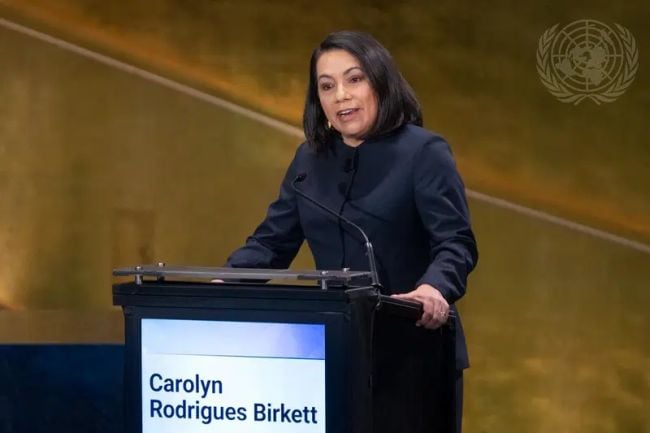
-outlines five areas for immediate action if elected
Facing what could be a decisive sixth vote tomorrow for the post of UN Secretary General, Guyana’s candidate Carolyn Rodrigues-Birkett last week said that advancing reforms of the UN Secretariat and improving the humanitarian situation in areas of conflict are among five areas she will address in her first 100 days in office should she be elected to office.
Rodrigues-Birkett told the UN Town Hall Meeting held at the UN headquarters in New York that she would also start to address the issue of the unrepresented and underrepresented, an issue that came up from many member states in interactive dialogues and she will start to dialogue with international financial institutions (IFIs) for concessional financing mainly for developing countries.
Rodrigues-Birkett fell to third position in the fifth straw poll held on October 7 while Costa Rica’s candidate Rebeca Grynspan maintained the lead she has kept for most of the race.
The next vote tomorrow will be crucial as the five permanent members of the UN Security Council will indicate whether they will wield the veto against any of the candidates. A veto against any of the candidates will automatically bring their campaign to an end.
There have been suggestions that the US may oppose Rodrigues-Birkett’s candidacy on the basis of her declaration of Israel’s war in Gaza as genocidal.
In her final statement at the UN Town Hall she said her first order of business would be to recruit a competent senior team that will be geographically and gender balanced.
She will be committed to work in close collaboration and to be accessible to member states in a systematic way. “I believe that is realistic for the first 100 days,” she said.
In advancing the reform of the Secretariat, she will provide member states with the neutral information they need, she said, “to make the structural reforms because that reform is in the hands of member states.”
On the issue of conflict resolution and prevention, she said she will start deploying the tools, such as mediation or good offices, at the disposal of the Secretary General.
Noting the terrible humanitarian situation in areas of conflict and some of the work being done to improve it, she will continue to advance that work by looking at the impediments – political, logistical and how to deliver better services.
She will start to dialogue with the IFIs while working for greater reforms, she said, “Even small systemic steps can bring relief to countries especially when it comes to concessional financing.” This she wants done in partnerships with member states.
“We have the multidimensional vulnerability index (MVI) and work has already started on going beyond the GDP. How do we use the MVI for example to work on concessional financing for the most vulnerable countries,” she said.
In her opening statement she said that over the past eight decades, the UN has served humanity well, but it was now at crossroads with the proliferation of conflicts, lack of implementation of the UN Sustainability Goals, a liquidity crisis and an increase in humanitarian needs. “Reform to make this organisation more efficient, more effective and more agile is now an imperative, she said.
Why she is the best person for the job of Secretary General, Rodrigues-Birkett said, “The UN needs a Secretary General who is practical, realistic and who is pragmatic.”
Over her 30 years of working life, she said serving in the fields, in government serving as a minister, in the Parliament, as an international civil servant and as a diplomat including leading Guyana on the Security Council, she has gained not only experience but the expertise in many areas the UN needs.
“I have also led in times of scarce resources and even with scarce resources I delivered results to ensure that we mobilise additional finances. I have also had the approach of building bridges and uniting people around common goals and objectives and ensuring fairness.,” she said.
Asked by the moderator what was the most important lesson she learned from the Covid-19 pandemic and that the world has yet to act upon and if another pandemic arises during her first year in office were she to be elected what her first priority would be, Rodrigues-Birkett said, “Let’s not call that into existence at all because that would be devastating for the world community especially now when we face severe financial constraints in many of our countries. Many of our countries have not recovered from Covid-19. If you look at the reports of the Sustainable Goals you will see that Covid played a very big part in regressing development for many states and stifling it in other states.”
Having not answered the question fully and prompted to answer, she said, she believes mechanisms in place, like the World Health Organisation, and all the nations that experience the pandemic are better prepared.
“But if we don’t have the necessary financing and the necessary vaccines, the same thing would happen as happened before where it was survival of the fittest,” she said.
Hoard
In the case where wealthy nations hoard vaccines, she said the Secretary General would have to use her voice, and the cooperation of all member states would be essential to address the issue.
“This General Assembly discusses the pandemic ever so often, but I believe in the collective wisdom of our 193 member states as well. We have seen what the pandemic has caused before, and we don’t want that to happen again,” she said.
Asked by a UN staffer how she would approach reform to strengthen staff morale, improve managerial efficiency and ensure accountability across all levels of the organisation, Rodrigues-Birkett said, the UN has already begun the reform of the secretariat to make it more efficient and effective and she will continue that work if elected.
“I will continue that work using technology, for example, to make it more effective. A Secretary General is as strong as the team around her and an organisation is as strong as the people who work for it.”
In consultations, she said member states want to see the staff of the Secretariat looking like the world it represents.
Adverting to the closing of the Strait of Hormuz by Iran and the Security Council’s inability to adopt a resolution to reopen it, a questioner asked if diplomacy inside the council fails what would she do to ensure the UN still plays a meaningful role in keeping the peace. Rodrigues-Birkett said, “There is space for the Secretary General when there is no agreement by members of the Security Council to present options that could possibly be utilised, to dialogue with the conflict parties.” She said she was not oblivious to the geopolitical situation.
“One thing the Secretary General does not have the luxury of doing, that is, not trying. The Secretary General must try. I would be that Secretary General who would try, whether it is in Iran, Haiti, Sudan or in the DRC (Democratic Republic of the Congo) to put those proposals to the Security Council if the tools at my disposal as Secretary General are not good enough.”
Paralysed
Noting that the Security Council was increasingly paralysed by vetoes, Rodrigues-Birkett in response to how she would make it effective when its most powerful body cannot act, reiterated that there was always space for the Secretary General.
“I have served on the Security Council, and I have seen in time when the Security Council could not act when certain members or groups of members had different views on issues, and when this current Secretary General was able to act. I would want to follow in that same path. You bring neutrality as Secretary General,” she said. She added that she would capitalise on that neutrality, the tools at her disposal and on the footprint that the UN has on the ground.
As a follow up, she was asked if she will act without the Security Council’s authorisation if it means preventing a crisis and she answered in the affirmative.
“The Secretary General is the chief administrative officer of the organisation and there are certain tools at the Secretary General’s disposal. Mediation, good offices, appointing special representatives. Of course, there will be times when that would not be enough, and the Secretary General would have to depend on the Security Council. But, if, for example, a veto is going to bring immense suffering, then I would want to speak with that member state to let them know of the consequences.”
With growing support for the UN to appoint its first female Secretary General after eight decades of male leadership she was asked what the female candidates want governments and people around the world to say that the UN does better five years from now. Rodrigues-Birkett said that the reforms the UN had begun were completed, that delivery was being made especially on the ground where the impact is most felt and that there is a post 2030 agenda that is realistic and workable.
“Mindful that this Secretary General will be there in 2030,” she said, “The UN must be more present especially in the peace and security arena. That we would have moved from where we are today to a UN that is delivering better in peace and security, both on the prevention side and in the ending of conflict.”
She added that at that time, the world would have seen that a woman as a Secretary General can deliver while working with member states.
Asked what the greatest threat was facing the world’s peoples, Rodrigues-Birkett said the fragmentation of multilateralism.
“Multilateralism is the guarantee for our global security and protection. We must protect this at all costs. I know the world out there is looking to see how multilateralism is benefitting the people on the ground, how is it ending conflicts or preventing conflicts, how is it delivering on development,” she said.
It is the responsibility of the Secretary General, she said to communicate to the world’s population the importance of the United Nations and multilateralism and what actions are being taken by the UN to address the global challenges faced today.
“The generation of World War II is not with us anymore and history has a way of repeating itself if we do not learn from it and we do not communicate about it. I think communicating the work of the UN is better when it is underpinned by action, and action to make changes on the ground, to see development on the ground.”
Meanwhile, the other candidates in their opening statements, in questions and closing statements had similar talking points to Rodrigues-Birkett’s and she too had similar ones as theirs, more so on the importance of multilateralism, conflict resolution and prevention, the liquidity crisis and accountability and transparency.
Diversity
Macky Sall, former President of Senegal echoed Rodrigues-Birkett on the issue of competence of staff, diversity and a balance of geographical representation and she agreed with his view on collaboration with IFIs and concessional financing.
Sall said he will strengthen the UN’s capacity on peace and security through preventive diplomacy, early warning, negotiation, good offices and closer cooperation with regional organisations particularly on peace operations.
He added that he will keep human rights and development at the heart of the global agenda and will begin consultations on the post climate 30 agenda with member states, the Bretton Wood institutions, IFIs, the private sector, civil society and philanthropy.
He will also promote development financing, and will focus more on investment, trade and partnerships while improving developing countries access to capital markets, knowledge and innovation.
Rebuilding trust and reform were also a focus of Sall, Grynspan, former Vice President of Costa Rica and head of UN Trade and Development, Maria Fernanda Espinosa of Ecuador, and Rafael Mariano Grossi of Argentina.
Apart from returning peacekeeping to the UN, Grynspan said she will establish a good offices support unit in the executive office of the Secretary General and engage all parties in areas of conflict as well as the Security Council.
In rebuilding trust, Espinosa said, to date, 72 member states have not paid their dues to the UN and this was not only due to financial issue but it was a message that the UN needs to regain the trust of member states so they can see value for money.
Contending that the UN was in crisis she said, she will make it more accountable, more transparent and more impact driven, she will institute a new business model for the UN based on impact performance and accountability and will be present and visible in areas of conflict.
Espinosa said she was the woman for the job because of her proven track record having been elected as President of the UNGA, as a minister of defence and minister of health and as a reformer.
Grossi said that in a world today that is registering the highest number of armed conflicts over the past 40 years and that the UN’s performance is not what it should be he believes that multilateralism was the way to go.
“I say this because I live it. I live it every day through the work of an organisation dealing with one of the most dangerous, sensitive and gravest of areas in international life, nuclear weapons. Nuclear safety. We through the IAEA (International Atomic Energy Agency) have been able to act and to act effectively in theatres of war, to talk to leaders who are fighting with each other and to be accepted as interlocutors. This is what the UN must recover.”
Grynspan said she was running for the Secretary General’s office “to give them real solutions and honest answers.”
She said she was bringing integrity, impartiality and transparency in her campaign along with proven leadership under pressure.
“I have led organisations in and out of the UN. In each I built coalition and consensus for action. I talk and listen to everyone. I close no doors, serve no interests but the Charter. I lead though influence, not rhetoric. I bring proven leadership under pressure. I led crisis-work in Afghanistan, Somalia, Haiti. I negotiated my country’s debts. I brokered deals that opened seaways in the middle of war. “







Discussion