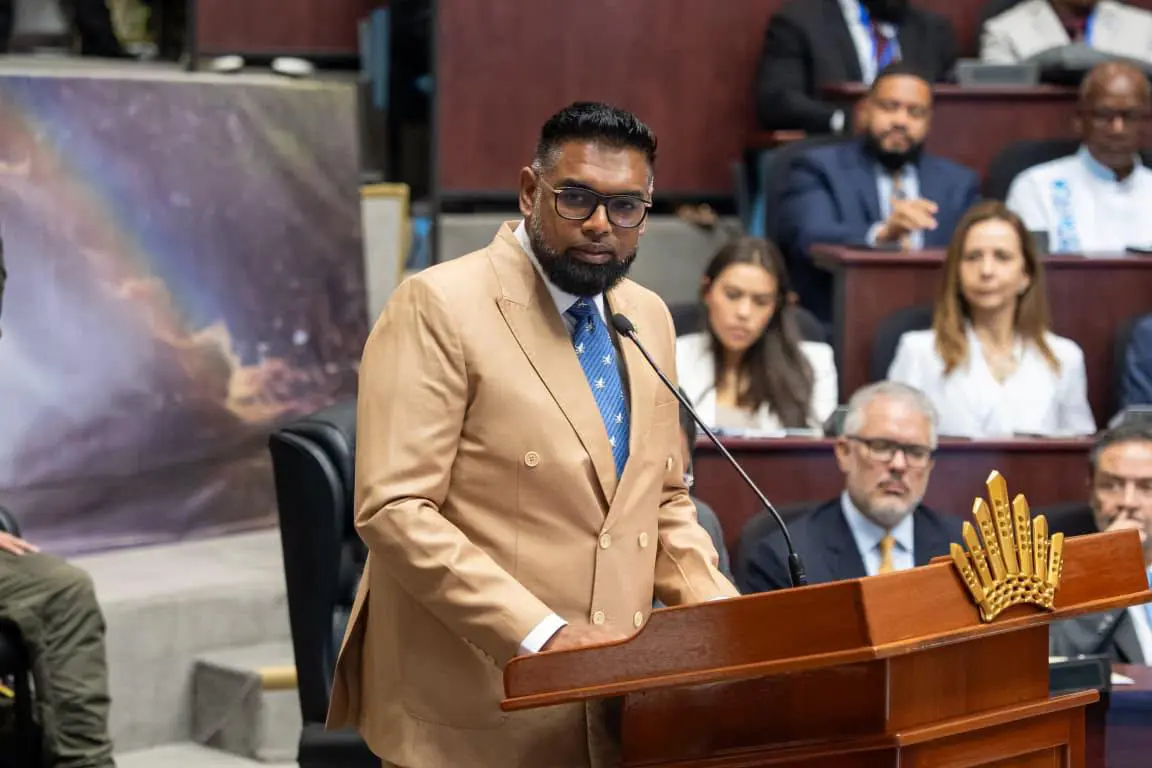
President Irfaan Ali has proposed that members of the Global Biodiversity Alliance adopt common fiscal incentives and regulations to attract conservation investment, while challenging participating countries to prepare at least one project for financing before they meet again next year.
Addressing the opening of the alliance’s second conference in Georgetown, Ali said countries needed to move beyond identifying funding shortages and establish mechanisms that would direct capital towards projects capable of protecting biodiversity while generating jobs and economic returns.
“We can have all the conversations we want about protecting biodiversity, but unless we change the economics of conservation, we will struggle to achieve the scale of change the world needs,” he said.
Ali proposed special fiscal incentives for investments that advance biodiversity protection, incorporated into a framework that alliance members could pursue together.
“So that we have one platform, one agenda, one set of incentives, one set of regulations that we all pursue together,” he said.
He also urged private sector representatives from member countries to explore a joint investment mechanism and a common approach to marketing biodiversity-related opportunities.
Such an arrangement, he suggested, could operate under one brand, with common values, regulations and structures, while creating opportunities for villages, communities and national economies.
The proposals were among three priorities Ali outlined for the alliance over the next 12 months: connecting scientific knowledge and innovation; unlocking finance and investment; and implementing initiatives that demonstrate how conservation can support livelihoods and national development.
He said the alliance’s secretariat should help participating countries assemble the expertise needed to prepare projects and connect them with financing.
“I challenge all of the participants here in biodiversity-rich countries to work with the Secretariat in developing projects that we can put out there to be financed,” he said.
Each country, he proposed, should work towards presenting at least one such project by the next gathering.
Ali said businesses in biodiversity-rich countries must be involved in designing solutions and connecting investors with practical opportunities. Guyanese private sector representatives, he reported, had already met international counterparts during the week to examine biodiversity financing.
He acknowledged Chevron’s support for environmental programmes and called for more partnerships combining commercial expertise, scientific knowledge and sustainable development.
Forest conservation
The President also reiterated plans to permanently conserve a large forest landscape, saying this would effectively double the area of Guyana under permanent protection and contribute to its commitment to protect 30 per cent of its lands and waters by 2030.
A joint announcement published by Rainforest Trust identifies the proposed landscape as the Acarai–Rupununi Corridor, covering more than one million hectares. It describes the corridor as one of the largest intact forest landscapes remaining in the Americas.
According to background accompanying that announcement, roughly 8.4 per cent of Guyana’s land is currently within the National Protected Areas System. The proposed corridor would roughly double the protected-area footprint. Guyana’s 30 per cent conservation target forms part of its Low Carbon Development Strategy.
Ali said a biodiversity inventory had been completed and an initial stakeholder process was underway. Further engagement, management planning and biodiversity monitoring would guide the next steps towards permanent conservation.
He said the initiative would respect community interests, be guided by science and remain consistent with national development priorities.
“We are not protecting this landscape instead of developing Guyana. We are protecting it as part of developing Guyana,” he said.
The ambition, he added, extended beyond protecting an area on a map. The landscape should also support scientific research, sustainable livelihoods, responsible investment and new economic opportunities.
Ali argued that traditional development assistance alone could not meet the scale of financing required to address biodiversity loss. Countries protecting ecosystems, he said, should receive a fair share of the economic value of those resources.
Conservation needed to become central to economic planning, rather than being treated as a separate undertaking.
He also challenged arguments that placed a moral obligation on developing countries to protect nature without giving equal weight to their responsibility to provide for their populations.
“It’s also a moral responsibility to feed the people of their countries and provide services to the people of their countries,” he said.
Ali pointed to Guyana’s experience with forest financing as evidence that economic arrangements could be changed to recognise the value of standing forests.
Recalling the development of the country’s forest conservation approach under then President Bharrat Jagdeo in 2009, he said it had challenged an economic system in which forests were worth more when cleared than when left standing.
Guyana had argued that forests provided services of value to the world and that developing countries should be able to protect them while earning revenue to improve their citizens’ lives, he said.
He cited the country’s partnership with Norway and subsequent participation in international carbon markets, saying the proceeds had supported national development and investments in priorities identified by Indigenous communities themselves.
Indigenous and riverine communities, he said, must have access to livelihoods, infrastructure, social services and the same opportunities as other citizens. Their responsibility for safeguarding forests could not be separated from investment in their well-being.
Commonwealth centre
Ali also announced plans for a Guyana Commonwealth Centre for Biodiversity, which he said had been agreed following discussions with the Commonwealth Secretary-General earlier this year.
The centre would support implementation of the alliance’s work plan through scientific expertise, research and capacity building, he said.
He reported that the design for a building to house the alliance’s secretariat had been completed and would be presented during the conference.
According to Ali, the alliance had grown from 17 founding members at its launch in July 2025 to 147 members. Almost 300 overseas delegates had registered for the conference, he said.
He described the gathering as bringing together researchers, financial institutions, policymakers, community representatives and businesses, including participants from the oil and gas industry.
The alliance, he said, needed different stakeholders to find common ground on conservation and development.
Ali said its success would ultimately depend on whether discussions produced financing, investment and practical benefits for biodiversity-rich countries and communities.
“The world has enough declarations about the importance of biodiversity,” he said. “But we now need a practical mechanism to turn conviction into investment, investment into opportunity, and opportunity into lasting protection for nature.”









Discussion