
-was due for drydocking later this year
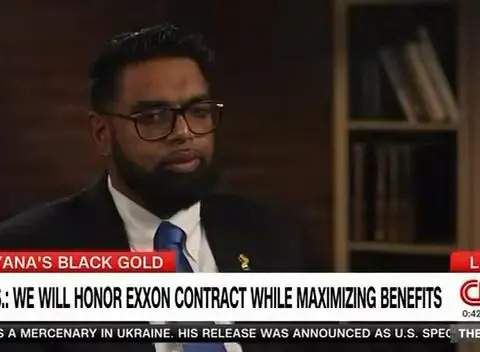
Public Works Minister Juan Edghill last evening defended the seaworthiness of the MV Barima, saying there was no report declaring the vessel unfit for service, even as tender documents circulated by Opposition Leader Azruddin Mohamed raised questions about extensive repairs that had been identified for the ferry earlier this year.
Speaking at a government press conference on the sinking of the vessel, Edghill acknowledged that the Barima was an ageing vessel but asserted that it had been maintained in accordance with established procedures.
“The vessel in question, the MV Barima, it’s an old vessel, but it’s a vessel that has been kept intact. It was last dry-docked in 2024 and it’s due for dry-docking… in the latter half of 2026 along with the MV Malali as well as the MV Makouria,” he said.
His comments came amid renewed scrutiny of tender documents, circulated by Opposition Leader Azruddin Mohamed in March, which indicate that approximately $124.5 million in repairs had been proposed for the vessel in March.
The documents list a broad range of structural and mechanical works, including replacement of approximately 10,000 kilogrammes of deteriorated hull plating and frames, a further 3,000 kilogrammes of internal plating and framing, repairs to cargo hatches, propulsion and steering systems, sea valves and underwater fittings, together with ultrasonic thickness testing of the hull.
The documents also call for repairs to sea chest valves, suction boxes and overboard strainers, replacement of propeller shafts and stern tubes, installation of two new turbochargers, repairs to rudder components and replacement of zinc anodes used to combat underwater corrosion.
Mohamed has argued that the scope of the proposed works pointed to significant structural and mechanical deficiencies and questioned whether the repairs were ever completed before the vessel returned to service.

Addressing the issue, Edghill rejected suggestions that the bill of quantities reflected a vessel that was unseaworthy.
“We have seen some suggestion that has been made and while I’ve checked with my procurement manager and the head of the Transport and Harbours Department… the bill of quantities of anticipated work to be done was given to all of the contractors,” he said.
“The bill of quantities—there was no report of any kind that suggests unworthiness of the vessel. It’s normal just like with the Makouria, just like with the Malali. You have to go to docking, you develop a bill, examination of the hull, all the underwater works to be done, improvements that have to be made, the seaworthiness, and if you put the bill in circulation you can get an outcome like what we are seeing circulated, he said.
Edghill said the vessel’s scheduled dry-docking formed part of the Transport and Harbours Department’s routine maintenance programme.
“It was last docked in 2024 and it is in line for dry-docking in keeping with the schedule,” he said.
The tender documents have assumed added significance following accounts from survivors who alleged that water entered the vessel before it capsized and that the ferry experienced engine problems before departing Georgetown. Those allegations have not been independently verified and remain under investigation.
Among the items identified in the repair schedule are works to the vessel’s cargo hatch system, including replacement of hatch beams and hatch boards, repairs around hatch openings and installation of a tarpaulin hatch cover.
Mohamed contends that damaged cargo hatches could allow seawater to enter the cargo hold, while water moving within the hold could reduce stability through what is known in naval architecture as the “free surface effect.”
He has also questioned whether the ultrasonic hull thickness testing identified in the tender documents was ever conducted and whether the results will be made public.







Discussion