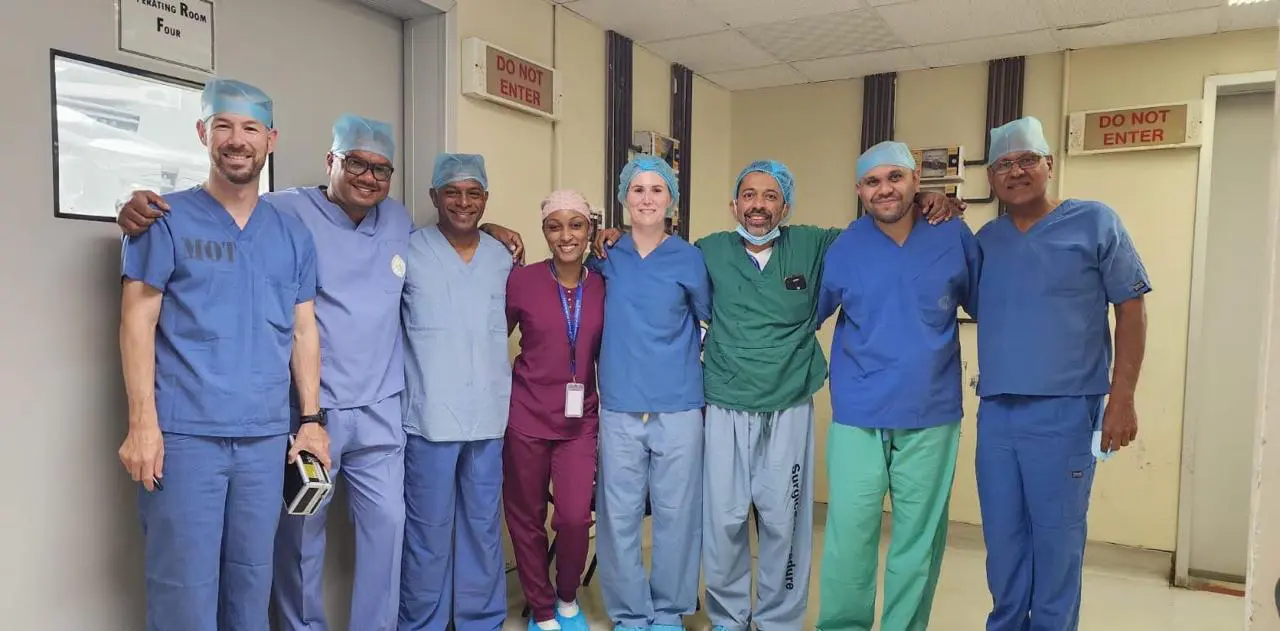
Five patients, including four who had undergone mastectomies following breast cancer, received complex reconstructive surgery at the Georgetown Public Hospital Corporation (GPHC) last month through a collaboration between local clinicians and visiting specialists.
In a statement, GPHC said seven free flap procedures were performed between September 11 and 15. The fifth patient had a complex soft tissue defect in his leg which could not be repaired using conventional methods.
The visiting specialists, from the British Association of Plastic, Reconstructive and Aesthetic Surgeons (BAPRAS) and the Caribbean Association of Plastic, Reconstructive and Aesthetic Surgeons (CAPRAS), worked alongside the hospital’s team. The collaboration also included training aimed at enabling local clinicians to eventually perform the procedures independently.
Free flap reconstruction involves transferring tissue and its blood supply from one part of the body to another, then reconnecting the blood vessels at the new site. According to GPHC, the team performed six Deep Inferior Epigastric Perforator (DIEP) free flaps and one Latissimus Dorsi (LD) free flap.
For breast reconstruction, the DIEP procedure uses skin and fat from the lower abdomen while preserving the abdominal muscle. Blood vessels only a few millimetres wide are joined under a microscope to restore blood flow to the transferred tissue.
GPHC reported that the breast reconstruction patients were recovering well, with one minor complication.
The hospital said the aim was for the transferred tissue to heal and provide an appropriate breast contour, with further refinement where necessary. Reconstruction could also reduce the discomfort and burden of relying on a prosthetic breast following a mastectomy.
The LD flap was used to cover the fifth patient’s leg wound and protect structures important for mobility. GPHC said that objective had been achieved so far, although he would require additional surgery to complete his treatment.
Head of the General Surgery Department, Dr Shilindra Rajkumar, emphasised the preparation required for microsurgery, including patient selection, pre-operative planning, imaging, equipment checks and training of the operating team.
According to the statement, preparations took months. Equipment had to be functioning and properly calibrated, while doctors, nurses and other personnel needed to become familiar with the procedures, specialised instruments and possible challenges during surgery.
The operations can last more than six hours and require close coordination among surgeons, nurses, anaesthesiologists, biomedical engineers and other personnel. Following surgery, the transferred tissue is closely monitored during the first few days, particularly for blood flow problems which could jeopardise the reconstruction.
Before the surgical mission, local doctors and nurses participated in a microsurgical workshop. They received practical instruction in the use of microscopes and specialised instruments, suturing, needle control and techniques for joining small blood vessels.
GPHC said Rajkumar regarded this training as central to developing the knowledge and skills needed for local clinicians to undertake the procedures independently.
The hospital noted that microsurgical reconstruction had previously been undertaken in Guyana. In January 2025, a team from the British Foundation for International Reconstructive Surgery and Training (BFIRST), working with local clinicians, performed three microsurgical procedures—an anterolateral thigh flap and two DIEP flaps.
The latest collaboration builds on that work, although GPHC acknowledged that further investment and training would be required to establish a sustainable service.
Among the requirements are reliable operating microscopes, specialised instruments and sutures, Doppler technology, flap-monitoring equipment and other supplies. Supporting services, including anaesthesia, intensive care, nursing, radiology and rehabilitation, would also need to be developed.
The hospital said its eventual goal was for local teams to plan, perform and monitor complex reconstructive procedures, with international partners continuing to provide mentorship and training.








Discussion