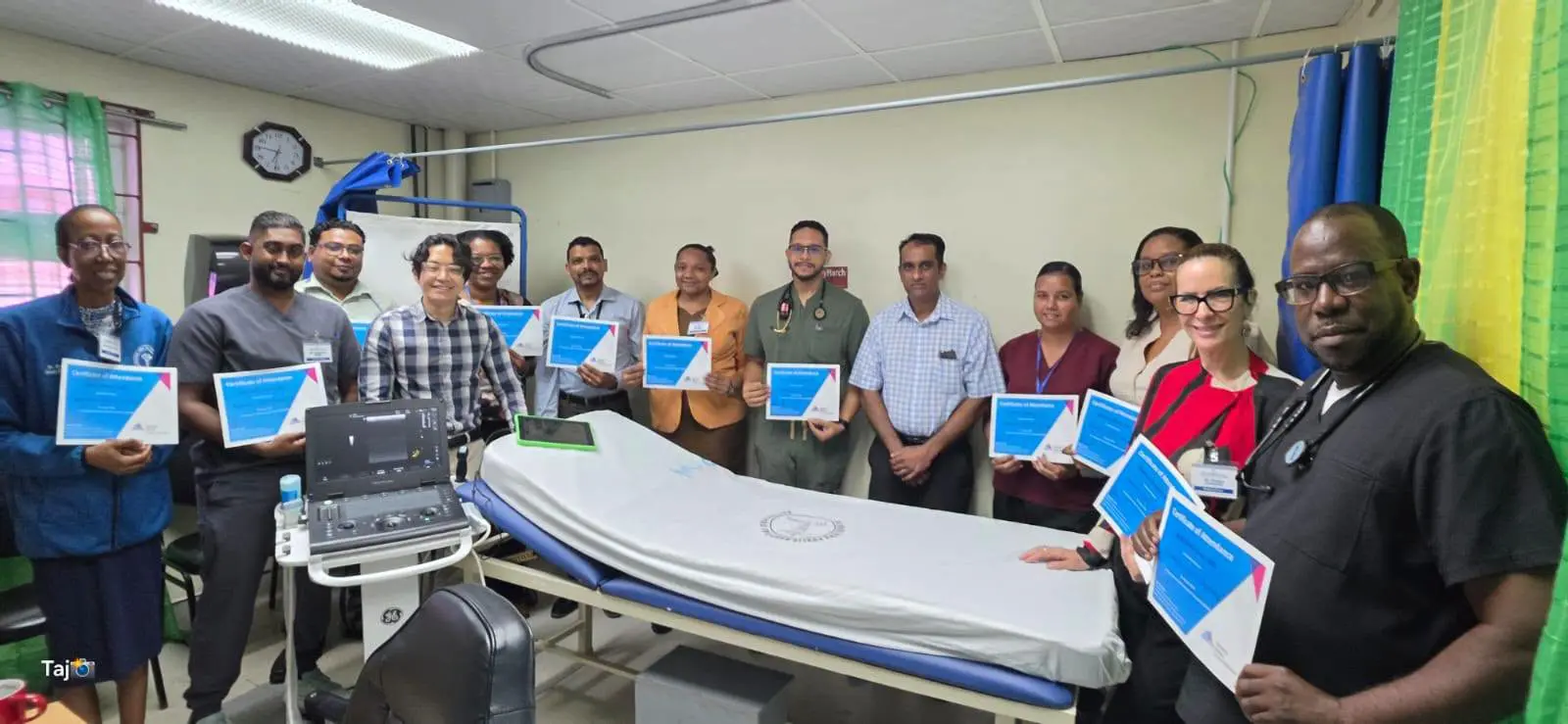
Twelve physicians from across the Georgetown Public Hospital Corporation’s (GPHC) Ambulatory Network have completed training in the use of portable ultrasound technology to support bedside assessments and faster clinical decision-making.
In a statement, GPHC said the intensive two-and-a-half-day Point-of-Care Ultrasound (POCUS) programme was conducted from August 11 to 13 through its continuing collaboration with Mount Sinai International.
POCUS allows trained physicians to use portable machines to conduct focused ultrasound assessments at a patient’s bedside when clinically necessary.
The corporation explained that ultrasound examinations are traditionally conducted by its Radiology Department, requiring patients to be referred or transported there. With POCUS, physicians may obtain information needed to answer certain clinical questions without waiting for radiology personnel or moving the patient.
GPHC stressed, however, that the technology does not replace the Radiology Department or comprehensive diagnostic ultrasound examinations. It is intended as an additional tool for immediate clinical assessment and decision-making.
The programme covered cardiac assessments and lung, renal and biliary conditions, as well as deep vein thrombosis. It combined classroom instruction with practical scanning exercises.
According to GPHC, the technology can help physicians obtain focused information during initial assessments, identify findings requiring further investigation and guide some procedures with greater precision.
While its use is now being expanded across the Ambulatory Network, POCUS has been employed for several years in the hospital’s Obstetrics and Gynaecology Department.
Following targeted training for physicians in that department in 2025, GPHC said it achieved 100% compliance in conducting bedside ultrasound assessments on patients upon admission as of January this year.
Head of the Department of Gynaecology Dr Rafi Rozan said making the technology available to patients presenting at the Obstetrics and Gynaecology Emergency and Admission Suite had long been a priority.
The corporation said the continued expansion of the service should reduce delays and provide clinicians with more immediate information to guide patient care.













Discussion