
In addition to the huge loss of $16.9b for 2025, GuySuCo saw poor results in the field, particularly with planting, leading to a warning from the Agriculture Research Department (ARD) that future ratoon cycles and productivity could be under threat.
The Agriculture Services Department (ASD) noted that production in the industry fell short of its budgeted sugar target by 40,400.3 tonnes. Cane yield decreased by 2.05 TC/Ha (tonnes of cane per hectare) from estimates, while the sugar yield was 3.38 TS/Ha (tonnes of sugar per hectare) against the budget of 4.34 TS/Ha. Sugar recoveries varied widely at the respective factories, with an actual average of 15.65 TC/TS (tonnes cane/tonnes sugar) compared to a budget of 12.84 TC/TS.
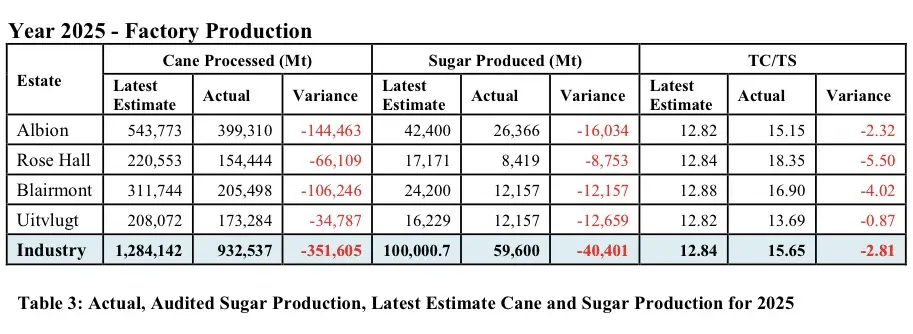
The best TC/TS ratio was at Uitvlugt at 13.69, which meant that it took 13.69 tonnes of sugar cane to produce one tonne of sugar. Utivlugt was never traditionally a top performer and it appears that its performance was better due to the returns from private cane farmers.
At Albion it took 15.15 tonnes of cane to produce one tonne of sugar, the figure was 16.90 at Blairmont and at Rose Hall it was a high figure of 18.35. Rose Hall was the one estate reopened by the PPP/C government but its results have not been good. While the TC/TS figures ranged between 13.69 to 18.35, GuySuCo had been projecting a figure of 12.82 to 12.88. No estate met this target.
During 2025, the ASD said that agronomic activities and production on all estates were generally impacted by low field labour availability and machine downtime.
“The larger issue faced by the industry was the severity of the weather; just to reflect, the industry and Guyana had experienced an extended La Niña, which began in November 2020 and ended in mid-2023. During that extended period of La Niña (also known as the “triple dip” anomaly), the 2021 flood affected the Country and adversely impacted production within the industry, the corporation is still recovering from the 2021 flood due to the limited machine operations available days from 2021 to 2024. After this La Niña period, the country experienced the opposite climatic condition, which was an El Niño (drought) for the 2nd Crop of 2023 to the end of 2024. The El Niño (drought) conditions experienced during both crops resulted in a significant amount of canes being water-deprived, as the water demands for both Plant and Ratoon Canes were far more than the industry’s ability to respond optimally. This resulted in growth stress in 2024 on the sugarcane plants; that is, the mature sugarcane plants did not have the desired height, girth, weight and quality. The effects of 2024 also had a significant impact in 2025, which resulted in a reduction in the stool population”, the ASD said.
The figures for land preparation and planting were dismal.
Land preparation and planting recorded a total of 1,446.6 and 2,052.6 hectares, respectively; or 23.92% and 31.32% achievement of their respective 2025 programme. Labour attendance was a problem on all estates.
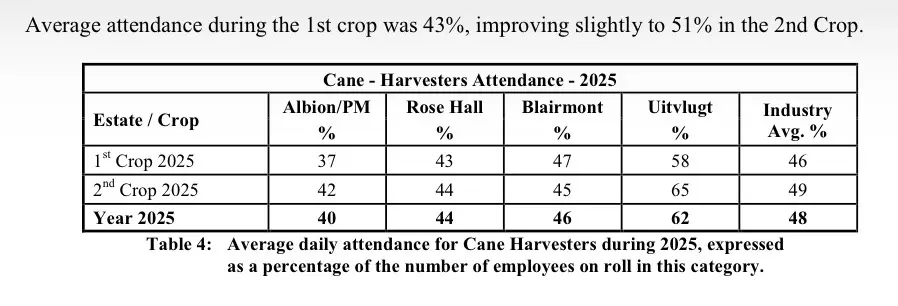
The average attendance of Cane Harvesters slightly increased in the 1st Crop of 2025; from 43% in 1st Crop 2024 to 46% in 2025 and slightly decreased from 51% in 2nd crop 2024 to 49% in 2025. The year’s average was 48% compared to the average of 47% for 2024.
“Agriculture operations continue to suffer from low labour turnout, particularly Cane Harvesters; this (has) affected the harvesting rate and the delivery of fresh canes at the optimal age/ maturity to the factories with a negative impact on recoveries”, the report stated.
The report said that the estates completed 2,052.6 hectares of planting against a budget of 6,554.4 hectares (31.3% achievement), which is a decrease against the previous year when 83.3% of the budget was achieved.
“The reduced availability of manual planters created an achievement problem for the Estates; hence, the shift to alternative methods such as semi-mechanical or fully mechanical planting is necessary and is continuously (being) incorporated. The level of supplying required in fields that were semi-mechanically planted continues to be high, indicating the need for greater attention to quality/standards of work in this method of planting. Most of this work was done during the out-of-crop periods or when planters were not engaged in planting; the effort was concentrated on repairing prime-cycle”, the report stated.
The adequate availability of agro chemicals was a challenge during different periods of the year, the report acknowledged. The timely application of both LGRP (low-grade rock phosphate) and fertilizers was also affected throughout the year by labour shortages, and downtime of the mechanical applicators and tractors in use. In addition, field layout limited use of mechanical methods. Albion and Blairmont Estates used their available labour on LGRP application during the land preparation periods, at the expense of timely fertilizing of canes. On December 31, 2025, the report said that the estates had a total of 5,454.3 hectares of unfertilized canes.
“The shortage of labour across the estates continues to affect the timely relieving and cleaning of harvested fields, further delaying, and in some instances preventing, the application of pre/early post-emergent herbicides”, the report said.
Despite several challenges, the GuySuCo 2025 report said that Private Cane Farmer’s overall performance during 2025 saw meaningful improvements in several key areas over the previous year, 2024. The area of significant improvement was in production where there were increases of 44.2%, 37.8% and 54.5% in hectares harvested, tonnes cane reaped and tonnes sugar produced respectively.
The top five contributors in production were P. Ramraj with 1,126 tonnes (31.2%), followed closely by T. & H. Deonarine with 952 tonnes (26.4%), P. Chandar, R. Ramharack and Gaimchand with 284 (7.9%), 255 (7.1%) and 220 (6.1%) tonnes respectively.
The ARD said that the Agricultural Research Centre (ARC) continues to operate under significant constraints.
“The most critical issue is the shortfall in planting programme delivery—only 29.9% of the planned 6,241 ha was achieved in 2025, with three estates below 35% of targets—threatening future ratoon cycles and productivity. Additionally, the continued dominance of older, lower-yielding varieties (D 9017, DB9969, and DB9633 covering 70% of the area) highlights the urgent need for varietal renewal. Labour shortages in key operations, including rodent control, spraying, and variety trials, continue to limit progress, compounded by restricted rodenticide options. At CAEMS, ageing laboratory equipment such as fume hoods and polarimeters requires replacement. While drone operations offer strong potential, reliability issues persist due to battery constraints and operator certification gaps in both contractor and in-house fleets”, the ARC said.
According to the GuySuCo report, revenue in 2025 was $9.1b compared to $9.3b in 2024. The cost of sales was a massive $27.6b in 2025 compared to $22.5b in 2024. When administrative and other expenses were taken account of, GuySuCo’s operating loss for 2025 was $15.5b compared to $9b in 2024. With its finance cost and employees retirement benefits factored in, its loss before taxation was $23b in 2025 compared to $15.2b in 2024. The government’s $5.9b subsidy in 2025 helped to bring the sugar corporation’s total loss down to $16.9b. The government’s subsidy in 2024 was $11.9b.
As it relates to production, GuySuCo Chairman Paul Cheong said “The year 2025 was marked by both improved sugar production and significant operational challenges. GuySuCo produced 59,600 metric tonnes of sugar, representing an increase of approximately 26.5% over the 47,108 metric tonnes produced in 2024. Notwithstanding this improvement, production represented only 59.6% of the latest estimate of approximately 100,001 metric tonnes, resulting in a shortfall of 40,401 metric tonnes”.











Discussion