
Guyana’s electricity grid has recorded its highest-ever peak demand at 242.64 megawatts, as rapidly rising consumption, extreme heat and an expanding economy place unprecedented pressure on the country’s power infrastructure.
The warning came yesterday during a press conference involving Prime Minister Mark Phillips, Minister of Public Utilities and Aviation Deodat Indar, senior officials of Guyana Power and Light (GPL) and other energy-sector stakeholders.
Officials said demand, which stood at about 221 megawatts at its peak last year, could climb to approximately 266 megawatts during August, September and October traditionally Guyana’s hottest months.
Indar said the situation is being driven by a combination of factors, including unusually high temperatures, population growth, new housing developments, commercial and industrial expansion, and the rapid growth of Guyana’s economy.
The number of GPL customers has increased from approximately 204,000 in 2020 to 250,000 as of the end of July 2026, an increase of about 46,000 customers.
Peak demand has also nearly doubled over the same period, rising from about 125 megawatts in 2020 to 242.64 megawatts today.
Officials stressed, however, that the immediate problem is not simply a shortage of generation capacity.
Instead, several parts of the transmission and distribution network are struggling to carry the increased load, resulting in overheating, voltage fluctuations and feeder trips during peak periods.
Thermal limits
In Region Four, GPL officials identified several areas where transmission and distribution infrastructure has reached or exceeded its thermal limits.
One feeder serving the Sophia-Ogle-Sussex corridor is designed to carry approximately eight to nine megawatts, but increased demand has pushed the system beyond that capacity.
Officials said the feeder experienced several trips during a recent peak period.
GPL has since shifted some of the load onto another feeder to reduce the pressure and prevent further outages.
Similar problems have been identified along the East Bank corridor, where increased housing, industrial activity and commercial development have placed additional pressure on existing lines.
A new parallel feeder is being constructed there and is expected to take approximately three months to complete.
Officials said the intervention will allow GPL to progressively remove some of the load from the existing line.
Region Three is also facing significant pressure.
Demand there has risen from approximately 26 megawatts to 41 megawatts, while available generation capacity is about 26.1 megawatts.
Power is therefore transferred from Georgetown across the Demerara River to supplement Region Three.
However, the existing underwater cable is only considered safe for approximately seven megawatts of bulk transfer because of previous damage and repairs.
Officials said the cable recently carried approximately 15 megawatts more than double its normal safe transfer level to meet demand.
Indar warned that repeatedly pushing additional power through the damaged cable could overheat and damage it, potentially creating an even greater supply problem.
Princes Street
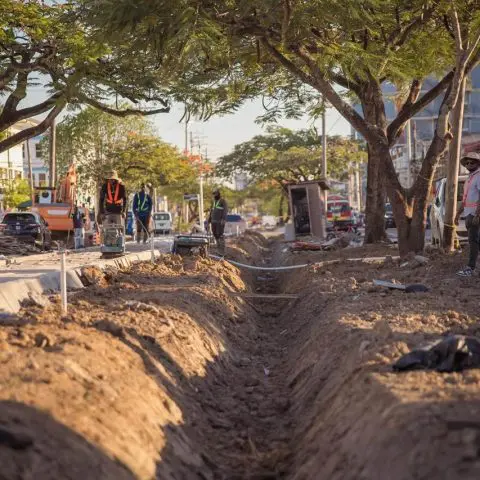
As an immediate intervention, a second cable is being installed between Princes Street and Riverview to increase the transfer capability.
A larger underground cable project is also being pursued under an existing contract, with the new installation expected to allow substantially more power to move across the river and eventually facilitate dredging in the area.
In Region Five, an aging transmission line that carries power toward Berbice is also under pressure.
The line, constructed decades ago, is now carrying more than 25 megawatts and is vulnerable to trips caused by interference near the transmission corridor.
A new high-voltage transmission line is being constructed from the Eccles area toward Williamsburg to replace the aging infrastructure and strengthen the system supplying Berbice.
In Region Six, recent voltage fluctuations were severe enough to affect water-production facilities.
Officials said two large customers were temporarily removed from the system and voltage stabilisation measures were implemented.
Another 2.2 megawatts of generation is expected to be connected directly to feeders in the area over the weekend to reduce the amount of power being pushed through a single cable.
A 4.5-megawatt Hyundai generator at Canefield is also expected to return to service within approximately three weeks after repairs to its turbocharger.
Despite the problems across the transmission and distribution network, officials said generation capacity is being increased.
Reliable generation currently stands at approximately 256 megawatts.
A new 9.3-megawatt engine is expected to come online by Monday, bringing available generation to about 265 megawatts.
By the end of August, officials expect additional interventions including the return of the 4.5-megawatt generator, another 5.5 megawatts from an engine undergoing overhaul, and approximately five megawatts from the power ship to bring total generation capacity to approximately 280.3 megawatts.
Officials said that level should provide a greater reserve over the projected peak demand of approximately 266 megawatts.
The government also expects additional generation from the Gas-to-Energy project, including a turbine expected to provide approximately 57 megawatts.
Since taking office in 2020, officials said the government has added approximately 196 megawatts of additional generation capacity.
The government is also turning to conservation measures to reduce pressure on the grid.
Government ministries and agencies will be instructed to switch off unnecessary lighting and equipment after working hours.
Officials also identified large floodlights at sporting facilities and other locations that remain on when no events are taking place.
The Ministry responsible for sport and culture is being asked to ensure those lights are switched off when they are not needed.
Large commercial and industrial customers with their own generation capacity are also being asked to remove themselves from the GPL grid during peak periods where necessary.
Officials said three major customers have so far been asked to do so, accounting for roughly three megawatts of demand.
The government is also encouraging households and businesses to reduce unnecessary electricity consumption, particularly during the evening peak.
Region Ten
Region Ten is facing a different challenge, with demand exceeding the available generation capacity of the Linden system.
Officials said demand recently peaked at 15.1 megawatts, while the BOSAI generation facility was producing approximately 14.1 megawatts.
The increase is being attributed largely to the growth of the sawmilling industry.
Officials said 32 sawmills are currently operating in Region Ten, with high-powered machinery placing substantial additional demand on the grid.
The government and Linden Electrification Company are therefore engaging sawmill operators to shift their operations away from peak periods.
Officials said most of those who attended an initial meeting had generally agreed to the proposed arrangement, with further discussions planned with the remaining operators.
Authorities are also examining cases where sawmills and residential properties share a single electricity connection and are seeking to separate the commercial and household connections.
An additional three megawatts of generation is also being discussed for Linden.
Meanwhile, solar projects are expected to add further capacity, including approximately seven megawatts from projects targeted for completion by the end of the year.
Prime Minister Phillips said the current strain on the electricity system cannot be blamed solely on the El Niño weather event.
He said the weather phenomenon is amplifying an existing problem created by rapid economic growth and increased electricity consumption.
The expansion of housing, roads, schools, hospitals, hotels, commercial facilities and industrial operations is driving demand for electricity.
Phillips pointed out that a new large hotel can consume approximately one to 1.5 megawatts of electricity, illustrating the additional burden being placed on the grid as development accelerates.
Officials said the combination of extreme heat and economic expansion has created the current peak-demand conditions.
The government also outlined plans to modernise GPL’s transmission and distribution network.
Approximately 425 kilometres of 13.8-kilovolt infrastructure are currently under active contracts and execution.
Officials also reported extensive maintenance work, including the replacement of about 1,000 transformers this year, 104 kilometres of network extensions and substantial replacement of conductors and other feeder components.
Emergency response contractor teams
GPL currently has 81 emergency response contractor teams operating across the country to respond to outages.
Longer-term plans include the development of a smart grid, supported by information technology and advanced metering.
Officials said the technology should eventually allow GPL to identify electricity theft remotely and improve the company’s ability to monitor the network in real time.
Officials maintained that there is currently no need for widespread electricity rationing.
With generation expected to increase from approximately 256 megawatts to more than 280 megawatts by the end of August, the government expects the additional reserve capacity to ease pressure on the system.
The immediate concern, however, remains the condition and capacity of specific transmission and distribution infrastructure.
Officials said interventions are therefore being targeted at individual problem areas rather than treating the entire national grid as a generation shortfall.











Discussion