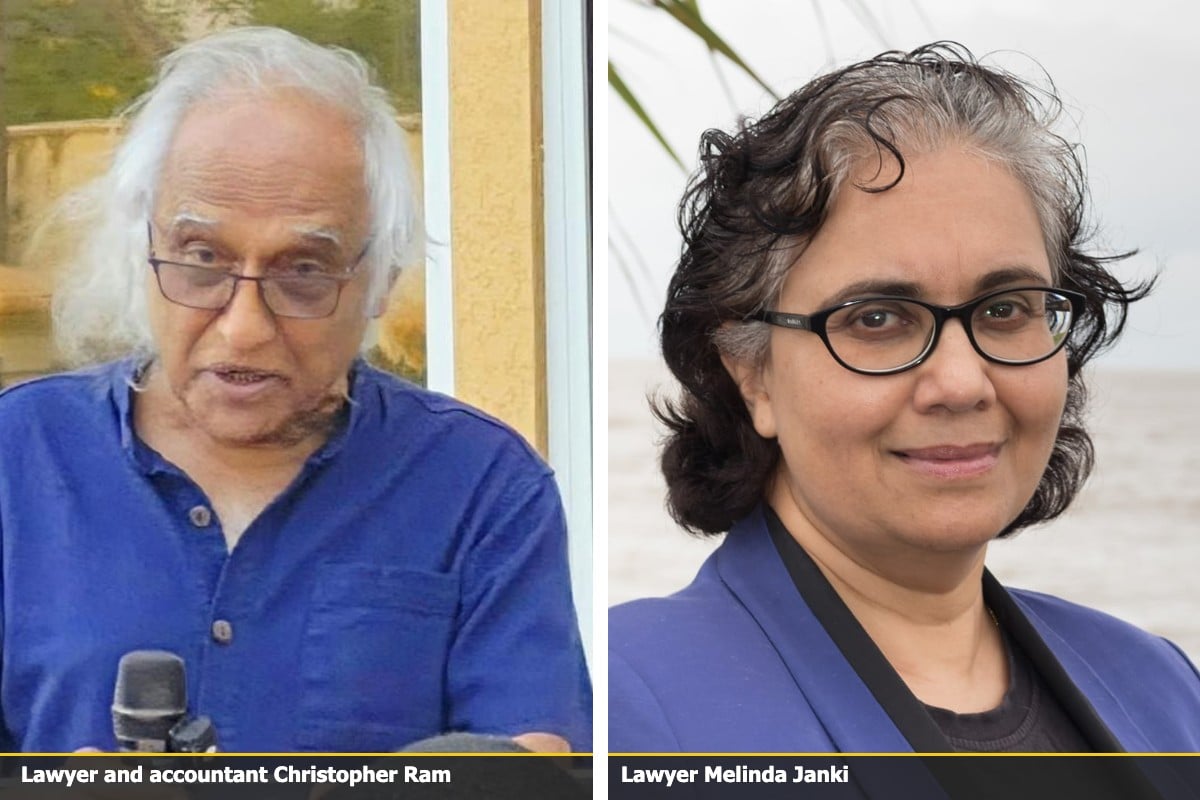
President Irfaan Ali has been severely criticized by attorneys Christopher Ram and Melinda Janki over his claim in a recent Al Jazeera interview that the `sanctity of contract’ prevented any changes to a bad deal with ExxonMobil.
In a letter in the September 16 edition of Kiskadee Watch Janki said that the President did not seem to comprehend the difference between renegotiation and sanctity of contract.
“Sanctity of contract is simple – you have to do what you agreed to do in the contract. You cannot break a bargain because you don’t like it any more. Business depends on the simple proposition that you do what you promised to do in the contract or else you pay the other person for the loss they suffered because you broke your promise.
“Renegotiation is an entirely different matter. The parties to an agreement were free to enter into the agreement. They are also free to come back and change it if they wish. If President Ali reads the Petroleum Agreement he will see that Article 31.2 of the Petroleum Agreement says: `This Agreement shall not be amended or modified in any respect except by written agreement entered into by all the Parties which shall state the date upon which the amendment or modification shall become effective.’”
Janki, who has taken up several public interest cases against ExxonMobil here said that the three companies in the Stabroek Bloc – Exxon, Hess and CNOOC – are here to make money for their investors.
“They will renegotiate if they get something advantageous. They will not (and should not as commercial entities) reduce the return to their investors unless there is some compelling legal or business reason to do so. In-country lamentations about exploitation and unfairness don’t count”, she declared.
Janki added that there is no guarantee that President Ali and his government will negotiate better than the Granger administration. “President Ali’s stewardship of Guyana’s energy sector has been unimpressive. Renegotiation is likely to make Guyana even worse off”, she declared.
Circus
In the 201st installment of his oil and gas series in today’s Kiskadee Watch Ram called for the “sanctity of contract circus” to come to an end.
He said that Ali recycles the argument so often that it is now official doctrine. Ram said that Ali knows no serious critic is suggesting Guyana should renege on the Agreement.
“Reneging means refusing to honour a contract; renegotiation means asking the other parties to agree to different terms. If they agree, the amended agreement becomes the contract to be honoured. Ali’s conflation of the two is not merely mistaken but disingenuous. It turns a lawful request for better terms into an accusation of contractual dishonour and smacks of evasion.
“Guyana cannot compel renegotiation or impose an amendment unilaterally. But it can ask. The contractors may refuse. What remains difficult to explain is why the Ali Administration refuses to ask”, he stated.
He pointed out that the sanctity argument is undone by facts Ali rarely acknowledges. Ram pointed out that the 1999 Petroleum Agreement was replaced by the 2016 Agreement, itself the product of a renegotiation of the contractual relationship. He noted that Exxon’s own then Country Manager described the 2016 PSA as a renegotiation. Further, the 2016 Agreement was later amended in 2019 over the treatment of the 2% royalty.
“Did Ali not know about sanctity when, before taking office, he thunderously promised to `review and renegotiate’ the petroleum contracts? Or is sanctity a principle he discovered only after assuming office? His earlier commitment is a matter of public record. In February 2020, he said everything was on the table for review and renegotiation”, Ram asserted.
Noting that Exxon’s affiliate Esso is the Operator conducting the day-to-day activities, Ram said that the Contractor comprises three parties: Exxon, Chevron and CNOOC and that the PSA makes the obligations of the parties comprising the Contractor joint and several.
Ram therefore suggested that the Guyana Government should write formally to each of the companies, setting out what Guyana proposes to discuss and request individual responses. Ram, also a chartered accountant, said that Ali recently spoke of obtaining experts on contract financing in an area where the Agreement gives Guyana limited direct control. Yet on the fundamental legal question whether the State may formally seek consensual amendments to an agreement worth many billions of dollars to the country, no considered legal opinion has been placed before the public, he lamented.
“If the Government is serious, it should stop speculating about what the companies might do, and proceed to establish. Put a formal written proposal to Exxon, Chevron and CNOOC separately, identifying the provisions Guyana wishes to revisit, and publish the responses. If all three refuse, the country will at least know that the companies have closed the door. Until then, every assertion that they would “walk away” is conjecture being used to justify inaction”, Ram declared.
He argued that Ali “must stop the charade and come clean with the public. If his Administration has made a political decision that the 2016 Agreement will not be touched, let him say so plainly, and boldly accept responsibility for that decision. He should stop dressing a policy choice in the language of legal inevitability”.











Discussion