
he South Rupununi District Council (SRDC) has joined the growing support for Chinese Landing residents in their ongoing standoff over mining equipment, warning that the dispute raises serious questions about Indigenous land rights, community authority and the protection of ancestral lands.
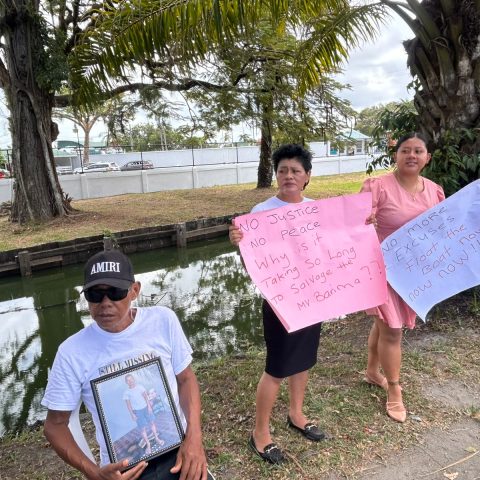
The Council, in a statement issued on August 28, said it was particularly concerned by reports that residents have maintained a round-the-clock presence to prevent heavy equipment from entering areas in Tassawini that are at the centre of the dispute.
It said the Chinese Landing Village Council has maintained that it did not consent to the movement of the equipment.
The SRDC said Indigenous communities should not be forced to physically position themselves between heavy machinery and their lands simply to have their concerns heard.
The Council called on the Government, the Guyana Geology and Mines Commission (GGMC), the Ministries of Natural Resources and Amerindian Affairs and other relevant authorities to intervene to prevent further escalation and ensure the safety of residents.
The SRDC also took issue with how a 2017 Caribbean Court of Justice (CCJ) ruling involving miner Wayne Vieira has been characterized.
It rejected suggestions that the ruling established Vieira as the winner of the Chinese Landing land dispute.
According to the Council, the CCJ was instead dealing with whether a GGMC officer had the legal authority to issue a 2010 Cease Work Order against Vieira under the Mining Act and its regulations.
The Court found that the officer did not have that statutory authority, the SRDC said.
The Council therefore argued that the ruling should not be interpreted as a finding that Vieira owns Chinese Landing’s titled lands, nor as having settled the wider issues of Indigenous land rights, mineral rights, environmental protection or the authority of the Village Council.
“The CCJ ruling should be understood and represented according to what the court actually determined,” the SRDC said.
The Council maintained that a mining licence, permit or other authorization does not, by itself, settle questions concerning Indigenous land rights, environmental protection, consultation or consent.
It said any resolution of the Chinese Landing dispute must consider the legal status and history of the community’s title, the authority of the Village Council, applicable mining laws and the principle of Free, Prior and Informed Consent (FPIC).
The SRDC is also calling for mediation, but said any such process must be conducted fairly and without intimidation or pressure.
It wants the Village Council recognized as the legitimate representative of the community and said residents should have access to independent legal and technical advice, as well as sufficient information and time to assess any proposals.
The Council further warned that mediation should not be used merely to defuse the immediate confrontation while leaving the underlying land and Indigenous rights issues unresolved.
The SRDC also referenced precautionary measures granted by the Inter-American Commission on Human Rights (IACHR) in 2023 in favour of members of the Indigenous Carib Community of Chinese Landing.
It said the IACHR had identified serious and urgent concerns regarding the beneficiaries’ rights to life and personal integrity in the context of opposition to mining activities.
The Council is urging the authorities to give meaningful attention to those measures and take steps to safeguard members of the community.
Beyond the immediate dispute, the SRDC is calling for stronger protections for Indigenous territories and the natural resources on which communities depend, including rivers, forests, farms, hunting grounds and fishing areas.
It is also seeking repairs to roads and pathways allegedly damaged by activities linked to the current dispute.
The Council has urged Toshaos, Village Councils, Indigenous communities and the National Toshaos Council to stand with Chinese Landing.
It said the developments there should be viewed as a wider Indigenous rights issue, arguing that what happens to one community can have implications for others across Guyana.
“When the rights of one Indigenous community are threatened, the rights of all Indigenous communities are at risk,” the SRDC said.








Discussion