-as diaspora voices hopes and concerns
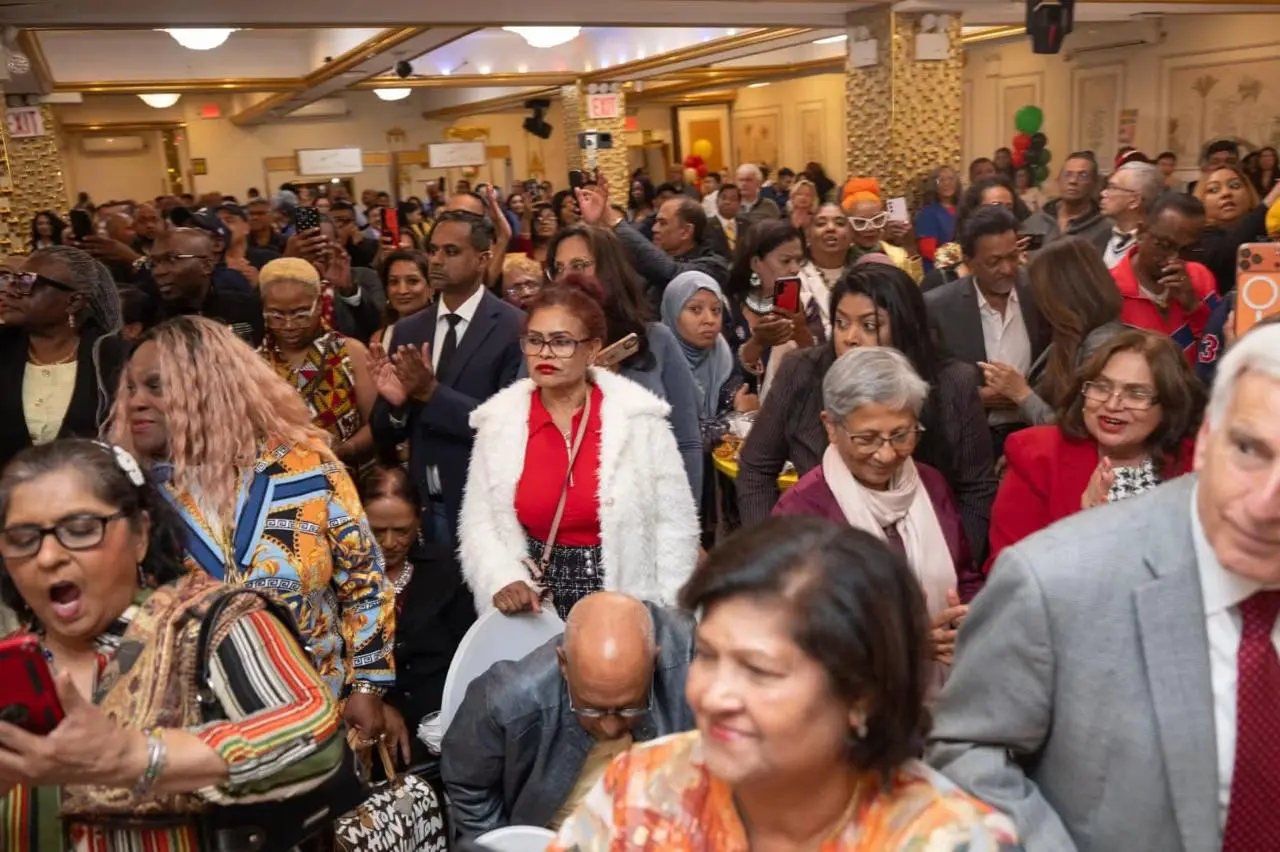
Some want to rebuild their lives in Guyana, while others say they have no plans to return permanently. Members of the Guyanese diaspora in New York shared contrasting views about life back home ahead of a packed meeting with President Irfaan Ali on Thursday evening.
The views were captured in a live video by Yvonne Deonarine as Guyanese gathered outside the Jericho Palace Banquet Hall in Queens Village, New York, waiting to be allowed inside to meet the President.
The event attracted a major turnout, with Guyanese from New York, Florida, other parts of the United States and Canada travelling to be part of the engagement.
For some, the prospect of returning home remains very real. Persons interviewed said they could see themselves eventually coming back to Guyana, with some expressing a desire to build houses and establish themselves back home.
Others said they did not see themselves returning to Guyana to live permanently, saying they would only come back in an emergency or when necessary.
Several persons nevertheless acknowledged developments taking place under the Ali administration, particularly infrastructure projects, the construction of new highways and the establishment or expansion of various industries. But even among those who praised the developments, there was a recognition that more changes are needed. Healthcare was one issue that produced contrasting views.
Some persons pointed to Guyana’s free healthcare system as an advantage over the United States, where healthcare can come with significant costs. Another woman interviewed during the live video, however, offered a different perspective, saying she did not trust the Guyanese healthcare system as much as she trusted the healthcare system in the United States.
MV Barima
The MV Barima tragedy also featured prominently among the concerns raised by persons outside the venue. One Guyanese woman said she hoped the President would ensure that the families affected by the tragedy are properly taken care of and that a full investigation is conducted. She said accountability was necessary and that the circumstances surrounding the disaster must be established to help prevent a similar tragedy from occurring again.
The MV Barima sank on July 18 while travelling from Georgetown to Port Kaituma, resulting in a major search-and-recovery operation and the deaths of dozens of people.
Addressing the gathering on the concerns surrounding the vessel, Ali said there was “nothing to hide” and pointed to the Commission of Inquiry and the ongoing process to select a company to salvage the vessel.
“Let me make it very clear, there’s nothing to hide, we’ve appointed one of the most accredited commission of enquiries you can find,” Ali said.
He said the Commission of Inquiry had started its work and that the government subsequently went through a public tender process to identify a company capable of salvaging the vessel.
“If the president has picked a company, they can say he picked a friend. We went through a public process,” Ali said, adding that bids had been received and were being evaluated by technical personnel.
He said the process would result in the selection of a company to undertake the salvaging of the MV Barima.
“That is the reality. We are not hiding from salvaging. There is a process and that process is ongoing,” the President said.
Ali also said he would not interfere with the work of the Commission of Inquiry.
“We are not hiding from investigation. The COI is doing its work right now. I will not interfere with the work of the COI,” he said.
“We are not going to shy away from any question. We are going to address every single question.”
More than two months after the tragedy, hearings by the COI have not begun and the vessel is still to be salvaged.
A letter submitted to Kiskadee Watch by commentator Vishnu Bisram described the turnout as the largest he had personally observed at a Caribbean leader’s diaspora engagement over nearly five decades of reporting.
Bisram estimated that about 2,000 people were outside, with many reportedly waiting for more than two hours to enter a venue that could accommodate only a fraction of the crowd. Some people reportedly left after waiting.
When Ali arrived, however, he stopped outside the banquet hall and greeted members of the crowd before making his way inside.
Photographs of Ali interacting with members of the diaspora were subsequently shared on his Facebook page. Inside, hundreds of Guyanese filled the banquet hall for the President’s meet-and-greet.
Not the same
Ali also told Guyanese that the country they left behind is changing rapidly.
“Guyana is not the same as you knew it. Guyana is punching in every ring. We’re in every conversation,” he said, adding that the country is preparing for “the second phase of transformation.”
Ali pointed to what he described as 160,000 new jobs, more than 50,000 households, over 5,000 kilometres of new roads, more than 100 new schools and extensions to more than 160 existing schools as achievements over the past five years.
Looking ahead, Ali outlined an ambitious development agenda that includes a deep-water port, additional power generation, the Wales Economic Development Zone, data centres, port facilities, hotels, hospitals, airport expansion, a fertiliser plant and a gas bottling facility.
He said the scale of Guyana’s expansion requires greater investment in people, skills and technology, while maintaining the country’s openness to international expertise and capital. Education and healthcare also featured prominently in his presentation.
Ali pointed to free tertiary education opportunities, thousands of scholarships and expanded teacher training as measures aimed at preparing Guyanese for the emerging economy.
He also highlighted specialised cardiac surgery for children at no cost to families and plans for a modern oncology centre of excellence and a women and maternal hospital.
The President announced plans to modernise public-service delivery through digital platforms and introduce a national payment system to make transactions more accessible to Guyanese at home and abroad.
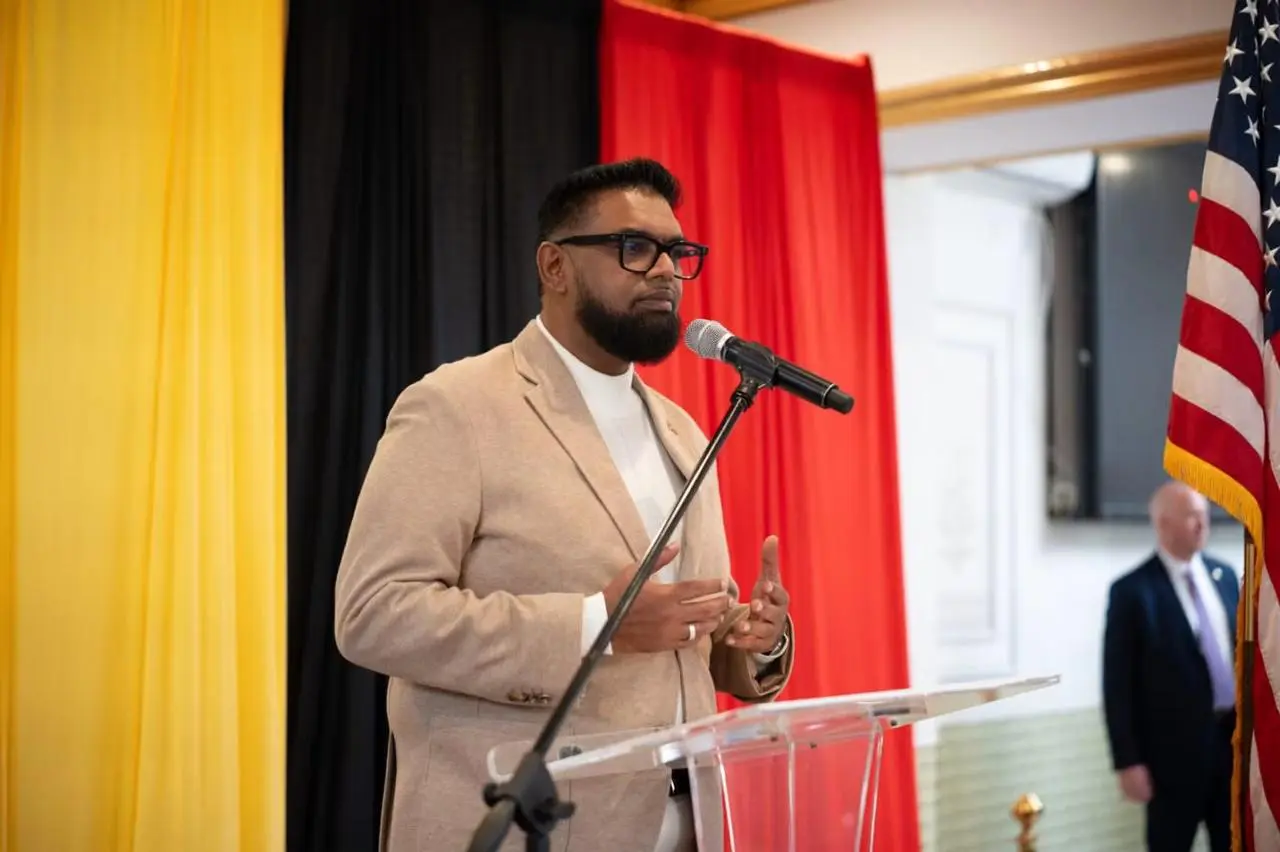
Ali encouraged Guyanese living overseas to maintain their connection with Guyana and take advantage of investment opportunities emerging across the economy.
He announced that a special investment vehicle will soon be launched to mobilise resources from the diaspora for projects including the planned fertiliser plant and gas bottling facility.
“Our diaspora is an important part of Guyana’s development,” Ali said. “No matter where you live, this land remains home and you have an important role in shaping its future.”
He thanked the diaspora for its love, support and commitment to Guyana, describing the turnout as a powerful reminder of the connection overseas-based Guyanese continue to have with their homeland.
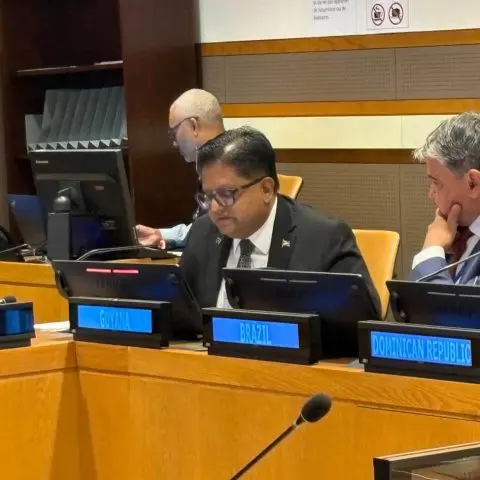
The President also reflected on Guyana’s presence at the United Nations earlier in the day, saying he became emotional while witnessing CARICOM leaders show their support for Guyana’s candidate for Secretary-General of the United Nations.
Ali criticised what he described as negative coverage by two Guyanese news outlets of the candidate’s prospects, saying they chose to focus on reports that the United States would veto the candidacy. He did not identify the outlets but this report was carried by Kiskadee Watch.
Ali said that rather than repeating that narrative, patriotic behaviour required citizens to make the case for their country and its candidate.
Protest
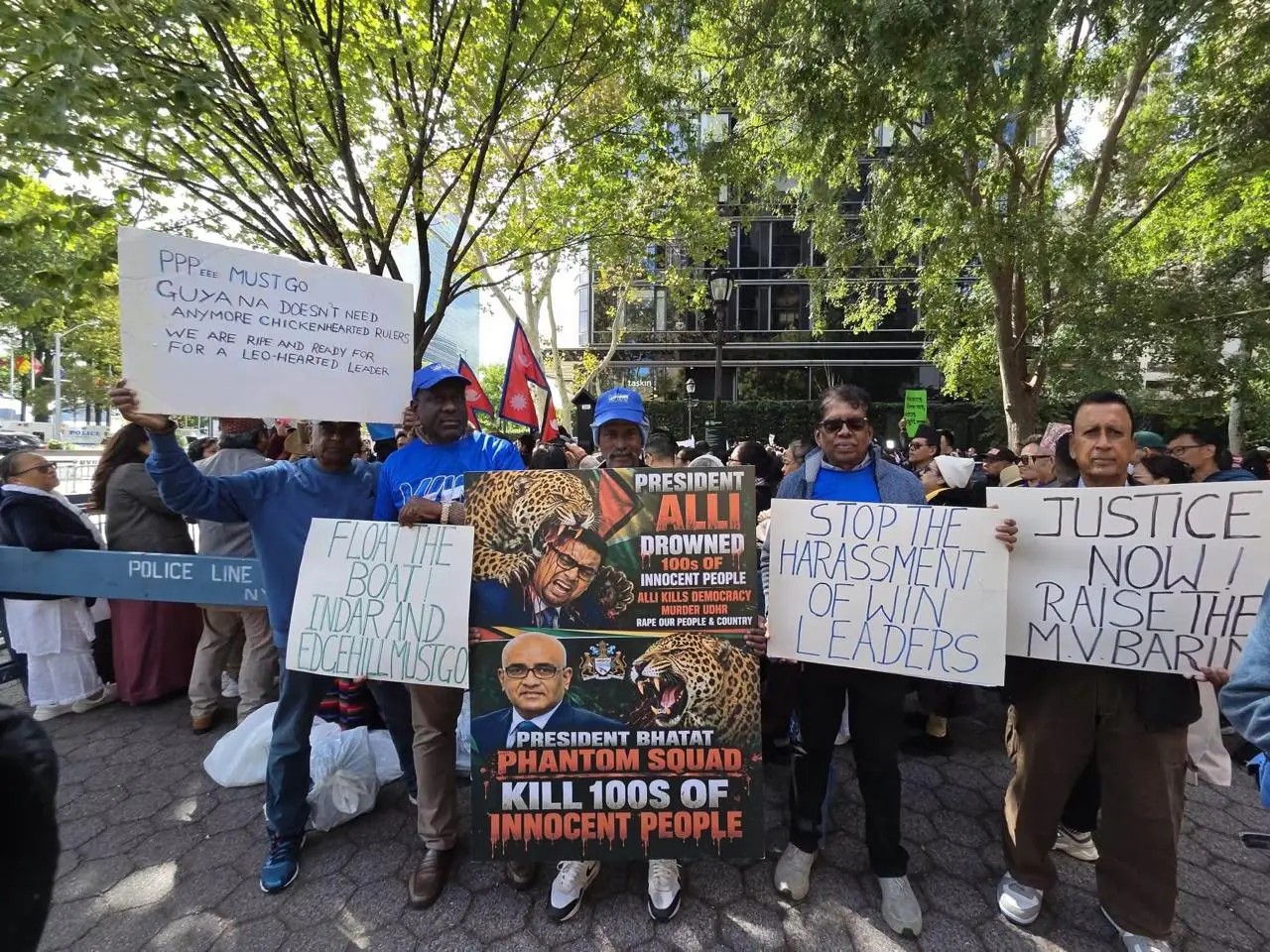
Earlier in the day, while Ali was delivering Guyana’s address to the United Nations General Assembly, supporters of the opposition We Invest in Nationhood (WIN) Party staged a protest outside the UN headquarters.
The WIN New York Chapter said the protest was intended to highlight what it described as the “harsh realities” facing Guyanese at home.
The protesters raised concerns including alleged political persecution of Opposition Leader Azruddin Mohamed, Opposition MPs, staff and supporters, poverty and the cost of living, democracy and human rights, judicial independence, alleged political interference in policing, corruption and a lack of accountability.
The MV Barima tragedy was among the central issues raised.
The protesters demanded: “RAISE THE BOAT!”
They called for the vessel to be recovered, evidence preserved, the full circumstances surrounding the disaster established, those responsible held accountable and affected families properly compensated.
The protest took place as Ali delivered his address to the General Assembly, during which he spoke about inequality, the rule of law and development.
Ali said there could be no enduring prosperity where inequality deepens and spoke of a world where law restrains power. He also said development must not merely make economies richer, but must make societies better.
WIN supporters said those principles must also apply in Guyana.








Discussion