-says Guyana on the way to becoming another sclerotic petro-state
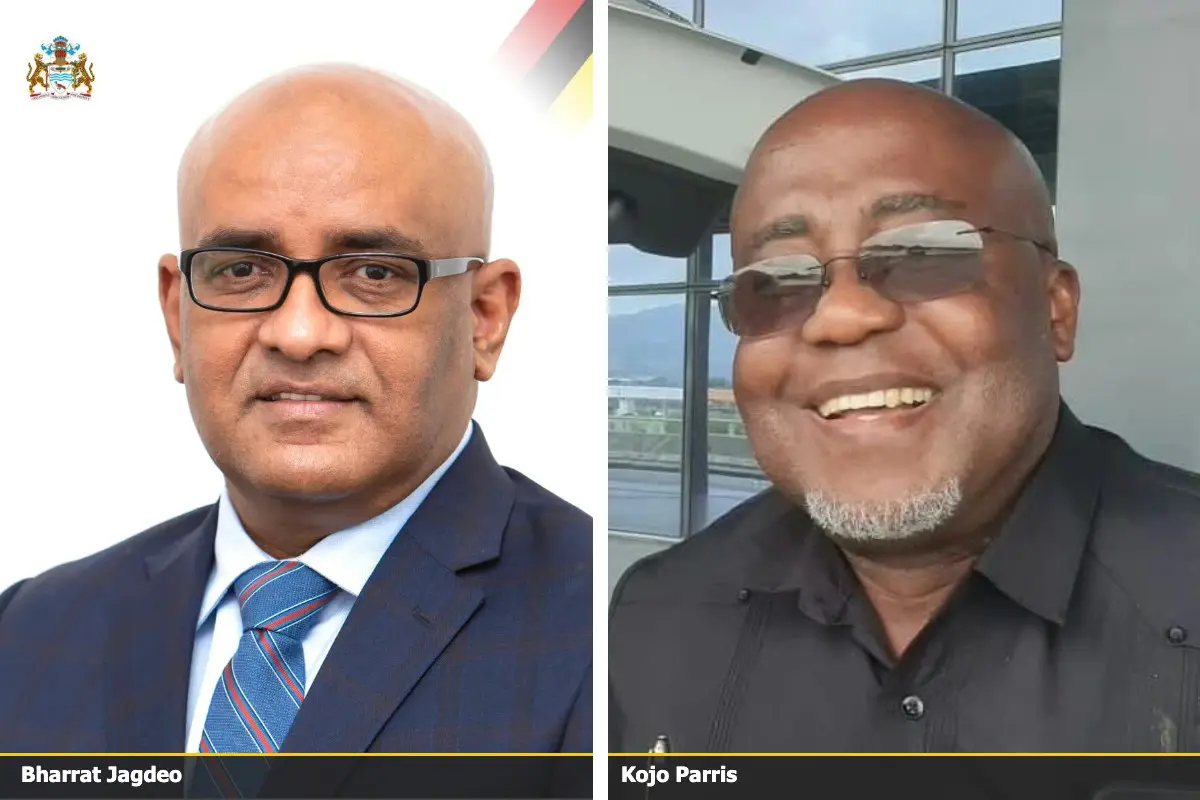
Investment banker turned social entrepreneur, Kojo Parris says it is time that Vice President Bharrat Jagdeo steps away from politics so that serious problems besetting the country such as the alienation of Afro-Guyanese and the governance structure can be addressed.
In a September 10 column in Kiskadee Watch entitled `The courage to become unnecessary’, Parris traced his connections with Jagdeo and underlined why the role being played by the Vice President is detrimental to the advancement of the country in key areas.
Parris, the son of longstanding PNC executive, Malcolm Parris, was full of praise for Jagdeo’s political work. He said that Jagdeo had few equals in Guyanese public life for sheer political capacity, work rate and tactical focus.
“His achievements are many and real, and some are the stuff of proud legacy. Almost singlehandedly he returned Indo-Guyanese, especially the rural cohorts, and much of the Amerindian population, to our political and social mainstream. I am convinced this, more than anything this will be his uncontestably transformative legacy and has been the single most valuable post-1992 achievement in our country. And the Low Carbon Development Strategy (LCDS) elevated Guyana as a genuinely original and innovative voice on the world stage. These alone are massive achievements”, Parris said.
He, however, argued that these are incomplete artefacts of nation building.
“The work of bringing one part of the nation in from the cold matters only if it leaves no other part feeling alienated, or transactionally included. As it was for the Indo-Guyanese communities before 1992, Afro-Guyanese and other non-ethnically defined groups now feel excluded, or at best transactionally included. And until that is remedied we cannot begin to focus on whether poverty is crowded out by a society at peace with itself, one proud not to litter, public servants ready to serve, in every community, regardless of political beliefs or cultural orientation”, Parris asserted.
He said that this larger work has stalled and even reversed and he blamed the governance architecture which he said is increasingly dysfunctional.
Parris charged that the system is built around a narrow executive, in which the governing party’s operating model replaces the State’s – a centre of gravity located in Freedom House, the headquarters of the PPP, not State House or Parliament.
“The problem is not just that Jagdeo pontificates on almost every substantive matter; it is that his exceptional authority has created perverse incentives beneath and around him. Difficult decisions travel upward. Officials wait for political cover. They draw influence from proximity to him, and citizens learn that access works better than process. And personal centrality at the top produces institutional stasis below. Formal systems ossify, and are thus bypassed, so they stay unexercised, weak, and because they stay weak, still more intervention …to (make) the system seem functional – Ministerial Outreaches – appears necessary”, he argued
He described Ministerial Outreaches as an awful charade of access theatre, shouting loudly at the systemic dysfunction.
“And for the citizen who reaches the right official, on the right day, the result can be gratifying, breathlessly splashed across social media. But for the 95% who did not win that day’s lottery of access, the lesson is corrosive. Why endure a ministry’s bureaucracy if a call to someone powerful works better? Access accretes value, discretion displaces process, and once responsive government hardens into the very distortion that makes further intervention necessary. This is how clientelism infects the soul of our people, nurturing a cynical descent into ‘hustler’ culture”, Parris posited.
He said that oil is now pouring vast new resources through this same narrow architecture, raising the stakes of the country’s national fragility enormously and giving rise to the paradox that a country can grow rich even as its citizens grow poorer by the day.
“For those of us who have watched this reality show elsewhere, we know that Guyana is well down the road to becoming yet another sclerotic petro-state – awash in cash flows, hollow in institutions, our historically extraordinary human capital, scattered and squandered. The standard of living for our people slides remorselessly. No need for GDP metrics – spend a few minutes at Federal bakery on Peter Rose St, Queenstown: in 2023 folks rushed in and grabbed a whole loaf. In September 2026, stepping tentatively, they are often asking for, and the price of, part loaves. Meanwhile more than 900,000 barrels are pumped each day – Each Guyanese can take home one barrel of the sweetest light crude, each day”, Parris wrote.
Underlining that this was not an argument against Jagdeo’s abilities, or even his intent, Parris said it was an indictment of how the extraordinary power the Vice President has accumulated is being deployed: to concentrate decisions in one man, and to make the nation dependent on his continued presence.
But none of this began with Jagdeo, Parris wrote, citing the schism between Forbes Burnham and Cheddi Jagan following external pressures and internal ambition. Burnham’s Declaration of Sophia, Parris said, would elevate Party Paramountcy over the State’s institutions, and the 1980 Constitution embedded an executive autocracy.
Jagdeo has doubled down on this governance, Parris charged.
He said that a leader of Jagdeo’s stature could choose differently.
“He might choose to be the person who finally helps close this nation’s wounds, rather than preying on them. This would be a role worthy of a former President”, Parris said.
He added that if all else fails, “perhaps his greatest contribution to Guyana could be to rebuild the institutions so diminished by him and his forever nemesis, the long-dead Burnham. Then let him will a grateful people with national institutions sufficiently strong that Guyana no longer requires Bharrat Jagdeo – that would be the courage to become unnecessary”.
Parris said that he and Jagdeo first met when he attended the 2002 World Summit on Sustainable Development in Johannesburg.
He said that visiting home in 2006, they met again and, “fending off his entreaties to join his government, we settled on my becoming his Honorary Consul to South Africa (this was an arrangement I could sell to my father!). Henceforth, we were in contact at least monthly, sometimes more often, discussing all manner of government and personnel related matters. He additionally deployed Doc (Roger) Luncheon to Big Brother me, a relationship that morphed into a fraternal mentorship”.







Discussion