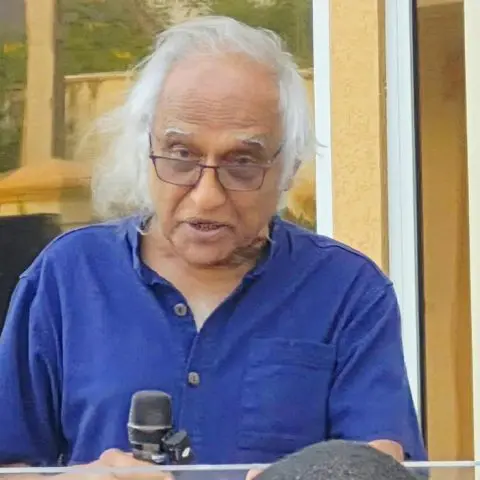
By Ambassador Byron W. Blake
Former Ambassador and Deputy Permanent Representative to the United Nations for Jamaica (2005 and 2009) and for Antigua and Barbuda (2008). Former Assistant Secretary General of the Caribbean Community.
The United Nations Conference of the Parties (COP) 31 ended Sunday, November 22, 2026, in Turkey, without an agreed outcome document. Extending the COP from Friday to Sunday made it the longest COP to date. Despite this, COP 31 ended without agreement, the first time this has happened.
Many commentators have described this as a colossal failure. Colossal failure, yes. Regrettable failure, no. This is absolutely the best decision for the Caribbean and the other SIDS. It could also be the best for the global environment.
Acceptance of any version of the Draft Outcome document advanced by the Presidency would, in all probability, mean, among other things, (i) putting the final nail in the coffin of “transition away from fossil fuels”. Recall that COP 30, with the cunning deception of President Lula, Chair of that COP and President of the host Country, the UN-savvy Republic of Brazil, accepted an Outcome which omitted the phrase “transition away from fossil fuels” that was in the previous agreement. With that victory, the fossil fuel producers led by Saudi Arabia opposed any mention of the phrase in the COP 31 Document.
The science has been undisputed: fossil fuels are the primary driver of global warming,
(ii) inadvertently further increasing fossil fuel use by accepting the host country’s non-negotiated and diversionary proposal to electrify 35 percent of energy by 2035, since there were no details on the preferred source of energy for such electricity generation.
(iii) accepting the illusory carbon capture and storage as a major vehicle for mitigation.
Fortunately, COP 31 was convened at a time and in an environment where (i) the science could not be clearer. In fact, the science has been clear since the publication of the Intergovernmental Panel on Climate Change’s fourth Assessment Report (AR4) in 2007; (ii) there is the lived reality of the breach of the 1.5°C and the clearly associated second-strongest Atlantic hurricane on record at the end of October 2025; (iii) there is the strongest El Niño on record; and (iv) there is also nature’s response in the form of unprecedented floods, fires, droughts, dried rivers, and scorching heat on all continents.
These costly realities, together with (a) the muscular stance by the fossil fuel producers led by Saudi Arabia in resisting any mention of the transition from fossil fuels, (b) the absence of credible national plans and programmes to reduce emissions in a manner that could achieve the 1.5 degree C target, (c) the refusal of the developed countries to commit to the provision of funds for adaptation consistent with the threats, and (d) a level of ineptitude by the Presidency, provoked resentment among a wide mix of countries.
Led by the EU, African Countries and the Pacific SIDS, mostcountries took a stand. They would not accept a weak document for the appearance of a “successful” Conference and the pride of the host Country. A break with traditional diplomatic niceties. The issues are existential. The break has changed the dynamics for any future COP.
WHAT WAS THE POSITION OF THE CARIBBEAN SIDS?
We have no information about the position of CARICOM and other Caribbean SIDS at COP 31. Monitoring the Caribbean media, one would be forgiven for concluding that COP 31 did not happen. At one level, this would appear surprising. Surprising, since the Caribbean is one of the regions most threatened by Climate Change. Moreover, this region has been hammered by an unprecedented number of Category 3 and 4 hurricanes since 2004. It has experienced the “bookends”: out of Season, Category 5 Beryl in June 2024 and Melissa at the end of October 2025. Those are not theoretical; the people in Western Jamaica have hardly begun to pick up the pieces. The massive Category 5 Melissa was at the same time as COP 30 in Belém, Brazil, which removed the vital phrase “transition away from fossil fuels” from a settled United Nations decision.
But to the keen observer in the Caribbean, particularly CARICOM SIDS’ posture at COP 29 and COP 30, it would be disappointing, not surprising. First, priorities shifted from climate and global warming to the search for finance. Prime Minister Gaston Browne and Prime Minister Mia Mottley have been gaining traction in this area. Second, with the combined shocks of Hurricanes Beryl and Melissa, and possibly Donald Trump, CARICOM leaders seemed to have resigned themselves to the “inevitable.” Climate Change or global warming did not appear on the agenda of the February 2026 or July 2026 meetings of the Conference of Heads of Government. Further, unlike in 2025, few, if any, CARICOM leaders focused on the issue in their addresses to the UN General Assembly in September 2026.
Prime Minister Mia Mottley, speaking as Chair of the Climate Vulnerable Forum and V20, made a powerful intervention calling for courage and launched a global movement for 1.5 billion voices for 1.5°C.
We understand from a report in the Jamaica Gleaner that for the first time at the COP, CARICOM negotiated as a bloc apart from the Alliance of Small Island States (AOSIS). Bahamian Prime Minister Philip Davis, in his national presentation, argued forcefully that The Bahamas aligned with the Caribbean Community (CARICOM) and the Alliance of Small Island States (AOSIS) in rejecting the proposed final text. Davis is reported to have argued that signing the draft would have amounted to accepting “their own harm in writing” because it omitted all mentions of fossil fuels and dropped a proposed US$120 billion annual adaptation finance target.
The Belize representative also rejected the final proposal.
We have not seen a CARICOM statement or its general positions at the Conference. We are clear, however, that there was no CARICOM strategy going into COP 31 focused on the climate issue; that is, the urgency in reducing greenhouse gases.The “failure” of COP 31 has created the opportunity for Caribbean SIDS to reset.
THE IMPORTANCE OF THE DRAMATIC BREAKDOWN
In our view, the COP 31 decision is the most consequential in the annals of the COP. The COP was created for the international community, working collaboratively, to head off a clearly looming crisis. It tried to achieve the objective while appeasing those responsible for creating the increasingly visible crisis. COP 31 has said: no more appeasement; the crisis is here.
It has laid bare that man has unleashed an attack on nature with no mechanism to moderate or reverse it. And it has unmasked the many unrepentant drivers of climate change.
It has also revealed the acceptance by most States that this is not a crisis for the SIDS whose homelands will soon be underwater, and whose people will be transformed into climate refugees. It is not a crisis for developed countries like those in Europe who have now felt the heat and decided to flee from the fire. It is a crisis for all countries, organisations and businesses; for all creatures which dwell on earth or sea. It is not a crisis that can be solved by some while others continue to live high off the fuel driving the crisis. It is a crisis that must be solved by all people who inhabit this earth, with pain-sharing.
It requires urgent action. Those who have felt the heat and seen the light must resolve to act with urgency.
IS SUCH ACTION POSSIBLE?
Having accepted that the climate crisis is an existential threat, the leaders of the willing must meet urgently to ask and resolve the questions: (i) how did we get here? and (ii) how do we get out?
In our view, the World has come to this juncture because of three (3) interlocking and reinforcing indulgences. One, reliance on a production technological system that is destructive of the natural environment in how it produces raw materials (large monocrop plantations, large mines, etc.), converts inputs, and transports final products to consumers. Every step is driven by “cheap” fossil fuels that release increasing volumes of greenhouse gases into the atmosphere.
Second, a consumption culture/system that places increasing demands on the production system for more short-use consumer goods.
Third, a permissive governance/ policy system that has facilitated these destructive production and consumption systems.
These developments were in the context of a global philosophical framework that relied on private capital for economic and technological initiatives and policy advice, with governments as providers of security, and the general population as passive observers.
HOW DO WE EXTRICATE OURSELVES?
The crisis has demonstrated that the philosophy is fundamentally flawed. The mindsets it has spawned must change, but they will resist. All must be arrayed against them- governments as active partners in development and people as protectors of the environment.
These are difficult and uncomfortable issues. Daunting, yes; impossible, no. World leaders have tackled major challenges before using collaborative approaches. We give three examples.
The first was to understand Climate Change. When it was accepted as a major issue in the early 1990s, it was realised that relatively little was known about the science driving it. The United Nations Framework Convention on Climate Change (UNFCCC) needed to understand the science to negotiate effective solutions. But it lacked the resources to conduct the required scientific research.
The United Nations Secretary-General established the independent Intergovernmental Panel on Climate Change (IPCC). It was built on teams of reputable scientists in government service, universities, and other institutions. They worked separately but collaboratively. They covered all relevant disciplines and were organised in teams. They remained in their employment but volunteered time for the additional research, writing, and consultations for the international activity. The UN system bore the travel costs of scientists from developing countries. All other costs were borne by the volunteers, their organisations or governments. The IPCC scientists produced reports of the highest quality. Their report, AR4 of 2007, was awarded the Nobel Prize. Five of those scientists were CARICOM nationals working in the region, with a sixth working in the United States of America (Drs. John Agard, Anthony Chen, Leonard Nurse, Roger Pulwarty, Samuel Rawlins, Ulric Trotz).
Second is the international cooperation and collaboration in response to the COVID -19 pandemic. By April 2020, it was recognized that COVID had become a global pandemic. The WHO and others appealed for international cooperation and collaboration. The response was swift. Collaboration included the provision of emergency medical supplies, protective clothing, and technical assistance; the production and sharing of guidance materials; and the development and sharing of vaccines. Over 60 countries, several multilateral organisations, and other agencies became involved.
One result of this unprecedented international cooperation and collaboration was that by May 2023 the major pandemic was considered over.
The third example was a little earlier. In the early 1960s, when space exploration became a major challenge, the United States created the New York Project. Anchored at Cornell University and dubbed the “New York Consortium for Space Technology, Innovation and Development (NYCST),” it brought together over 60 universities, businesses, and government partners to design, build, test, and fly space technology. This project might seem to have been a United States project, but it had a significant international component.
First, there were many international scientists and researchers in the Universities involved, and second, the Project developed collaborative relationships with several institutions in other jurisdictions, including the USSR, the main competitor in the race into space.
There are three features, in addition to their collaborative nature and success, that are worthy of note in the present situation. One, they drew on existing institutions, which reduced time and costs. Two, they were anchored in public institutions, which ensured that the information and technologies generated were not proprietary. And third, they involved the private sector, but not in a dominant role.
THE WAY FORWARD
The States that confronted the monster at COP 32 and other willing parties should:
A. meet early, possibly within the next six (6) months, inter alia, to:
1. establish themselves as a working coalition in the context of Climate Change and the COP process.
2. agree on major lines of action leading up to, and in COP 32.
3. indicate national initiatives, including national plans for reducing fossil fuel use by, say, 2035
4. agree on a strategy to enhance the voice and presence of private sector entities before and at COP 32, like the initiative by Prime Minister Mia Mottley for individuals.
B. Recognise that
(i) “technology” bears much of the responsibility for the current state of the global environment and that technology will be needed to save the global environment.
(ii) there are thousands of appropriate technologies in operation, in pilot phase, or in development that could have a positive impact on the global environment, but they are not being applied, applied at scale, or available where they could make the greatest difference.
CLOSING REMARKS
The crisis can be averted with the will, supported by determined action.
COP32, in Addis Ababa, Ethiopia, in November 2027, provides a fitting venue for the last stance. But the collaborative and cooperative work must begin now.







Discussion