From Manager (Finance) to Deputy Auditor General
My story begins with my appointment as Deputy Auditor General in December 1987. In early 1987, the auditors from the Audit Office were auditing the accounts of the Mahaica, Mahaicony, Abary-Agricultural Development Authority (MMA/ADA) where I was the Manager (Finance). During the audit, I requested that the auditors brief me every week on their findings. This was to ensure that I took the necessary corrective actions promptly based on the deficiencies identified, rather than waiting for the audit report to be issued. When the audit was finalized and the report issued, I prepared a response to the Auditor General, the late Mr. Farnum, acknowledging the findings, conclusions, and recommendations and setting out in detail the actions the Authority took or proposed to take to implement the recommendations contained in the report.
Mr. Farnum was overwhelmed when he received my response. He reportedly stated that in all his years as Auditor General, he had never seen such a courteous and professional response from any government official to the Audit Office’s report. The Audit Office was without a Deputy at the time and, recognizing that his retirement was three years later, his eagerness to fill the vacancy was understandable. Mr. Farnum promptly sent one of his senior officers to discuss with me the possibility of becoming his Deputy. I readily agreed and so on 1 December 1987, I took up appointment with the Audit Office.
My duties as Deputy Auditor General included not only assisting the Auditor General in the drafting of his reports to the National Assembly but also:
(a) Performing the duties of Accounting Officer, managing the finances of the Audit Office and accountable to the Public Accounts Committee (PAC) of the National Assembly.
(b) Organizing and managing the work of the Audit Office with a staffing of close to 200.
(c) Monitoring the work of the various audit units undertaking audits of not only Ministries, Departments and Regions but also in excess of 200 other entities comprising public enterprises, statutory bodies, local government bodies and trade unions.
(d) Providing the necessary technical guidance and assistance to staff members.
(e) Assisting in the training of audit staff at all levels.
I worked very hard to support Mr. Farnum, who allowed me a free rein to run the office. Sometimes he would enter my office and as soon as I realised this, I would stand up. Mr. Farnum would insist that I sit down, but I would remain standing out of respect for him as my boss. Whenever I took a report or any other document for him to sign, Mr. Farnum would do so without question because he knew the efforts that I would have made to ensure that the report or document was in order. In short, Mr. Farnum had complete trust and faith in me and was able to sit back and allow me to take charge of matters. It was therefore without saying that when the time came for him to retire, he knew that he had found a replacement!
At the time of my appointment, the last set of audited accounts of the country was in respect of 1981. I had discussed some of my ideas for a restart of the process with Mr. Farnum, but he was reluctant to take any action for fear of “rocking the boat”, with national elections round the corner.
In early 1989, Mr. Farnum approved my participation in the International Auditor Fellowship Program administered by the United States Government Accountability Office (USGAO) in Washington D.C. The programme was a six-month one involving a combination of classroom sessions and attachment to USGAO’s regional offices. Participants were senior officials of national audit offices, especially from less developed countries around the world. The focus was exposure to the work of the USGAO, especially in the areas of performance auditing, report writing, and the use of computers.
I should mention that I was offered the position of local financial specialist at the Inter-American Development Bank when I was acting Auditor General, no doubt in recognition of the Audit Office’s efforts under my supervision to audit the accounts of the projects funded by the Bank. I declined the offer since I felt that it would be better for me to be in the service of my country rather that to a foreign institution.
Appointment as Auditor General
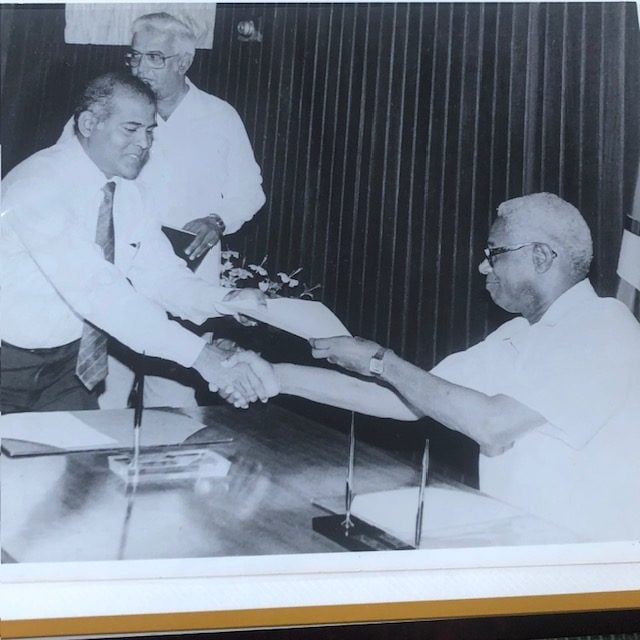
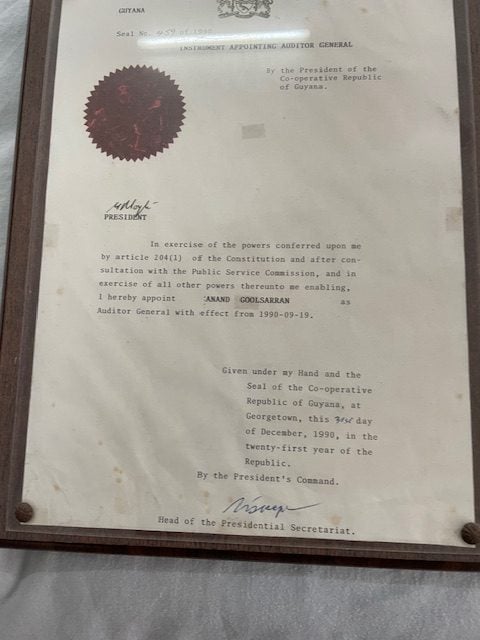
On 17 September 1990, Mr. Farnum went on pre-retirement leave and I was appointed to act as Auditor General. On 31 December 1990 I was substantively appointed to the position and accordingly took the oath of office, as attested by the attached two photographs and my instrument of appointment.
My early days as Auditor General were extremely challenging. The most important challenge relates to what contribution I could make to restore public accountability in Guyana. The audited public accounts were, and still are, to be finalized within nine months of the close of the financial year, and the results presented to the Assembly. The failure to strictly adhere to this deadline would adversely affect the system of public accountability since subsequent years would be affected. My experience has shown that undue delays in having audited accounts of an organization are an indicator that all is not well with its financial management systems and procedures and are symptomatic of a more fundamental problem.
My first task was to bring to the attention of the Minister of Finance, the Accountant General and other responsible senior government officials the requirements of the law relating to financial reporting and the fact that the said law had not been complied with for eight years. I also took the opportunity of reminding them of the deadline for the submission of financial statements for audit examination and certification for the fiscal year 1990.
The Accountant General was adamant that computer problems prevented him from finalizing the public accounts relating not only to the backlogged years 1982 to 1989 but also the year in question – 1990. He could not indicate how soon these accounts would be submitted for audit. Accounting officers, on the other hand, contended that it was the Ministry of Finance’s responsibility to process transactions relating to their Ministries and to submit periodic printouts for reconciliation with their records. Because of the absence of such printouts, they stated that they could not carry out the necessary reconciliations and therefore could not prepare financial statements for audit. It soon became clear that no effort would be made to redress the situation unless there was political intervention.
During the period 1982 to 1990, as is the normal auditing practice, the Audit Office had conducted preliminary audits of Ministries, Departments and Regions and the related reports issued to those entities. The findings were, however, held in abeyance pending the submission of financial statements.
I took the view that in the absence of financial statements, the results of the preliminary audits should be presented to the Legislature. The Government, however, vigorously opposed this view, although Section 32 of the Financial Administration and Audit (FAA) Act permitted the Auditor General to transmit a special report on any matter incidental to his powers and duties under the said Act, if it appeared to him to be desirable. I must point out that without the legal safeguard of Section 32, any government could withhold the submission of financial statements in the hope of thwarting the efforts of the Auditor General to report to the Legislature on the financial stewardship of the Government.
As a result of the Government’s opposition to having the preliminary reports presented to the Assembly, I sought a legal opinion from the then Attorney General, the late Keith Massiah, on the matter, which opinion supported my view. The Stabroek News of 11 June 1991 reported the Attorney General as having stated that: (i) the Auditor General has the obligation to report to the National Assembly not later than of 30 September every year and failure to do so will constitute a breach of the Act; and (ii) the non-submission of financial statements does not exempt the Auditor General from reporting to the Assembly.
I recall spending sleepless nights in the Audit Office trying to piece together from the various audit correspondence to the Ministries, Departments and Regions as well as their responses to ascertain what were the audit findings for the backlogged years, commencing 1982. I would leave the office at around 5 p.m. during the week and return at around 8.00 p.m. accompanied by my wife who would lie on the sofa in the office, while I worked away at the reports. We would then leave the office at around 2.00 a.m. The same happened during weekends.
There were no computers at the time in the Audit Office. Using my personal funds, I had bought an IBM 286 compatible desktop computer while on attachment with the USGAO. I then I installed it in the Audit Office and used it to process the preliminary reports for the years 1982, 1983, 1984 and 1985 which, once completed and printed, were presented to the Assembly. Both the Guyana Chronicle and the Stabroek News reported that the Audit Office dispatched these reports to the Minister of Finance – 1982 on 25 July 1991; 1983 on 12 August 1991; 1984 on 29 August 1991; and 1985 on 30 October 1991 – all in the space of five months of the Attorney General’s ruling.
The parliamentary records will also attest to the laying of these reports in the Assembly, while Chartered Accountant and Attorney-at-law Christopher Ram can confirm that the reports were printed by his office since I could not have gone to the government printery to have the reports printed. I could not have presented any further reports because another opinion from the Attorney General’s Office suggested that the issuing of such a report did not have the support of the law. In any event, the focus had to be shifted on what needed to be done going forward.
Proposals for a restart of financial reporting of the public accounts
In October 1991, that is, within ten months of my appointment, I wrote to the acting Minister of Finance, the late Winston Murray, outlining the problems associated with the Government’s financial management and making several recommendations. I proposed a two-pronged approach to restart financial reporting, with 1991 as the cut-off year. The other key recommendations were:
(a) Close all government bank accounts and open new ones with effect from 1992 to avoid any contamination from the backlogged years. Most of the bank accounts had not been reconciled for several years and some of them were heavily overdrawn, including the Consolidated Fund bank account. The minimum number of accounts should be used.
(b) Institute proper systems and procedures to ensure accurate recordkeeping and reconciliation, and to facilitate timely, reliable, and accurate financial reporting for the future, commencing 1992.
(c) Set up a task force to deal with the backlogged accounts covering the period 1982 to 1991.
The Accountant General had estimated it would take approximately six months for each of the backlogged years to be finalized. In other words, it would have taken until 1997 to bring the backlogged accounts up to date, by which time the current year’s accounts would have become backlogged by four years, hence the recommendation for a two-pronged approach. Although the Minister of Finance accepted these recommendations, they were not implemented despite strenuous efforts by the Audit Office to get the Ministry of Finance to do so. The Catholic Standard of 20 October 1991 under the caption “Draw Line, Start Afresh: Auditor Tells Minister”, captures the results of the meeting with the Minister.
(To be continued)







Discussion