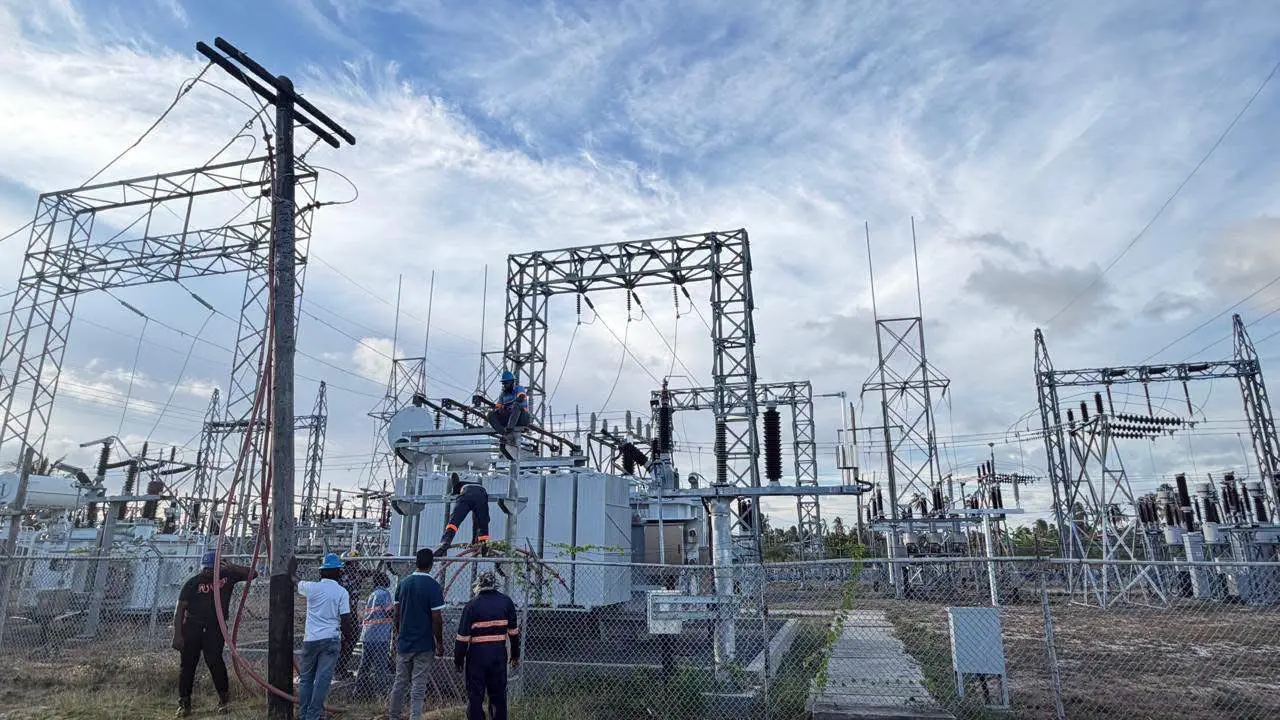
GPL today provided an account of the events that led to the two-day blackout on East Berbice/Corentyne.
A press release from GPL follows:
𝐏𝐑𝐄𝐒𝐒 𝐑𝐄𝐋𝐄𝐀𝐒𝐄 || 𝐆𝐏𝐋 𝐏𝐑𝐎𝐕𝐈𝐃𝐄𝐒 𝐀𝐂𝐂𝐎𝐔𝐍𝐓 𝐎𝐅 𝐂𝐀𝐍𝐄𝐅𝐈𝐄𝐋𝐃 𝐒𝐔𝐁𝐒𝐓𝐀𝐓𝐈𝐎𝐍 𝐎𝐔𝐓𝐀𝐆𝐄 𝐀𝐍𝐃 𝐑𝐄𝐒𝐓𝐎𝐑𝐀𝐓𝐈𝐎𝐍 𝐄𝐅𝐅𝐎𝐑𝐓𝐒
Guyana Power and Light Inc. (GPL) acknowledges the prolonged electricity disruption experienced by customers in sections of East Berbice from November 19, 2026.
The Company regrets the inconvenience caused and wishes to provide customers and the wider public with a detailed account of the circumstances surrounding the outage at the Canefield Substation, the technical challenges encountered, and the extensive efforts undertaken to safely restore electricity to affected communities.
The outage commenced at approximately 8:14 p.m. on Thursday, November 19, 2026, when the T2 13.8 kV incomer tripped, resulting in the loss of all circuits and a lockout of the 13.8 kV bus.
Shortly thereafter, a flash was reported from the B4T1 cubicle following attempts to restore the system. GPL’s specialised technical team was directed to Canefield to commence investigations and restoration works.
Extensive Investigation and Testing
Upon arrival at Canefield during the early hours of Friday, November 20, the technical team commenced a systematic investigation of the substation equipment. Initial checks included controlled switching, testing of potential transformers (PTs), inspection of the busbar system, and repairs to areas where deterioration or electrical tracking was observed.
During the investigation, several equipment deficiencies were identified. These included deterioration of some PTs, condensation within the SG2 switchgear cubicle, suspect insulation and components, and poor insulation-resistance readings associated with some equipment. The team cleaned, repaired, re-insulated and tested the affected components and, where necessary, replaced suspect components.
Despite these interventions, repeated attempts to energise the system continued to result in tripping. Consequently, GPL’s technical personnel progressively isolated and tested different components in an effort to identify the source of the fault.
The ST2 auxiliary transformer was subsequently determined to be damaged based on its insulation-resistance results and was disconnected. However, another attempt to energise the bus with ST2 removed resulted in the same trip, indicating that ST2 was not the only cause of the recurring system fault.
Troubleshooting continued overnight into Saturday, November 21, with further dismantling, testing and reassembly of switchgear components. Specialist support was also engaged, resulting in further testing of the busbar, grounding transformer, switches and associated equipment.
In the course of attempting to locate the fault, the technical team undertook extensive refurbishment of the SG2 panel at the Canefield Substation, which was constructed in 1975, utilising available spare components.
A significant breakthrough was achieved at 3:30 p.m. on November 21 during another attempt to energise the system. Arcing was observed beneath metal covers over a recently installed 500 mm² cable, while the T2 transformer incomer protection relay also registered a trip.
This development redirected the technical investigation towards the cable.
Subsequent insulation-resistance testing confirmed that the B-phase of the 500 mm² cable was defective, with a short circuit to ground. This finding provided the critical fault indication required to advance restoration efforts.
GPL’s team subsequently tested the previously installed 400 mm² incomer cable, which was found suitable for return to service. Work commenced at approximately 6:00 p.m. to reconnect the cable at the 60 MVA transformer terminal and the transformer incomer cubicle of the 13.8 kV switchgear.
Restoration of Electricity Supply
At 6:25 p.m. on Saturday, November 21, the technical team successfully re-closed the bus tie, allowing the phased restoration of electricity to affected customers to commence.
Substation operatives, working in coordination with System Control, subsequently began restoring customer feeders. Feeders F1 and F4 were energised to restore power from New Amsterdam to Mara along the eastern bank of the Berbice River, followed by F3, which serves customers between Canje and Williamsburg.
Following restoration of the main electrical system, GPL’s teams continued working to restore the substation’s auxiliary power supply.
Since the ST2 auxiliary transformer had been identified as damaged and removed from service, teams tested alternative transformers on site and installed a replacement auxiliary supply. This arrangement was completed at 1:30 a.m. on Sunday, November 22, restoring auxiliary power to the substation.
The restoration exercise required extensive diagnostic testing, as several equipment abnormalities were discovered during the investigation while repeated attempts to energise the system continued to result in protective tripping. The eventual identification of the defective B-phase of the 500 mm² cable enabled the technical team to revert to the serviceable 400 mm² cable and proceed with the restoration of customer feeders.
GPL fully recognises the significant inconvenience and disruption experienced by households, businesses and other customers in East Berbice as a result of the prolonged outage.
The Company sincerely apologises to all affected customers and thanks residents, businesses and other stakeholders for their patience and understanding while GPL’s technical teams worked continuously to identify the fault and safely restore electricity supply.
GPL also acknowledges the sustained efforts of the technical personnel involved in the troubleshooting and restoration exercise.
The Company remains committed to reviewing the circumstances surrounding the outage and the equipment deficiencies identified during the restoration process, with a view to strengthening the reliability and resilience of its infrastructure and reducing the likelihood of similar prolonged disruptions.










Discussion