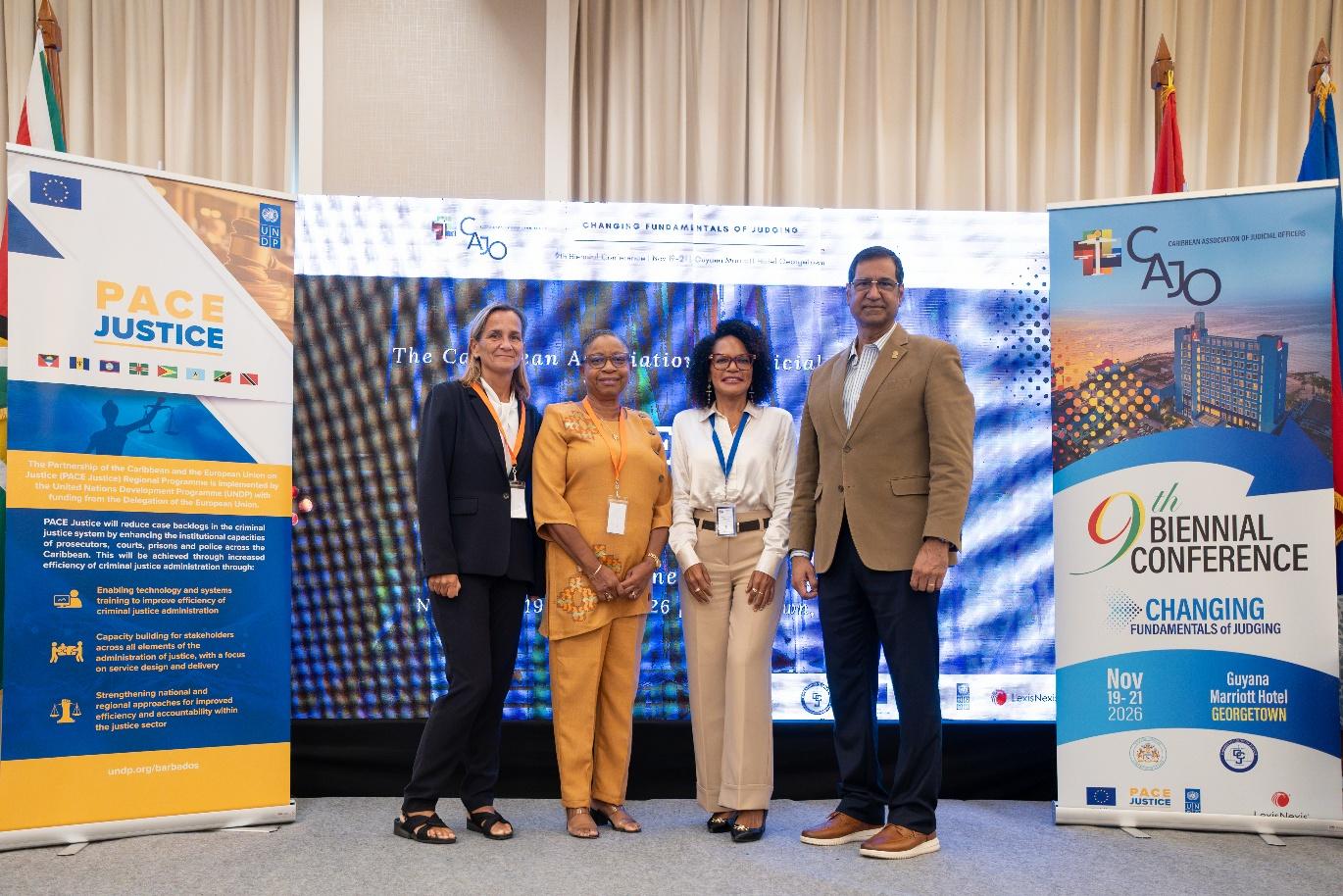
The Caribbean Association of Judicial Officers (CAJO) has urged governments to provide courts with enough staff and resources to administer justice effectively, following a three-day conference in Georgetown that also warned that unfounded attacks on the judiciary undermine public confidence and the rule of law.
In resolutions adopted at its ninth biennial conference, the association called for closer collaboration among agencies involved in the justice system to improve court efficiency. It also called for continuing training to strengthen judicial responses to arms, drug and human trafficking, and for greater attention to the wellbeing of judicial officers and court staff.
The Judiciary of Guyana hosted the conference at the Guyana Marriott Hotel from November 19 to 21 under the theme ‘Changing Fundamentals of Judging’. CAJO said more than 200 judicial officers, court administrators and academics attended, making it the association’s largest conference to date.
Through plenary discussions and breakout sessions, delegates examined the use of artificial intelligence and other technology in courts, public trust in the judiciary, crime and violence, human rights, judicial ethics and the wellbeing of judicial officers. The resolutions called for prudent use of AI and urged courts to consider the needs of marginalised and vulnerable court users.
Former Caribbean Court of Justice (CCJ) President Justice Adrian Saunders presented a proposed model practice direction that regional courts could adapt to address gender stereotypes in proceedings and protect vulnerable participants. The proposal builds on existing gender equality protocols.
In his feature address, Jamaica’s Chief Justice Bryan Sykes said that while the circumstances in which courts operate had changed, the principles governing judicial decisions had endured.
“The fundamentals of judging have not changed. Independence, impartiality, integrity and fidelity to the rule of law are exactly what they were. What has changed is the ground,” Justice Sykes said.
Professor Justin Robinson, Pro Vice-Chancellor of the University of the West Indies’ Five Islands Campus, examined what a weakening international legal order means for small and medium-sized states. He argued that Caribbean countries have a role in defending international law by strengthening regional institutions and ensuring their own courts function effectively.
“International law is not dead. It has been abandoned by those who needed it least and left in the care of those who need it most,” Robinson said.
CAJO’s resolutions reaffirmed the importance of international law and a rules-based global order to the political, economic and social development of small and medium-sized states.
President Irfaan Ali used the opening ceremony to propose a mechanism for briefing judges on regional security threats, including intelligence on criminal networks and terrorism. He said public trust helped safeguard judicial independence and urged more Caribbean countries to adopt the CCJ as their final court. CCJ President Justice Winston Anderson said courts had to adapt to changing circumstances while preserving their independence and maintaining public trust.
Judicial independence had also featured in Kiskadee Watch’s coverage of a September judicial conference in Jamaica, where retired Justice Courtney Abel raised concerns about prolonged acting appointments at the head of Guyana’s judiciary and a US travel restriction affecting High Court Justice Gino Persaud.
CAJO elected a new 15-member management committee. Its next biennial conference will be held in the Cayman Islands in 2028.










Discussion