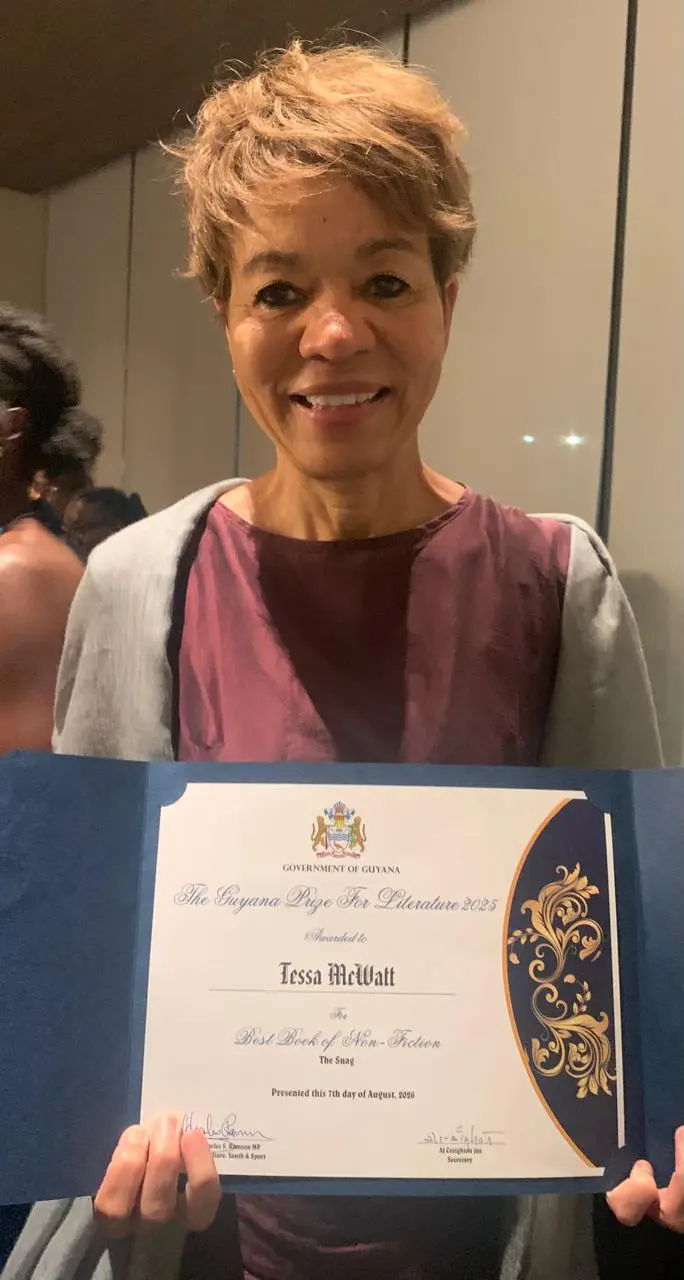
`I am constantly stuck in this place of not fully belonging anywhere—here in Guyana, in Canada or in the UK. It’s a kind of roaming space, but I think that is why I write’
Winner of the 2025 Guyana Prize for Literature in the non-fiction category, Professor Tessa McWatt, is urging the public and private sectors to provide more support, including sponsorship, for young writers.
She is also hoping that sponsors will come forward to enable the local staging of The Knife of Dawn, an opera based on the imprisonment of Guyanese political activist and poet Martin Carter.
Guyana has a rich literary history and body of literature, McWatt said. She noted that she encountered promising work by young writers during workshops held as part of the recently concluded Literary Festival, organised by the Ministry of Culture, Youth and Sport, and expressed the hope that their writing would develop further.
“There is so much scope for creativity and writers in this country. There need to be more workshops and seminars for young people, and greater access to reading, publications and publishing,” she told Kiskadee Watch during a recent interview in Georgetown.
“It is very intimidating to be a writer, especially if you have no one in the family who is a writer or you do not have a community of writers. It is absolutely crucial for young people to have support,” she said.
Compared with previous years, a large number of young people attended the Guyana Prize for Literature 2025 awards ceremony, held on August 7, 2026, at the Atlantic Conference Centre, Pegasus Hotel.
Turning to The Knife of Dawn, which she co-wrote with British-Guyanese composer Hannah Kendall, McWatt said they would like to stage the opera in Guyana, but doing so would be an expensive undertaking.
“We need sponsorship,” she said.
The one-man opera depicts Carter’s incarceration without charge during the 1953 state of emergency imposed by the British colonial government. Set on the final night of his hunger strike, it explores the conflict between his roles as poet and political activist.
The opera examines Carter’s work and incorporates several of his poems.
Kendall, who is of Guyanese parentage, grew up in London and now teaches at Columbia University in New York.
McWatt, a Fellow of the Royal Society of Literature, is a professor of creative writing at the University of East Anglia in England. She holds a Bachelor of Arts in Literature from Queen’s University in Kingston, Ontario, and a Master of Arts in Commonwealth Literature from the University of Toronto.
Asked what inspired the opera, McWatt said, “Kendall approached me because she knew I am a writer and we both understand the colonial period, what it means, and the end of it in Guyana. It was her first opera and my first as well. We collaborated with an English director, John Walton. The three of us developed the libretto. It was such a beautiful collaboration.”
The Knife of Dawn was first staged at the Roundhouse in London in 2016. It was performed again at the Royal Opera House in London in 2020, during the COVID-19 pandemic.
“It was the last show at the Royal Opera House before the COVID shutdown was enforced,” she said.
The production, which was well received in London, was staged at the Dutch National Opera in Amsterdam, the Netherlands, in March 2026. That performance was directed by a Surinamese director.
Asked when the opera might be staged in Guyana, McWatt said, “We want that so much. We have musicians. There are three singers in addition to the main singer. We would love to come. It is expensive. We need sponsorship.”
Heritage
Born in Georgetown, McWatt left Guyana for Canada with her family in 1962, when she was three years old. She grew up in Canada, where she spent most of her life, and moved to England 26 years ago.
“I have a glimpse of our house in Kitty in my memory, but most of my early childhood in Guyana is based on what people told me,” she said.
Speaking about the focus of her writing on Guyana and the Caribbean, McWatt said there was something about Guyana’s interior and its complex history of enslavement, the plantation system and indentureship—all of which form part of her biological heritage—that drew her to examine the self and social systems.
“I think I started writing before I knew I was writing. Before I realised I was a writer, I was writing,” she said.
Her winning entry in the 2025 Guyana Prize for Literature’s non-fiction category, The Snag: A Mother, a Forest and Wild Grief, is her second work of non-fiction.
Describing it as a lament for the planet and a plea for change, McWatt said, “The book is based on grief due to damaging climate change, and a grief that intertwines with my mother getting dementia and having to move out of her home.
“Just so that you understand the title, the snag, in forest terms, is an old, dead or dying tree that provides vital ecosystems. The snag, even though it is dying, is the most important tree in the forest because of its decay. It is the place where biodiversity resides, the place where fungi and all the small creatures feed.
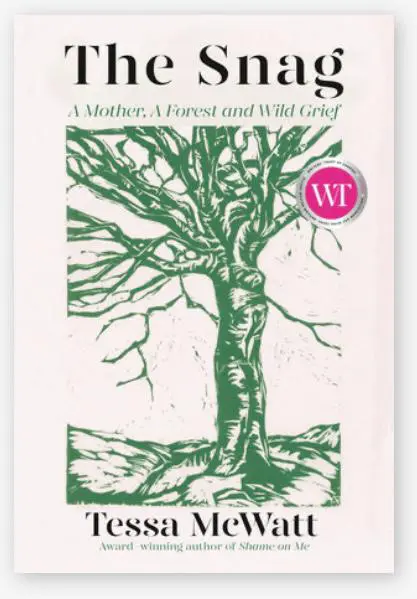
“There is an irony there, in decay and in importance and beauty, that I compared with my mom, who is old. She is 93 this year and has lost her memory, but is still giving us an incredible amount of joy and enrichment. The book is organised around the stages of a tree—from seed, seedling and sapling to a mature tree and, finally, a snag.”
McWatt said she was thrilled that The Snag won the top prize. She had not been thinking about the award when, about two weeks before the event, she received an invitation to participate in the Literary Festival.
“It was a lovely event and a lovely surprise. I’m happy to be here in Guyana. I was here in 2018. Lots of changes. I hope the change is good for everyone,” she said.
The Snag also won the 2026 OCM Bocas Prize for Caribbean Literature. McWatt’s first non-fiction book was Shame on Me: An Anatomy of Race and Belonging, published in 2020.
She is also the author of seven novels and two novellas for young people. She is working on her eighth novel and expects to complete the first draft by the end of the summer.
With one exception, all her novels feature West Indian or Guyanese themes or characters.
“Even though I grew up in Canada and am Canadian in many ways, and even though I have been living in England for more than two decades, most of my books, except for one, have some sort of Guyanese or Caribbean angle or character,” she said.
“That’s what I mean when I say that Guyana or the Caribbean lives in me. Even though I left Guyana as a child, Guyana has not left me. It is an important part of who I am. I don’t come very often, but it’s still there.”
Her first novel, Out of My Skin, centres on a character living in Montreal who discovers her Guyanese connections through her grandfather’s diaries, written in the New Amsterdam asylum in the early 1960s. Her other books include Dragon’s Cry, This Body, Step Closer, Vital Signs, The Snow Line and The Taste of Marmalade.
Her writing is political in nature.
“In my novels, the characters challenge racism and political structures that are oppressive in a subtle way. My non-fiction challenges those things a little more directly,” she said.
Influences
McWatt said that, for children growing up in the diaspora, life at home was very Guyanese or Caribbean, while the world outside was distinctly Canadian.
“You get a kind of double existence, a double sense of being. You are manoeuvring yourself at home and outside, and you’re kind of the envoy for your parents in this new world,” she said.
In Toronto, members of her extended family remained close. Her father had six brothers and a sister. With the exception of one brother who moved to London, the siblings and their families settled in Toronto.
“We had lots of Guyanese cousins in Canada. We had weekends of family camping, so we maintained the Guyanese culture there with the extended family. We were very lucky that way,” she said.
“I am deeply rooted in my Guyanese-Caribbean culture, even though I have lived away from Guyana for so long. It shows up in my writing.”
When she was younger, McWatt said, she looked up to her older cousin, poet and writer Mark McWatt, a multiple winner of the Guyana Prize for Literature in the poetry category. He was also one of her mentors.
“The extended family in that diasporic setting would have influenced my writing,” she said.
“I am constantly stuck in this place of not fully belonging anywhere—here in Guyana, in Canada or in the UK. It’s a kind of roaming space, but I think that is why I write. I write to belong in a space that is not limited by nationality.
“I am also very privileged to have access to these three spaces. I have three passports and I am very, very privileged. I acknowledge that in my work and in my being. My writing really does reflect that.”









Discussion