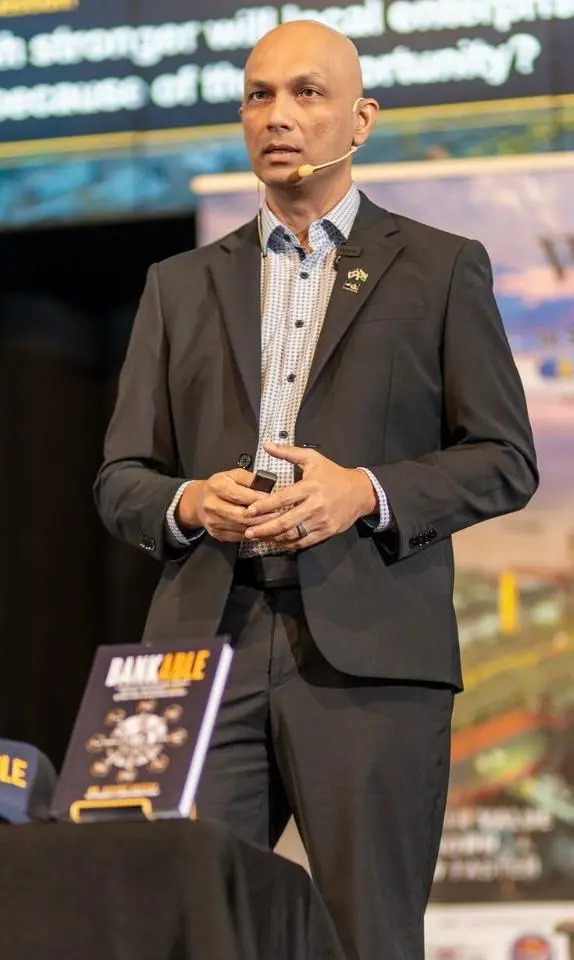
At 19, Vishnu Doerga sought a loan to expand his fledgling business. Within 20 minutes, he recalled, his application was rejected. He was underprepared and had not established the credibility needed to secure financing.
Twenty-six years later, the business coach and entrepreneur has drawn on that experience and his work with other companies to write Bankable, a guide to building credible, profitable and scalable businesses in developing countries.
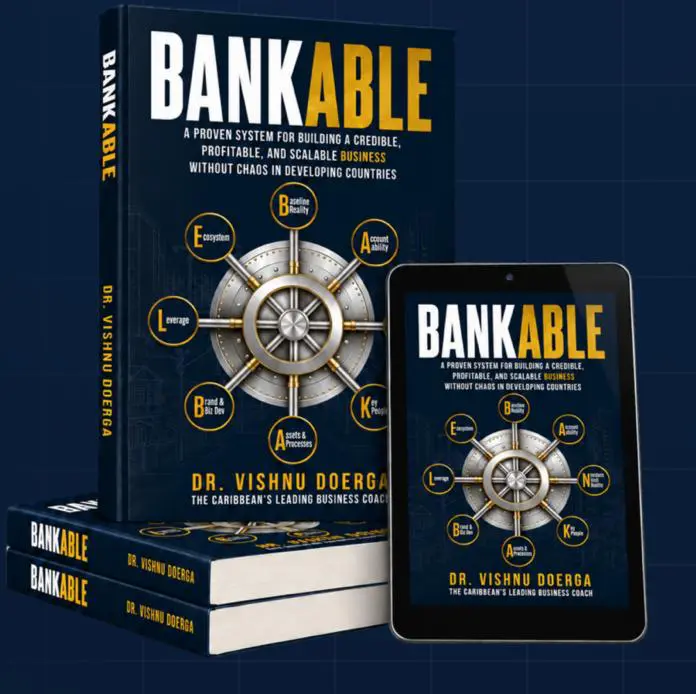
The 254-page book, subtitled A proven system for building a credible, profitable and scalable business without chaos in developing countries, addresses challenges ranging from financial record-keeping and accountability to partnerships, staffing and growth.
It is intended for entrepreneurs as well as employees who develop ideas and solve problems within existing organisations—often described as intrapreneurs.
“I’ve had to cope with that for 26 years. I’ve helped many businesses to cope with that, so they become a lot stronger and not blame the environment,” Doerga told Kiskadee Watch in an interview.
“Businesses tend to blame the environment around them instead of working on themselves and their businesses. The book is meant to remove some of those excuses.”
Doerga, whose qualifications include a master’s degree in business administration and a doctorate in entrepreneurship, said business literature developed for the United States and United Kingdom did not always reflect the conditions facing entrepreneurs in developing economies.
Access to financing, establishing credibility and operating within challenging business environments were among the issues he wanted to address.
Stronger companies, he argued, also contribute to the wider economy.
“When companies do well, that is how they impact the economy. They hire more people, they pay them well, they pay their taxes, they become better corporate citizens. That is how the economy develops faster.”
A central concern is the consistency of business records. Doerga said some entrepreneurs approached banks with plans that were not supported by their account activity, tax returns or other records.
Such discrepancies, he argued, weakened their financing applications and their ability to compete with companies that could demonstrate compliance and transparency.
He also linked responsible business conduct to the credibility of demands made of others.
“For example, I would be hard pressed to make demands of anyone if I’m not paying my fair share of taxes.”
Choosing partners
Doerga said Guyana’s expanding economy offered opportunities, but businesses needed to undertake due diligence before entering partnerships.
He recalled that in 2017 the Canadian High Commission recommended a Canadian staffing company as a potential partner for his training business, Action Invest Caribbean.
The two sides held discussions and visited each other’s countries before agreeing to work together.
Doerga contrasted that process with partnerships announced during a Canadian trade mission around the same period, which he said had not all endured. He attributed the strength of his own partnership to the preparatory work and the alignment between the businesses.
The resulting staffing operation, NSB Omega, serves companies including SBM and MODEC, as well as Guyanese businesses, he said.
Bankable encourages business owners to examine not only a prospective partner’s resources, but also its culture and commitment to the market.
Doerga said entrepreneurs should be equally careful about the volume and range of work they accepted.
Complaints about poor delivery, he argued, sometimes arose because businesses took on more than they could manage.
“Now we’re now in a feast, but we’re bringing a famine mentality to a feast although the buffet on the table is widely laid out. It is like greed. We grab because we want it for ourselves and now, we are choking on it,” he said.
Building trust and cooperating with other businesses would help companies respond more effectively to opportunities, he added.
Employees with ideas
Doerga cautioned against treating business ownership as the only route to benefiting from economic growth, particularly in a small market where too many similar ventures could struggle to survive.
“We want strong entrepreneurs, but we also want intrapreneurial employees to be given the space within the organisation to test out their ideas, to be able to add value to the product and to become shareholders in the company they work for.”
Some companies, he said, created their own competitors by failing to recognise and reward employees with ideas and initiative.
Giving employees an ownership stake could strengthen their interest in the company’s performance and provide benefits through dividends and longer-term financial security, he argued.
He cited Action Invest Caribbean as an example. In 2016, he owned the entire business, then known as Action Coach. It now has four other shareholders, including its business development manager and a coach who had worked with the company from its early years.
Doerga also urged people to examine demand for skills before deciding on education, training or a business venture.
He identified technical trades, occupational health and safety, logistics, accounting and auditing as areas offering employment opportunities. NSB Omega had approximately 50 vacancies at the time of the interview, ranging from sales and deckhand positions to health and safety, operations and general management roles, he said.
Hotels, restaurants and transportation businesses also required workers, including technical, administrative and accounting personnel.
Doerga said there was a mismatch between some people’s qualifications and the jobs they held, and urged educational institutions to align training more closely with available employment.
He also saw manufacturing opportunities if the gas-to-energy project delivered lower electricity costs, and encouraged students to consider how Guyana’s raw materials could support production.
With a small population and growing demand for labour, he said, Guyana would also need a migration policy capable of attracting the skills required.
From survival to growth
The book’s title provides the framework for its approach, with BANK addressing the foundations of a business and ABLE examining the systems and relationships needed to develop it further.
The first four elements are baseline reality, accountability, numbers and key people.
Baseline reality requires owners to assess their business model and whether it can generate the profit they need. Accountability involves establishing reporting and feedback systems, while numbers focuses on the activities that drive performance, including clients, proposals and follow-ups.
A checkpoint between the two sections asks owners to consider whether they want to expand. Not every business, Doerga stressed, is intended to scale.
The second section covers assets and processes, brand and business development, leverage, and enabling networks.
It examines how a company can operate beyond its founder, develop its market and use financing and partnerships to grow.
The financing discussion considers grants, development financing, commercial banks and equity investment. The final element looks at the organisations and platforms—including chambers of commerce and conferences—that can help businesses reach wider markets.
The book also includes a farming case study. Doerga said farmers who treated their operations as businesses needed to consider storage, marketing and how to sell their harvest over time.
More broadly, he cautioned prospective investors to assess demand carefully. An attractive market could become difficult if too many businesses entered it without examining the likely customer base.
A resource for business owners
Doerga said he wanted the book and its accompanying tools to be accessible.
He gave the Amazon price as US$3.99 and said downloadable resources accompanying the chapters included cash-flow templates and other tools used in his coaching work.
Launched online in the United States in July and subsequently in Suriname, Bankable is scheduled for a Georgetown launch on November 13.
Hardcover and paperback editions are available, including through Action Invest Caribbean’s office and bookshops, he added.
Doerga said he had wanted to write the book for a decade. He began writing three years ago after his daughter told him she was getting married, prompting him to think further about preparing the next generation.
“It is our job to prepare our kids for the world,” he said.
His own business began as Doerga Business Enterprise in February 2000, initially addressing engineering problems. Early work included supplying heavy equipment for underpinning the foundation at St Joseph’s Mercy Hospital.
The operation subsequently moved into importation and distribution between Guyana and Suriname. It became Action Coach in 2014 and was incorporated as Action Invest Caribbean in 2018 following a strategic review and the expansion of its regional clientele.
The company now has two offices in Suriname and is seeking to establish offices in The Bahamas, Barbados and Trinidad and Tobago over the next two years, Doerga said.
He joined the Georgetown Chamber of Commerce and Industry in 2002 and later served as its president. His other positions have included heading the Suriname Guyana Chamber of Commerce, serving as vice-chairman of the Guyana Office for Investment and chairing the Guyana National Bureau of Standards.
The principles in Bankable, he said, are those he has applied in developing his own business.











Discussion