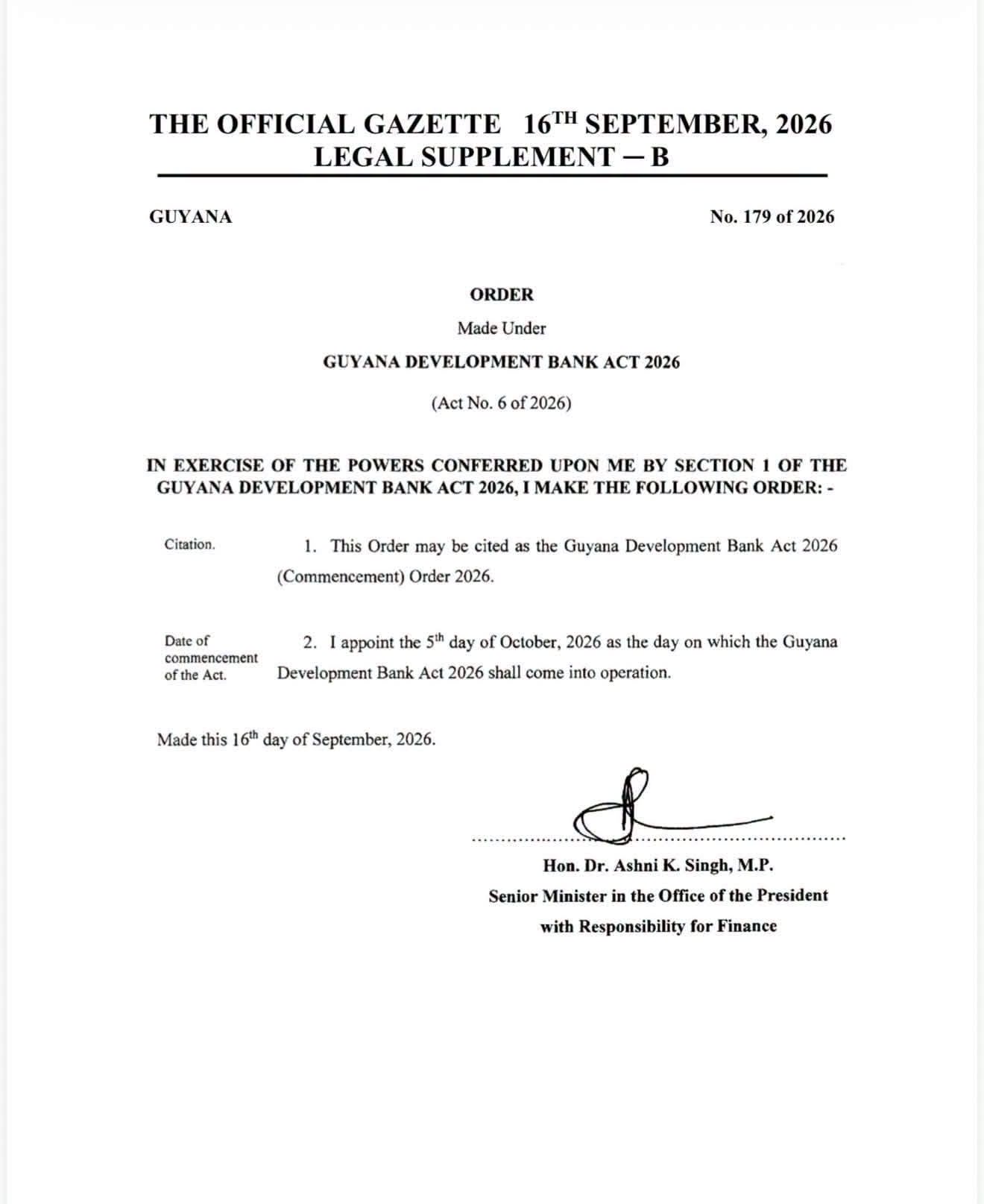
The Guyana Development Bank Act will come into operation on October 5, clearing the way for the launch of the state-owned lending institution with an initial injection of $20 billion.
Senior Minister in the Office of the President with responsibility for Finance Dr Ashni Singh yesterday announced that he had signed the commencement order operationalising the Act.
The order, dated September 16 and published in an Extraordinary Official Gazette, appoints October 5 as the date on which the Guyana Development Bank Act 2026 will take effect.
Singh said the government would provide a first tranche of US$100 million, equivalent to approximately $20 billion, at start-up. This represents half of the bank’s authorised capital of $40 billion.
President Irfaan Ali recently announced that the bank would be launched on October 5.
The institution is intended to provide small and medium-sized businesses with interest-free and collateral-free loans of up to $3 million. It is also expected to offer technical and advisory support, including assistance with business plans, financial management and expansion.
The Act was assented to by Ali on July 30 after being passed during a tumultuous sitting of the National Assembly, where opposition parliamentarians were protesting the government’s handling of the MV Barima disaster.
The legislation provides for the bank’s capital to be subscribed and paid by the government in amounts and at times determined by the Finance Minister. Singh may also amend the authorised capital by order, subject to a negative resolution of the National Assembly.
The Finance Minister will appoint the entire board, including its chairperson and deputy chairperson. The board will comprise between five and nine directors selected on the basis of their qualifications and experience in finance, economics, banking and law.
The bank will not be governed by the Financial Institutions Act and will not be permitted to accept deposits from the public, engage in speculative trading or conduct business inconsistent with its development mandate.
The exemption from the Financial Institutions Act and the degree of authority vested in the Finance Minister have attracted criticism from accountant and attorney Christopher Ram, APNU parliamentarian Terrence Campbell and other opposition figures.
Ram previously told Kiskadee Watch that lending by a development bank should be based on economic merit and developmental impact rather than political considerations. He warned that politicised lending could transform the institution into a “slush fund”.
Campbell has supported the establishment of a development bank, saying that it could fill a financing gap faced by young entrepreneurs and persons without adequate collateral.
However, he raised concerns that the minister’s power to appoint the entire board could lead to the institution being politicised. Campbell has called for opposition, banking, business, accounting, manufacturing, agriculture and risk-management representation in its governance structure.
APNU Leader Aubrey Norton has also said that his party supports the concept of a development bank but fears that the institution could be used to favour PPP/C supporters and discriminate against others.
APNU parliamentarian Sharma Solomon has questioned whether there will be mechanisms to ensure that businesses in all ten regions have equitable access to financing.
He argued that entrepreneurs and farmers in communities lacking infrastructure, institutional support and farm-to-market roads might be disadvantaged even if loans were made available.
The Act allows the Finance Minister to alter the $3 million loan ceiling by order, subject to a negative resolution of the National Assembly.
It also empowers the bank to recover outstanding sums by enforcing securities or guarantees provided for loans.
Persons who provide false or misleading information, obstruct the bank, falsify or destroy its records, disclose confidential information improperly or misuse its assets can face fines ranging from $5 million to $10 million.
The government has maintained that the institution will stimulate entrepreneurship and assist businesses which experience difficulty accessing financing through commercial banks.
Ali first announced the plan during a PPP/C campaign rally in Kitty in July 2025, when he promised zero-interest financing for small and medium-sized enterprises.
The government has not yet publicly announced the members of the bank’s board, its senior management team or the procedures and qualifying criteria through which businesses will apply for loans.













Discussion