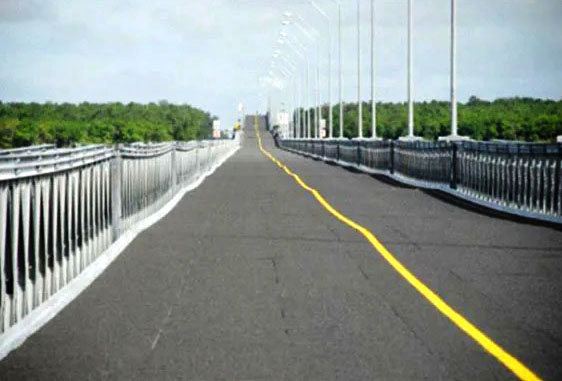
The shareholders of the Berbice Bridge Company Inc (BBCI) have voted to wind up the company and have appointed chartered accountant Raan Motilall as liquidator, according to notices published in the Official Gazette.
The move comes amid negotiations by the government to acquire the Berbice River Bridge more than a year after crossings were made toll-free.
According to the September 12 edition of the Official Gazette, BBCI’s members passed a special resolution at a meeting on August 21 that the company “be wound up voluntarily with effect from the 21st day of August, 2026.”
The notice, issued pursuant to Section 405 of the Companies Act, was signed by company secretary Amarnauth Singh.
A separate notice said Motilall, of 77 Brickdam, Stabroek, Georgetown, was appointed liquidator on August 21 for the purposes of winding up the company. The process was described as a members’ voluntary winding-up.
That notice was dated September 4 and issued under Section 428 of the Companies Act.
The notices provide no information on the company’s assets and liabilities, the treatment of its shareholders or the arrangements for the continued operation of the bridge. They also make no mention of the reported transfer of the bridge to the government or the price attached to any transaction.
There has been no detailed public statement from the government on the winding-up, nor has it released a sale agreement, valuation or other document setting out the terms under which the bridge would be acquired.
President Irfaan Ali had said last year that the government was in the final stages of negotiations to acquire the bridge from its investors and that Minister of Finance Dr Ashni Singh was leading those discussions. Ali had said that the interests of the investors would have to be addressed as part of any buyout.
Crossings at the Berbice River Bridge, along with the Demerara Harbour Bridge and the Mackenzie-Wismar Bridge, became toll-free on August 1 last year. Under that arrangement, commuters ceased paying tolls, while the government assumed responsibility for payments connected with use of the bridge.
The winding-up is of particular public interest because the National Insurance Scheme (NIS) is one of BBCI’s major investors.
Stabroek News had previously reported that the NIS held $950 million in preferred shares and $80 million in ordinary shares in the company. NICIL and several private investors were also involved in the public-private partnership established to construct and operate the bridge.
The bridge was built at a cost of approximately $8 billion and opened to traffic in December 2008, replacing the ferry service across the Berbice River. Its financing structure and the exposure of the NIS have been the subject of public concern over the years, particularly as the company struggled to meet its projected revenue.
In 2018, BBCI proposed steep increases in tolls, saying these were necessary to keep the company financially viable. The then APNU+AFC administration rejected the increases and temporarily assumed control of the bridge’s operations under the Berbice River Bridge Act. BBCI subsequently challenged that intervention in court.
The government has since announced plans for a new four-lane, high-span bridge across the Berbice River, which it says will be constructed at or close to the existing crossing.
The Gazette notices do not say whether BBCI’s decision to wind up is linked directly to a completed acquisition by the government. They also do not disclose what will be paid to the NIS and the other shareholders after the company’s debts and winding-up expenses are settled.
It is also unclear whether the government is acquiring the physical bridge, BBCI’s concession rights and other assets or the company’s shares.
The liquidation took effect on August 21, almost three weeks before the notices were published in the Gazette.
Queried
On February 15 this year, commentator Christopher Ram queried why the government was proposing to purchase the Berbice Bridge when it was shortly expected to own it based on the governing Act and the concessionaire’s agreement.
In a commentary in the Sunday Stabroek, Ram was responding to an announcement by Minister of Public Works Juan Edghill in Parliament’s Committee of Supply of the government’s intention to purchase the bridge,
“Why is the State proposing to buy an asset that it is already scheduled to own? The concession granted to Berbice Bridge Company Inc (BBCI). under the Berbice River Bridge Act expires in June 2027. It does not create a permanent private ownership that ends only with a buyout. Section 7(1)(a) provides that upon expiry of the Concession period, all of the Concessionaire’s right, title and interest in and to the Bridge revert to the Minister. The statutory architecture is clear – concession for a defined term, followed by mandatory reversion”, Ram said.
He said that the Minister responsible for Public Works is the authority named in the Act to regulate the Concession.
“The legal position is therefore fixed by statute and administered by the very office now asserting a negotiated acquisition. Frankly, there is no apparent justification or benefit”, Ram declared.
He said that there are certain basic propositions which are not in dispute. He said that the Concession Agreement remains in force and while the Coalition subsidised certain tolls, the PPP/C removed tolls in August 2025, compensating the Bridge Company with full payment for vehicles crossing the Bridge. The only change he said was the source of payment: motorists ceased paying tolls; taxpayers replaced that revenue stream.
Under the concession arrangement, Ram said that the Berbice bridge company is not entitled to keep every dollar generated by traffic. Toll revenue must first meet operating and maintenance costs and service the debt associated with the project. Only the agreed return, he said, constitutes its entitlement. In addition, the Concession requires the Bridge to be handed back in good condition at expiry of the arrangement. The obligation to maintain the asset until 2027 rests with the Concessionaire and is not a deferred cost to the State, Ram argued.
Between now and 2027, therefore, Ram said that the company’s entitlement is limited to its operating costs, debt servicing and its contractually defined return, net of its continuing maintenance obligations.
“When the Concession ends, no private right survives beyond that date”, he contended.
He asked whether the subsidy has exceeded that net surplus and if it has not, taxpayers have merely replaced motorists as the payer. “If it has, then public funds are enlarging the company’s economic position beyond what the Concession permits before expiry”, Ram warned.
The second question, he said, concerns the proposed acquisition. The State will receive the Bridge in 2027 and the only economic value to the Company remaining in 2026 is the limited net entitlement between now and expiry. Any purchase price must therefore correspond to that residual value. Payment beyond it is not payment for a continuing right; it is compensation for rights that terminate by law, he posited.
“It is difficult to reconcile the Minister’s public explanation with this statutory framework. The explanation offered is inconsistent with both the Act and the Concession Agreement. If the Minister’s position is otherwise, he must now state it by reference to those documents”, Ram said.
Ram added that further concerns arise because oversight from the Ministry of Finance and the Audit Office has been conspicuously muted in relation to this project, despite the magnitude of the public funds assigned.
Major shareholders in BBCI include Hand in Hand Fire Insurance Company Limited, New GPC Inc., and Queens Atlantic Investment Incorporated.











Discussion