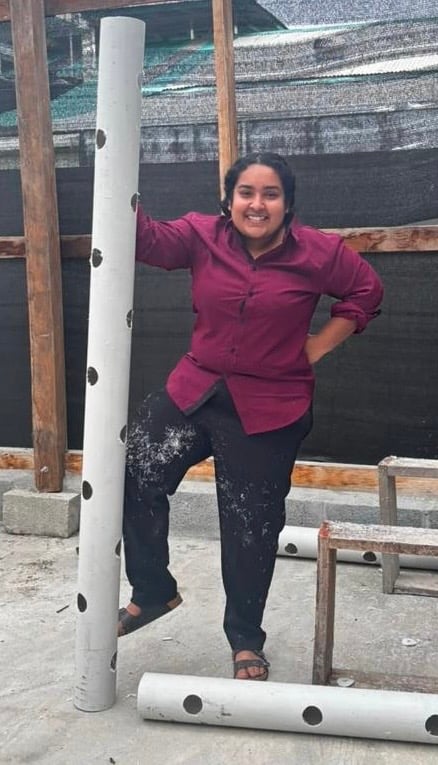
Kimberly Samad had promised herself that she would have a business up and running before she turned 30. At 28, the finance graduate is preparing to launch a hydroponic farm in Mon Repos, growing tomatoes, strawberries and kale on a plot measuring just 40 feet by 20 feet.

Her venture, Far East Hydro and General Services, initially met resistance from parents who had invested in her education and envisioned a career in finance.
“Somewhere along the line I realised that I hate being confined to a desk. Generally, I am more of an outdoor person. I have always loved agriculture, and I came up with this great idea to do something more innovative and different to the traditional agriculture that surrounded me,” Samad told Kiskadee Watch.
She holds a diploma in banking and a bachelor’s degree in finance, and is pursuing a master’s degree in finance and marketing. But agriculture has long been part of her family’s life. Her 92-year-old great-grandmother, Hansrajie Surujpaul, is a rice farmer, her mother spent much of her working life at the Guyana Sugar Corporation, and one of her grandfathers was a veterinarian.
Her relatives, however, needed convincing about growing crops in pipes and buckets.
“My family aren’t used to seeing plants growing in pipes and buckets. They are accustomed to preparing the land, planting seeds in the soil, watering plants and working hard to ensure a good harvest.”
Samad said explaining her work and demonstrating the results gradually brought her parents on board.
“I did what I had to do, and I explained to them what I was doing along the way. My actions brought them on board.”
The idea had occupied her thoughts for years before she began laying the groundwork three years ago. A relative agreed to let her use the land after she explained her plans, and she financed the project from her savings.
So far, she estimates that she has invested approximately $5 million, excluding the value of the land and her labour. Much of that money went towards constructing the shed.
“If I were to put a price on my time it would be way more,” she said.
Samad plans to formally launch the business on December 27, which is also her birthday.
She is developing the farm alongside her employment as a senior accounts clerk at the Pesticides and Toxic Chemicals Control Board. Weekends often find her working at the shed from 8 am to 4 pm, with additional hours fitted in after work during the week.
Her studies occupy her evenings.
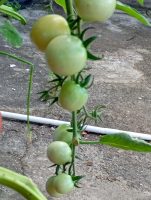
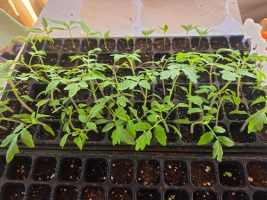
While many hydroponic ventures concentrate on leafy vegetables, Samad wants a mix of crops. She has been trialling strawberries, kale and several tomato varieties, including Roma and cherry tomatoes, and is considering mint and other herbs.
She hopes to offer locally grown produce at prices that make it accessible to more consumers.
Hydroponics involves growing plants without soil, with nutrients supplied through water. Samad uses coco peat, or coconut coir, as a medium for germinating seedlings.
Developing a system suited to her space and local conditions has required repeated adjustments.
“Because of the current climatic conditions, we had to change our systems quite a few times to adapt. The results were very favourable hence why I am going forward with it at this stage. The hardest part of hydroponics is the set up,” she said.
At first, she placed approximately 100 buckets on the ground. Finding that they occupied too much floor space, she began arranging them vertically, stacking four buckets to a tower.
“That is how I can get two plants per bucket and eight plants per tower. I had to ensure stability and that water was flowing from one bucket to the other,” she explained.
“I had to go back to the drawing board many times.”
Much of the equipment and material was sourced locally, including recycled food-grade buckets and bottles. Apart from construction of the outer structure, Samad said she built the internal arrangements herself.
The work has also introduced her to tools she had never previously used.
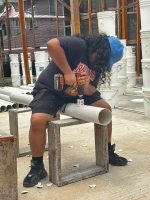
“Now I’m skilled at using an angle grinder and a master at using the drill. Almost every day, I teach myself something new.”
She has installed tanks to collect rainwater and plans to add solar lighting. She also intends to package produce in biodegradable bags.
Her interest in food production is partly personal. Samad said living with polycystic ovarian syndrome prompted her to pay closer attention to her diet and contributed to her interest in growing food.
She delayed publicising the business while conducting trials, wanting to establish that the systems could work before proceeding with the launch. Planting is continuing as she develops the operation.
Beyond selling produce, Samad wants the business to offer training and help others establish small growing systems, particularly women and single mothers.
“I want to empower other women so they can start their own businesses. We will facilitate training for young people, and anyone interested,” she said.
She also hopes eventually to assist orphanages and other institutions with growing systems and to expand to additional locations.
“My plan is to create employment and to try to keep things on the cheaper side, provide a healthy alternative,” she said.
Her community work already includes welfare activities through the Progressive Youth Organisation, particularly assistance for pensioners, shut-ins and vulnerable residents.
“I like helping people. Last year we raised funds to purchase food hampers for 100 pensioners and this year our aim is 300 hampers.”
Samad believes more young people should consider agriculture, including growing food in small urban spaces.
“You can go traditional. You can go hydroponics. There are so many ways in which you can plant. Plants are very versatile,” she said.
She would also like to see greater investment in processing local produce.
“We are producing, yes, but you hardly see processing. I would like to see more food factories out there.”
Coconut coir is one example of a resource she believes offers opportunities for local enterprise. She said a 50-pound quantity of the growing medium costs her $11,000.
“That alone could be a source of business. We have so many resources that we are not tapping into.”
For Samad, the venture’s name brings together her faith, her East Coast home and a name she found appealing after discovering that her first choice was already registered.
“Far East had a ring to it and that was it.”











Discussion