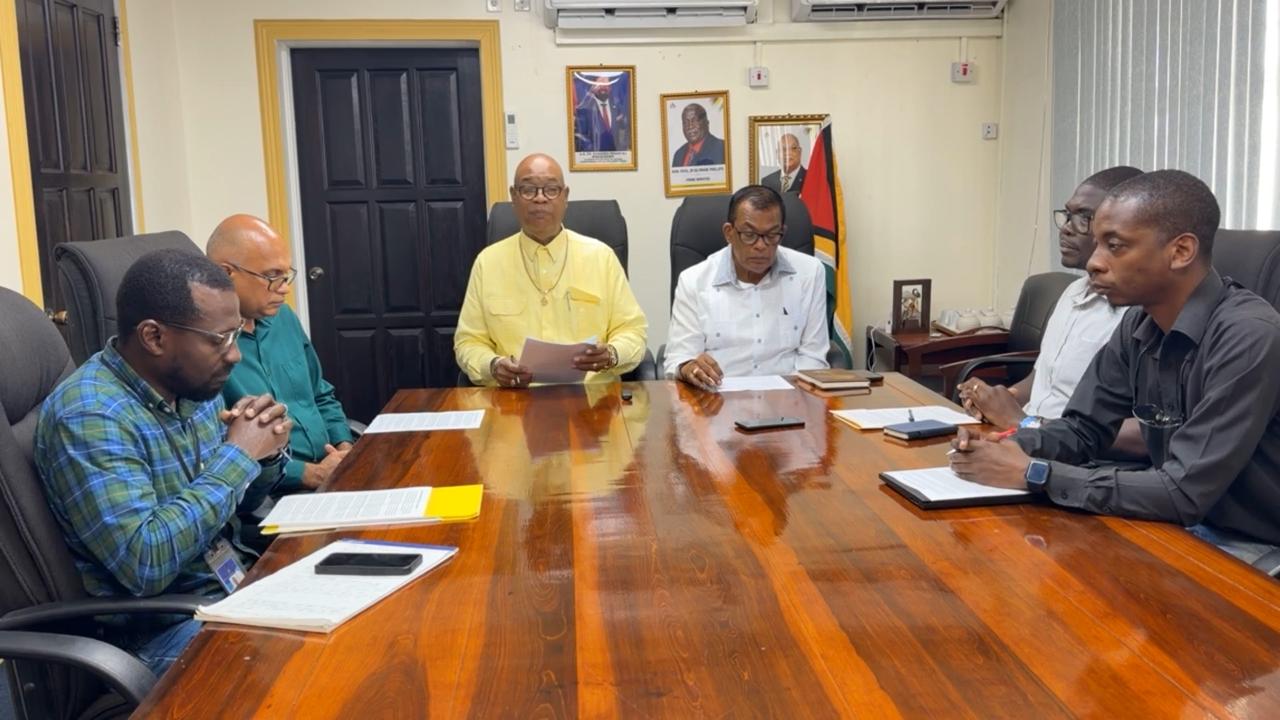
The Ministry of Public Works has defended its programme to reconstruct road shoulders and parapets, saying the works are intended to improve drainage, parking and road safety, while directing contractors to notify residents before construction begins.
During a Facebook Live presentation, Minister within the Ministry of Public Works Madanlall Ramraj, Public Works Minister Juan Edghill and technical officials outlined the programme and sought to address questions about construction in residential communities.
Ministry representatives distinguished between notifying residents about works and seeking their permission to undertake construction on public road reserves. They maintained that the programme concerned public spaces rather than private property.
Contractors were expected to explain what they would be doing and provide contact information through which residents could raise concerns.
The explanation comes amid objections from Lamaha Gardens residents, who have petitioned Edghill to suspend proposed parapet works along Duncan Street pending consultation and an independent technical review.
Kiskadee Watch reported on October 20 that residents feared replacing grassed parapets with gravel could reduce water absorption, increase surface runoff and worsen existing flooding.
Their October 18 petition followed a notice from R.R.T. Solutions and General Services announcing hard-shoulder rehabilitation and construction between the Eastern Highway and Bel Air Road. Residents said they had not received the engineering justification, project cost, detailed scope or maintenance arrangements.
Opening the presentation, Ramraj said the ministry recognised that residents had questions and wanted to explain the purpose of the works, how they would be undertaken and their anticipated benefits.
The programme, officials explained, would address roadside areas that become muddy and uneven during wet weather, retain water and provide inadequate space for road users.
They also pointed to the growing number of vehicles and resulting pressure on parking and existing road corridors.
The works involve clearing and reshaping shoulders and placing suitable compacted granular material to provide firmer, more uniform surfaces.
Technical officials said soft shoulders could force pedestrians onto the carriageway, exposing them to moving vehicles. Improved shoulders would provide additional space for pedestrians and other road users, as well as vehicles pulling over or becoming disabled.
They explained that a vehicle which breaks down could be moved off the carriageway onto a firm shoulder, reducing obstruction and the risk to other traffic.
The officials also identified drainage as a central part of the programme. In some communities, they said, roadside shoulders had become higher than the road, preventing water from flowing into drains.
Water remaining on the carriageway could compromise the road’s structural integrity and contribute to its deterioration, they explained.
Reshaping the shoulders to an appropriate level, while keeping drainage openings clear, was intended to improve the flow of water away from the road surface.
The presentation also referred to the need for properly installed drainage structures at property entrances so that access arrangements did not obstruct water movement.
Edghill placed the shoulder works within the government’s broader infrastructure programme, pointing to community roads, street lighting, pedestrian facilities, drainage improvements and the maintenance of public spaces.
He referred to works along the Kingston corridor and Independence Boulevard, as well as cleanup and beautification programmes.
The minister also acknowledged complaints about the quality of some previous works and said he had raised these with his team.
The presentation addressed encroachments on road reserves and access routes, with officials pointing to structures and property boundaries that had extended into public spaces.
They said such obstructions could restrict access, reduce visibility and interfere with the use of road corridors. The discussion also recognised residents’ concerns about security and safeguarding their investments.
Officials said the programme would be supported by traffic signs, road markings and traffic-calming measures, including speed bumps where required. Requests from communities for such interventions were being addressed, they said.
Street lighting was also presented as part of the wider effort to improve public safety and security.
The ministry additionally referred to a policy direction to relocate mechanic and vehicle-repair operations away from road reserves, where their activities could obstruct traffic and roadside access. The explanation linked this to the need to provide suitable spaces for economic activity.
Coordination with utility providers was identified as another requirement during construction, given the presence of infrastructure within road corridors.
The ministry’s emphasis on notifying residents, however, leaves unresolved the Lamaha Gardens petitioners’ request for consultation on the design and potential effects of the proposed works.
Residents have sought a meeting to examine the plans and consider alternatives. They also want an independent assessment of drainage capacity, flood risks, soil absorption, environmental effects, maintenance requirements and public safety.
The petitioners have maintained that they are not opposed to improvements but want the ministry to demonstrate that the changes are necessary, technically sound and appropriate for their community.












Discussion