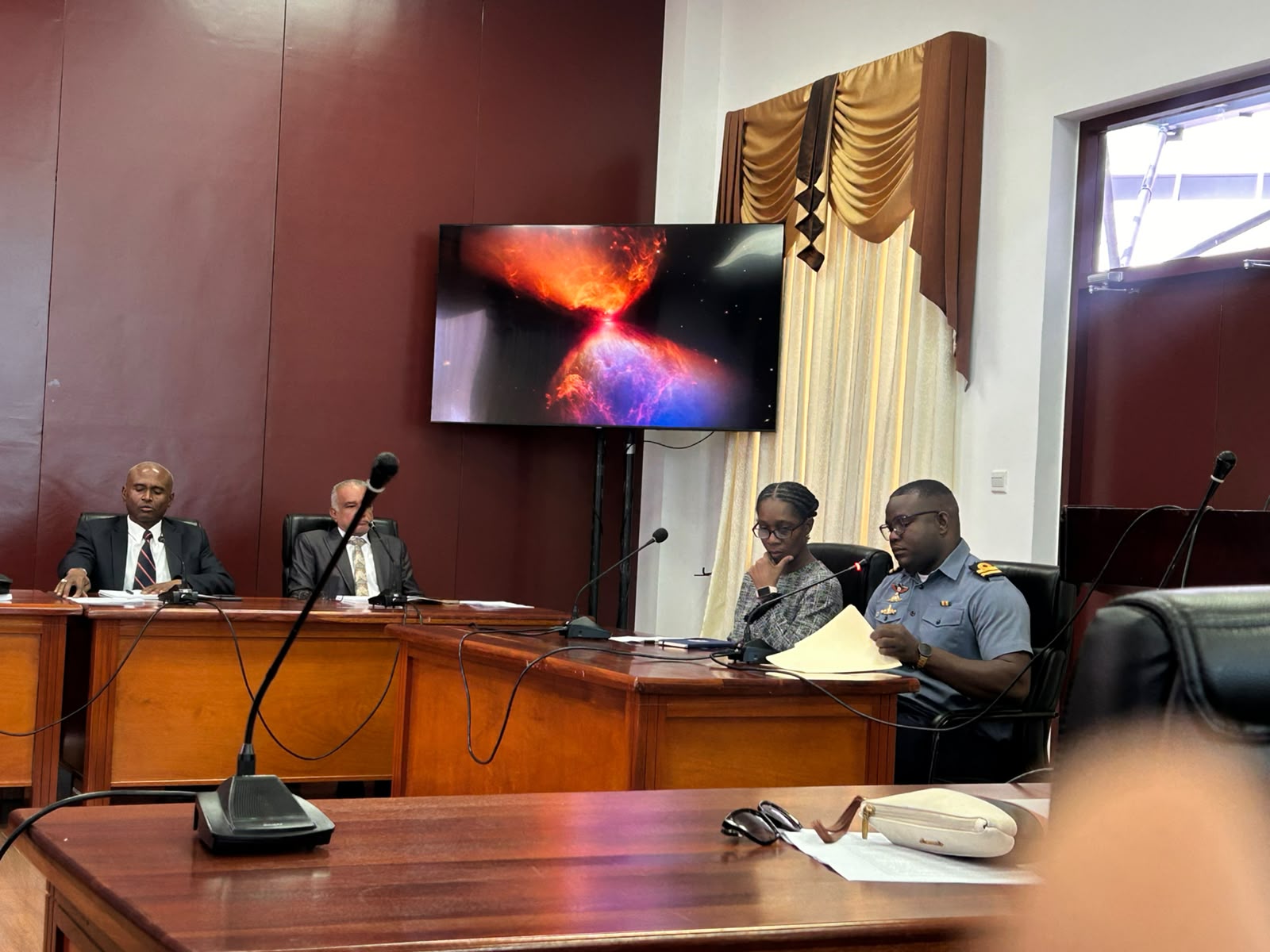
The Coast Guard’s offshore patrol vessel GDFS Shahoud left Georgetown more than four hours after a distress alert from the MV Barima was received, while a Roraima Airways aircraft that located emergency flares did not return to the search area after refuelling, the Commission of Inquiry heard yesterday.
Commissioners questioned witnesses about the time taken to deploy both assets during testimony on the initial response to the July 18 sinking. A Coast Guard team from the Pomeroon reached the area at approximately 1 am on July 19, ahead of the Shahoud’s departure from Ruimveldt at 3.30 am.
Coast Guard Lieutenant Rolwyn Heywood testified that the initial alert was received from the Timehri Control Tower at 10.51 pm on July 18, but officers did not immediately know which vessel was in distress or the scale of the emergency.
Heywood, who was on duty at Coast Guard Headquarters, said he acknowledged the alert a minute later and analysed the information. An updated position subsequently placed the distress signal near the Pomeroon.
At 11.10 pm, he submitted his findings to Coast Guard Commanding Officer, Commander David Shamsudeen, who was at home. The information was also forwarded to the Coast Guard’s Pomeroon base.
Asked by Commissioner Rear Admiral (Ret’d) Hayden Pritchard why approximately four hours elapsed before the Shahoud was deployed, Heywood said officers were still establishing the nature of the emergency.
“At this point, we were still trying to figure out the nature of the distress, and what is really going on. At this point we don’t even know if it is MV Barima. We just know that it is a distress and we have an EPIRB signal,” he said, referring to an emergency position-indicating radio beacon.
Had officers known from the outset that the Barima was involved, they would have understood the scale of the emergency and the need to deploy all available assets immediately, he told the commission.
He said the vessel’s identity was confirmed shortly after 1 am.
Heywood served as navigation officer aboard the Shahoud, which reached the general vicinity of the coordinates at approximately 7.30 am, following a four-hour voyage.
On arrival, the crew encountered a fishing boat operated by a man who identified himself as Haresh Singh. Two police ranks were also aboard.
Singh said he had 11 survivors who needed urgent medical attention and had to return to shore. Heywood said the crew allowed the fishing boat to continue, taking into account the presence of the police ranks.
The officer testified that several boats were searching when the Shahoud arrived, but there was no central command coordinating their efforts. The Coast Guard subsequently assumed command and assigned search areas to prevent duplication.
Six Coast Guard vessels and 12 civilian vessels, including fishing boats and Maritime Administration Department (MARAD) assets, were involved in the operation, he said.
At approximately 8.50 am, Heywood saw several life rafts, all of which were empty.
He also described poor visibility and difficult sea conditions. Heavy mist restricted daytime visibility to approximately one mile, while visibility at night was estimated at about 500 yards.
Even 32 vessels would not have adequately covered the search area under those conditions without air support, he said.
“Land assets alone would not, and sea assets alone would not suffice for this operation,” Heywood told the commission.
Flares
Meanwhile, Roraima Airways Director of Operations and commercial pilot Captain Learie Barclay testified that an aircraft crew located three emergency flares during an early-morning search.
Barclay, Captain Gerry Gouveia Jr and Christopher Chung were mobilised after coordinates were provided by National Security Adviser Captain Gerry Gouveia Snr, Roraima Airways’ founder.
Barclay said he was contacted shortly after midnight and travelled to Eugene F. Correia International Airport at Ogle. The aircraft departed at 1.36 am and reached the search area off Hampton Court, Essequibo Coast, at approximately 1.56 am.
He said low tide required the aircraft to search approximately three nautical miles farther offshore than the initial coordinates.
After switching to a distress frequency, the crew detected a strong emergency locator transmitter signal and followed it until they spotted the first flare at 2.09 am, approximately three nautical miles from the original coordinates.
Two more flares were subsequently seen, but the crew could not identify a vessel or another significant object on the water.
“We expressed concern in the cockpit, grave concern because the flares were very bright. We saw nothing of consequence on the sea,” Barclay said.
He explained that the crew had expected to find a vessel of considerable size.
The aircraft circled after the first sighting, and the crew notified Air Traffic Control. Coordinates were also relayed to MARAD to guide the rescue response.
The aircraft returned to Ogle at approximately 2.37 am. Barclay said he then briefed President Irfaan Ali, while Gouveia Jr briefed his father. The crew subsequently learnt that survivors had been found.
Pritchard questioned the mobilisation time, noting that Barclay had been contacted at 12.16 am but the aircraft did not depart until 1.36 am. He suggested that the response time could have been improved.
Commissioner Dr Andrzej Jasionowski also questioned why the aircraft did not return to the search area after refuelling.
Barclay said he believed maritime assets would be sent to the location once the coordinates were established. The crew did not know how many people were involved, and he considered further aerial searching in darkness over open water to be of limited value.
He nevertheless acknowledged the need for additional technology, including infrared equipment, to improve nighttime search and rescue operations.
The hearing continues today, when Shamsudeen is expected to testify.







Discussion