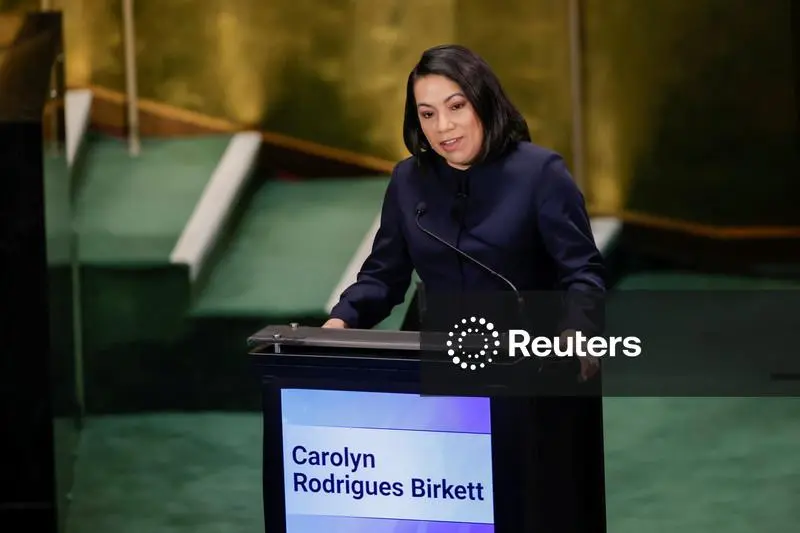
The United Nations Security Council is expected to hold another informal poll this month as it continues the process to select the next U.N. secretary-general, the council president for August said yesterday with Guyana’s former foreign minister Carolyn Rodrigues-Birkett in the running.
Portugal’s Antonio Guterres steps down as head of the world body at the year-end after two five-year terms.
A first “straw poll” in the 15-member council to replace him was held last week. Reuters reported that the poll showed that former Costa Rican Vice President Rebeca Grynspan was the narrow early frontrunner among seven current candidates, followed by Rodrigues-Birkett and then Argentina’s Rafael Grossi, head of the U.N. nuclear watchdog.
Christina Markus Lassen, the U.N. ambassador of Denmark, which holds the monthly Security Council presidency for August, said it was “aiming for and hoping to schedule” another poll on August 21, Reuters reported.
Avoiding a veto by any of the five permanent members of the Security Council – China, France, Russia, the United Kingdom and the United States – is crucial to a successful election.
Reuters said that precedent suggests multiple rounds of polling could continue in the coming weeks and conclude in late September or early October. Other candidates can still join the contest and the process could take longer if no consensus candidate emerges.
The other current candidates are former Chilean President Michelle Bachelet, former Ecuadorean Foreign Minister Maria Fernanda Espinosa, former Senegalese President Macky Sall, and Ugandan diplomat Olara Otunnu.
In the early rounds of straw polls, identical ballots are cast, allowing diplomats to see overall levels of support and opposition without revealing any negative votes from the five members of the Permanent Council (P5).
At a later stage, the P5 use ballots of a different colour that reveal whether a candidate has received a “discourage” vote from one of them.
The Security Council ultimately adopts a resolution recommending an appointment to the 193-member U.N. General Assembly. This needs nine votes in favour and no vetoes. Subsequent General Assembly approval has long been seen as a formality.











Discussion